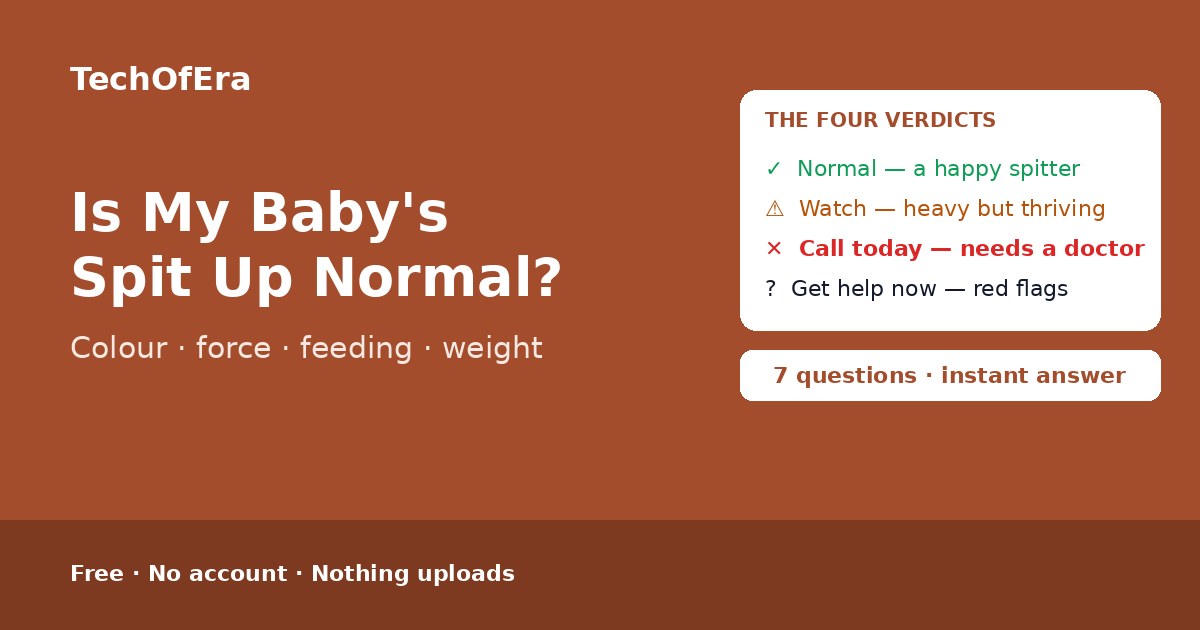
How to tell whether your baby's spit-up is normal
Spit-up is milk coming back up because the muscle at the top of the stomach does not shut tightly yet. Doctors call it reflux, and in a baby it is usually normal, not a disease — it only becomes GERD, a diagnosis worth treating, when it starts causing real problems like pain, feeding refusal or poor growth. Half of all babies under 3 months spit up at least once a day. It usually starts in the first weeks, peaks around 4 to 5 months, and is gone by 9 to 12 months for most babies. The question parents actually ask at 2am is not what reflux is — it is whether this spit-up, in this baby, is fine. This checker asks exactly what decides it.
To use it:
- Look at the colour first. Milky white, sometimes a little curdled from stomach acid, is normal. Green — like freshly cut grass — or blood-streaked, or vomit that looks like coffee grounds, is never normal spit-up: green vomit needs emergency hospital assessment the same day, and blood needs emergency help now.
- Watch how it comes up. Spit-up just comes up — effortless, often with a burp, and your baby may not even notice. Vomiting is active: the stomach contracts and pushes the milk out. Projectile vomiting, where milk shoots out, is a red flag at any age, and at 2 to 8 weeks it can mean pyloric stenosis.
- Check feeding and weight — the question that matters most. A baby who feeds well and gains weight is keeping down far more than they bring up, whatever the wet patch looks like. A baby who refuses feeds or is losing weight needs a doctor the same day.
- Check how your baby is between episodes. A content baby who spits up is a happy spitter. A baby who cries or arches in pain during or after feeds may have reflux that is damaging the food pipe. A baby who is lethargic, hard to wake or very pale is seriously unwell until a clinician says otherwise.
- Do not judge by the wet patch. One to two mouthfuls — about a tablespoon — spreads out to look like far more than it is. A soaked outfit can still be a normal amount.
- Use the happy-spitter check. Gaining weight, feeding well, 6 or more wet nappies a day after the first week, and content between episodes. Four yeses means a laundry problem, not a medical one.
Spit-up situations and what to do at a glance
The table below is built from the same rules as the checker, so it can never disagree with your verdict. Colour, force, feeding and behaviour decide together.
| Spit-up situation | Verdict | What to know |
|---|
What makes this checker different
The pages that rank for this search are guides — thorough explanations of why babies spit up, the tablespoon rule, and the happy-spitter picture — but they leave you to work out what that means for the spit-up you are seeing right now: whether a whole outfit soaked counts as a lot, whether it came up forcefully or just with a burp, whether yellow is different from green, and whether feeding less matters more than the amount. They also rarely name the red flags in one place — green vomit, blood, projectile vomiting, a lethargic baby — that change the answer from “normal” to “get help now”. This page is that answer: seven questions, an instant verdict, the reason named, and the red flags stated plainly instead of buried in the text — with nothing to install, no account, and nothing uploaded. It is a self-assessment, so it says plainly what it cannot know: a web page cannot weigh your baby, watch a feed, or see the colour of what came up, so anything you mark “Not sure” stays on the list until you confirm it.
When is this the right check?
Whenever you change a soaked outfit and wonder whether that much is normal: the spit-up after most feeds, the one that looks like the whole feed came back, the yellow tinge you have not seen before. Also whenever the pattern changes — spit-up that starts after 6 months, gets forceful when it used to be gentle, or comes with crying and arching that was not there before. And whenever you are not sure what counts: a mouthful versus a lot, a burp versus vomiting, curdled versus yellow. If the answer is “call today”, the checker tells you exactly what to have ready when you call — age, amount, frequency, force, colour, feeding and weight.
Honest limitations
A self-assessment, not a diagnosis
This checker works only from the answers you enter. It cannot examine your baby — no web page can weigh them, watch a feed, or see the colour of what came up. If an answer is wrong, the verdict is wrong. When in doubt, call your paediatrician or health visitor.
The happy-spitter picture is a rule of thumb
The NHS and the AAP describe the happy spitter as a baby who feeds well, gains weight and stays content — but it is a clinical picture, not a test. Only a weigh-in and a clinician’s look can confirm your baby is thriving.
Red flags override everything
Green or bloody vomit, projectile vomiting, or a baby who is lethargic, hard to wake or very pale are not wait-and-see questions — they need emergency medical help now, whatever else the checker says.
Colour is hard to judge at 2am
Screen colours and night lights change what you see. Check the colour in daylight or white light — and if you are unsure whether it is green or yellow, treat it as the more serious colour and get help.
Reflux medicine is not a first step
Testing and reflux medicine for babies under a year is generally reserved for poor growth, real pain, severe choking or lung complications. Do not start medicine or change formula because of spit-up alone — that is a decision for your paediatrician.
Rules from NHS, AAP and NICE guidance
The rules here follow NHS guidance on reflux in babies, AAP HealthyChildren.org guidance on spitting up, and NICE NG1, as they read in November 2026. Guidance can be revised, so re-check if a new edition appears.