How the boiler noise check works
A boiler makes some noise when it works — a gentle hum as the pump circulates water, a click as the burner lights, a tick as the pipes warm up. Vaillant calls those sounds perfectly normal. What matters is a noise that is new, loud, or different: a gurgle, a bang, a whistle, a hum that has got louder, or a rumble like a kettle. Each one points at a different fault, and the same sound can mean two different things depending on when it happens — a bang when a tap shuts is water hammer in the pipes, while a bang while the boiler runs is kettling. This checker weighs all of it — what the noise sounds like, when it happens, what kind of boiler it is, how old it is, the pressure, any recent work, other symptoms, how hard the water is, and where the noise comes from — and gives you a verdict: nothing to worry about, fix it yourself, book a heating engineer, or call one now, with the steps for whichever one it is.
To use it:
- Say what the noise sounds like. Stand by the boiler while the heating comes on and listen. Banging or knocking, gurgling or trickling, whistling or screeching, humming or vibrating, clicking or ticking, a rumble like a kettle boiling, or a single loud bang as it lights — each one points somewhere different.
- Say when it happens. Noise when the heating first comes on is often air collected over summer, pipes expanding, or a pump that has stuck through lack of use. Noise while the boiler runs points at the boiler itself — kettling, the pump, or the fan. Noise when a tap shuts is water hammer in the pipes.
- Say what kind of boiler it is. A combi boiler has no tank. A system boiler has a hot-water cylinder. A regular boiler has a loft tank. A heat pump is not a boiler at all, and an oil boiler needs an OFTEC-registered technician, not a Gas Safe engineer.
- Say how old the boiler is. Under 5 years old, trapped air or a loose fitting is likelier than wear. Over 15 years old, limescale, sludge and worn parts become much likelier, and the inhibitor that protects the system may be long gone.
- Say what the boiler pressure reads when the system is cold. Most manufacturers ask for about 1 to 1.5 bar when cold (about 12–22 psi on a US gauge; 1 bar is about 14.5 psi). Below 1 bar is low, and the boiler may lock out. Above 2 bar is high. Regular boilers with a loft tank have no gauge.
- Say whether there has been recent work. A noise that started after a service or a repair is often air let in while the system was open, or a panel refitted loosely. A new boiler making a noise is not normal — call the installer back, because it is under warranty.
- Say whether there are other symptoms. Radiators cold at the top mean trapped air. Radiators cold at the bottom mean sludge. A boiler that locks out is protecting itself from a fault. Water leaking, or a smell of gas, makes it urgent.
- Say how hard the water is. Look inside the kettle: white scale means hard water, and hard water is the commonest cause of kettling — limescale narrowing the heat exchanger until the water boils inside it.
- Say where the noise comes from. Put a hand on the boiler, then on a pipe, then on a radiator: the noise is loudest where it starts. Noise from the boiler itself points at the boiler; noise from the pipes is often expansion or water hammer; noise from a radiator is usually air in that radiator.
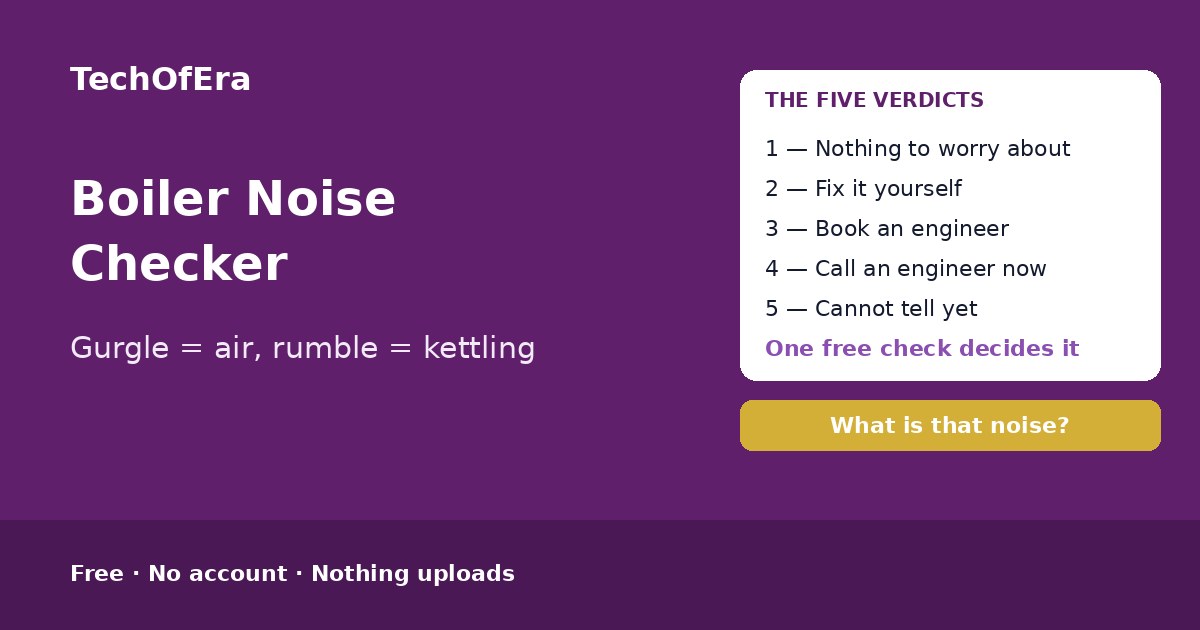
The five verdicts, and what each one means
Nothing to worry about
A gentle hum, a click as the burner lights, and ticking as the pipes warm up or cool down are ordinary boiler sounds. No repair is needed. If the sound changes or gets louder, run the check again.
Fix it yourself
Trapped air, low pressure, or a loose casing — jobs an owner can do without opening the boiler. Bleed the radiators that are cold at the top (heating off, cool for 30 minutes, quarter turn with a radiator key, close it as soon as water comes out), top the pressure back up to about 1 to 1.5 bar, or tighten the casing screws. Never open the boiler casing.
Book a heating engineer
Kettling, a pump fault, or a fan fault — the fault is inside the boiler or the system, and only an engineer may open the casing. Turn the heating temperature down slightly until they visit: it slows the kettling down.
Call an engineer now
A smell of gas, a single loud bang as the boiler lights, water leaking, or a boiler that keeps locking out. Stop using the boiler. If you smell gas, open the windows, leave the house, and call the gas emergency number from outside (UK: 0800 111 999).
Cannot tell yet
Not enough answers to judge: without the sound, the timing and the location, a gurgle, a kettle rumble and delayed ignition all look the same. Answer the first three questions and the verdict appears.
What makes this checker different
The pages that rank for this search are guides — a manufacturer's page on why a boiler is noisy, a plumber's guide to banging, a heating site's table of sounds and causes. None of them asks what your boiler sounds like, when it happens, how old it is, what the pressure reads, whether there has been recent work, or how hard your water is — and none of them gives you a verdict for your boiler. They all assume you already know which sound you have, which is exactly the question people are asking. This page is that answer: nine questions, an instant verdict, the blockers named, and the next steps. It is a self-assessment, so it says plainly what it cannot know: it cannot hear your boiler, read your pressure gauge, or smell gas.
When is this the right check?
When the heating comes on for the winter and the boiler starts banging, gurgling or humming for the first time — because a new noise is the one that matters, and the checker tells you whether it is air, scale, or something urgent. When the boiler sounds like a kettle — because that is kettling, and bleeding the radiators will not help, no matter how many times you do it. When a single loud bang happens as the boiler lights — because that is delayed ignition, and you should stop using the boiler. And when you can smell gas near the boiler — because that is an emergency, and the checker will tell you to leave the house and call the gas emergency number before anything else.
Honest limitations
A self-assessment, not an engineer's diagnosis
This checker cannot hear your boiler, read your pressure gauge, or smell gas. It cannot tell whether a hum is a loose casing or a failing pump, or whether a bang is kettling or pipes expanding. If the noise gets louder, or the boiler locks out, call a heating engineer.
Without hearing the noise, the verdict is weaker
What the noise sounds like is the single most useful answer: a gurgle is air, a kettle rumble is kettling, and one loud bang on lighting is delayed ignition — and the three need opposite responses. The checker still works without it, but it says so — the verdict drops to low confidence and the first step is to listen while the heating comes on.
Guides disagree on how urgent kettling is
Some guides call kettling a fault to book an engineer for; others call it an emergency. This checker says book an engineer soon, and call now if the boiler also locks out, leaks, or the pressure keeps rising — but if your boiler manual says otherwise, follow the manual: it knows your system.
Pressure figures are typical, not your boiler's exact ones
About 1 to 1.5 bar when cold is the range most manufacturers ask for, and 1 bar is about 14.5 psi. Your boiler manual's figures beat this page's: use them if you have them, especially if your boiler is a heat pump or an older regular boiler with a loft tank.
Steam systems are not covered
Older US homes with steam heat have air vents on the radiators, not bleed valves, and a sight glass on the boiler instead of a pressure gauge. The advice here is for hot-water (hydronic) systems. If your radiators have a chrome vent on one side and only one pipe, do not use this checker — call a heating technician who knows steam.
Rules from official sources, dated November 2026
The rules here are manufacturer guidance, including Vaillant on kettling and gurgling, Viessmann on gurgling, Glow-worm on whistling and humming, and the Gas Safe Register rule that anything inside the boiler casing is an engineer's job, as they read in November 2026. Guidance changes: recheck with a heating engineer if anything about the system changes.