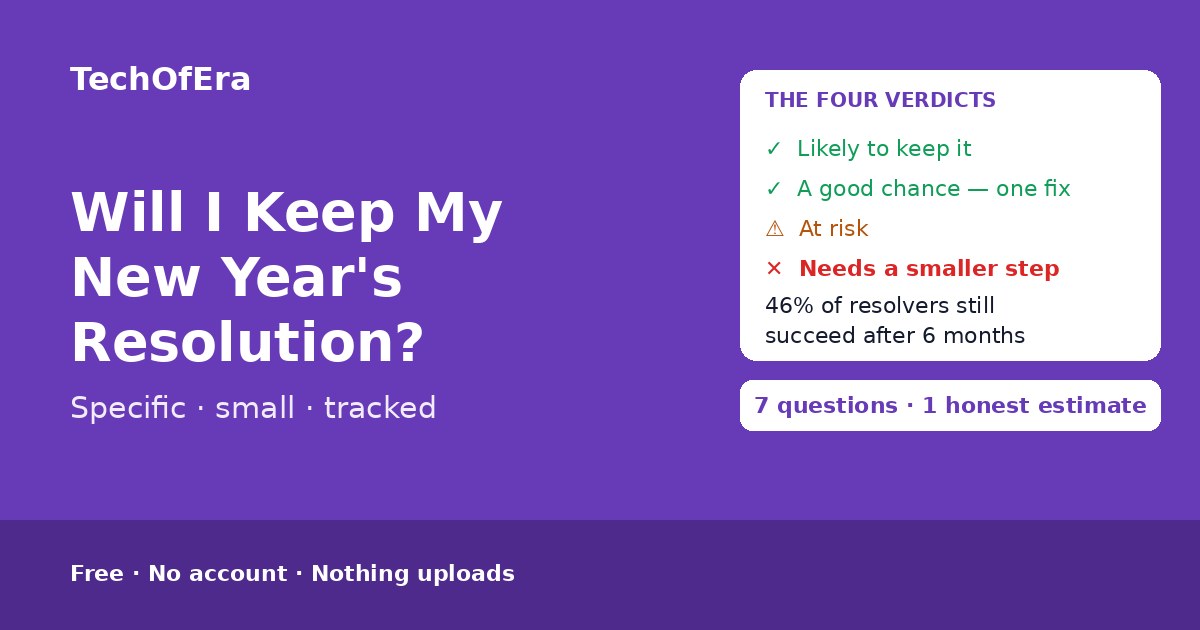
Will you keep your New Year's resolution — or will it fade by February?

About a third of resolutions are gone before the end of January — but in the best-known study, 46% of people who made one were still succeeding after six months. Answer 7 quick questions about your resolution and get an honest estimate of whether you'll keep it, the one fix that helps most, and a simple four-week plan. Entirely in your browser.

  • Instant estimate — likely, at risk, or needs a smaller step
  • Scored on research, not a guess — Norcross 2002, Oscarsson 2020
  • The one fix that helps most, named
  • Free, no account, nothing uploads
Will you keep your New Year's resolution — or will it fade by February?

Check your resolution

Try a preset:
4 of 7 answered

Your result

Pick a resolution first Pick a resolution first to get an estimate.
What this combination can do

Pick a resolution above and what this combination can do will appear here.

Blockers

Cautions

Still to confirm

Things to check

Your first four weeks

WhenWhat to do

What to do next

    Your result summary


    Pick a resolution and answer the questions — the estimate updates live.

    Privacy you can verify, not just trust

    Checking a personal goal by uploading details of your life to a website would be backwards — the check should never be the leak. This one can't: your answers are checked with plain JavaScript on your device, and they never leave the device — the only third-party requests are the site's own analytics, which count page views. Don't take our word for it:

    New cross-origin requests during use: 0
    1. Press F12 to open developer tools, then the Network tab.
    2. Answer the questions above. Watch: apart from the site's analytics, nothing new is requested — no uploads, and no data ever leaves your device.
    3. Extra credit: disconnect your internet after this page loads — the checker still works.

    How to make a resolution you will actually keep

    The wish is not the problem — the setup is. Most resolutions fail the same way: they are vague, too big, untracked, and unplanned for the first slip. The research on resolutions points at the same handful of fixes, and this checker scores your resolution against them. A resolution is just a goal with a start date, and the goal that survives January is the one with a number, a schedule, a daily tick and a plan for the bad day.

    To use it:

    1. Pick one resolution. Not five. One resolution you keep beats five you abandon. If you have a list, pick the one that would make the others easier, and start there. You can always add another in February, once the first one is a habit.
    2. Make it exact. A number, an action and a schedule: "walk 8,000 steps every weekday" instead of "get fit", "save £100 on the 1st of every month" instead of "save money". If you cannot tell on a Tuesday whether you did it, it is not specific enough yet.
    3. Make the first step small. One daily action under 15 minutes. A habit takes weeks to form — on average 66 days — and a small step you actually do beats a big step you skip. Grow it in February, once the habit exists.
    4. Track it daily. A tick on a wall calendar, one line in a journal, or a habit app — ten seconds a day. Monitoring progress makes reaching a goal more likely, especially written down, and a daily tick catches a missed day while it is still one missed day.
    5. Write an if-then plan for the slip. You will miss a day — everyone does. Decide now what happens then: "If I miss a day, then I do the smallest version tomorrow." A decision made in advance survives a bad day; a decision made on the bad day usually loses.
    6. Tell one person. A friend, a partner, a colleague — one conversation. If nobody knows, nobody notices when it quietly stops. Ask them to check in once a week, and agree the rhythm now so the check-ins actually happen.

    What the research says

    The table below is built from the same research as the checker, so it can never disagree with your estimate. Every figure is labelled with its study — the checker invents nothing.

    StudyWhat it foundWhat it means for you

    What makes this checker different

    The pages that rank for this search are guides — thorough explanations of why resolutions fail, the 46% figure, and the SMART-goal advice — but they leave you to judge your own resolution yourself: to decide whether your goal is specific enough, whether the size is right, whether your tracking and your slip plan are enough, and then to work out what to fix first. The quizzes that do exist ask a few questions and hand back a generic score with no reason attached. This page is that answer: your resolution in, an estimate out, with the score broken down factor by factor, the weakest part named, the one fix that helps most, and a four-week plan built from your answers. It is an estimate, so it says plainly what it cannot know: a web page cannot predict your future, so anything it cannot measure stays on the list until you confirm it.

    When is this the right check?

    Whenever you are about to make a New Year's resolution and want to know whether the one you have in mind will actually survive January: the "get fit" you have written down every year, the saving goal that has never made it past February, the habit you want to quit for the third time. Also whenever you are choosing between two resolutions and want to know which setup is stronger, or when you have already started and want to check whether the plan you are running is the one that keeps people going. And whenever the resolution you are carrying is a vague wish and you need it turned into something you can actually do on a Tuesday.

    Honest limitations

    An estimate, not a prediction

    This checker gives an estimate from the seven answers you enter, scored against what the research on resolutions actually found. It cannot know your willpower, your circumstances, or what January will actually bring — and it cannot predict your future.

    The score is only as honest as your answers

    If the resolution is vaguer than you admitted, or the tracking weaker than you planned, the estimate is wrong in the same direction. Answer for the resolution as it really is, not as you wish it were.

    Research averages, not your life

    The 46% figure is an average across hundreds of people with different goals, lives and support. Your own odds move up or down with the setup — which is what the score measures — but an average can never be your personal probability.

    Habits take weeks, not days

    Forming a habit took 18 to 254 days in the research, averaging 66 — there is no 21-day rule. A resolution that survives January is only just getting started, and a missed day in week three is normal, not a sign the habit failed.

    A slip is not a failure

    The people who keep resolutions are not the ones who never slip, they are the ones who restart the next day. Treating a missed day as failure is the fastest way to turn one bad day into a broken resolution.

    Rules from the research

    The rules here follow Norcross and colleagues (2002), Oscarsson and colleagues (2020), Lally and colleagues (2009), Harkin and colleagues (2016), and Franklin Covey, as they read in November 2026. Guidance can be revised, so re-check if a new study appears.

    Frequently asked questions

    What percentage of people keep their New Year's resolutions?

    In the best-known study, Norcross and colleagues (2002) found that 46% of people who made a New Year's resolution were still succeeding after six months — against 4% of people who wanted to change but made no resolution. About a third are broken before the end of January, according to Franklin Covey. So making a resolution roughly doubles your odds of changing, but only about half of resolvers make it past six months — which is why the setup matters more than the wish. This checker scores the setup, not the wish.

    Why do most New Year's resolutions fail?

    Three reasons cover most failures. First, the resolution is vague — 'get fit' has no finish line and no first step. Second, it is too big — a total life change from a standing start collapses at the first missed day. Third, there is no plan for the slip: motivation fades in weeks two and three, one bad day happens, and a missed day is treated as failure instead of a normal step. The University of California's experts add a fourth: no routine to carry the goal once the excitement of January wears off. This checker scores all four — specificity, size, tracking and the slip plan — so you can see which one is sinking yours.

    How can I make a resolution I will actually keep?

    Pick one resolution, not five. Make it exact: a number, an action and a schedule — 'walk 8,000 steps every weekday' instead of 'get fit'. Make the first step small enough to do daily in under 15 minutes. Track it every day with a tick on a calendar or one line in a journal — monitoring progress makes reaching a goal more likely, especially written down (Harkin and colleagues, 2016). And write an if-then plan for the first slip: 'If I miss a day, then I do the smallest version tomorrow.' That is the whole method, and this checker scores your resolution against it.

    Is it better to make a resolution to do something or to stop something?

    To do something. Oscarsson and colleagues (2020) found that approach-oriented resolutions — starting something new — had a higher success rate than avoidance-oriented ones — stopping something. So reframe a 'stop' resolution as a 'do' one: 'phone on the charger at 10:30' instead of 'stop scrolling at night', or 'cook dinner at home four nights a week' instead of 'stop eating junk'. The goal is the same, but the form that works better is the one with a concrete action to do.

    How long does it take to form a habit?

    There is no fixed number. Lally and colleagues (2009) followed people forming a new habit and found it took between 18 and 254 days, averaging 66 days. The popular '21 days' figure has no evidence behind it. Plan on weeks, not days: a resolution that survives January is only just getting started, and a missed day in week three is normal, not a sign the habit failed.

    What should I do when I break my resolution?

    Restart the next day, with the smallest version. A slip is not a failure — the people who keep resolutions are not the ones who never slip, they are the ones who restart the next day. The worst move is waiting until Monday, or next month: every day that is not Monday is a reason to wait, and a missed day becomes a missed week. Decide this in advance, as an if-then plan — 'If I miss a day, then I do the smallest version tomorrow' — so the decision is already made when the bad day arrives.

    Should I make more than one New Year's resolution?

    No — one, or two at most. Each extra resolution splits your willpower and your attention, and a list of five is really five chances to fail at once. The rule from the research is simple: one resolution you keep beats five you abandon. If you have a list, pick the one that would make the others easier, and start there. You can always add another in February, once the first one is a habit.

    Does this checker predict whether I will keep my resolution?

    No. It gives an estimate from the seven answers you enter, scored against what the research on resolutions actually found — Norcross and colleagues (2002), Oscarsson and colleagues (2020), Lally and colleagues (2009), and Harkin and colleagues (2016). It cannot know your willpower, your circumstances, or what January will actually bring, and it cannot diagnose or advise you. Nothing you enter leaves your device, and the only third-party requests are the site's own analytics, which count page views. You can verify it yourself with the network-request counter in the privacy section below the checker.