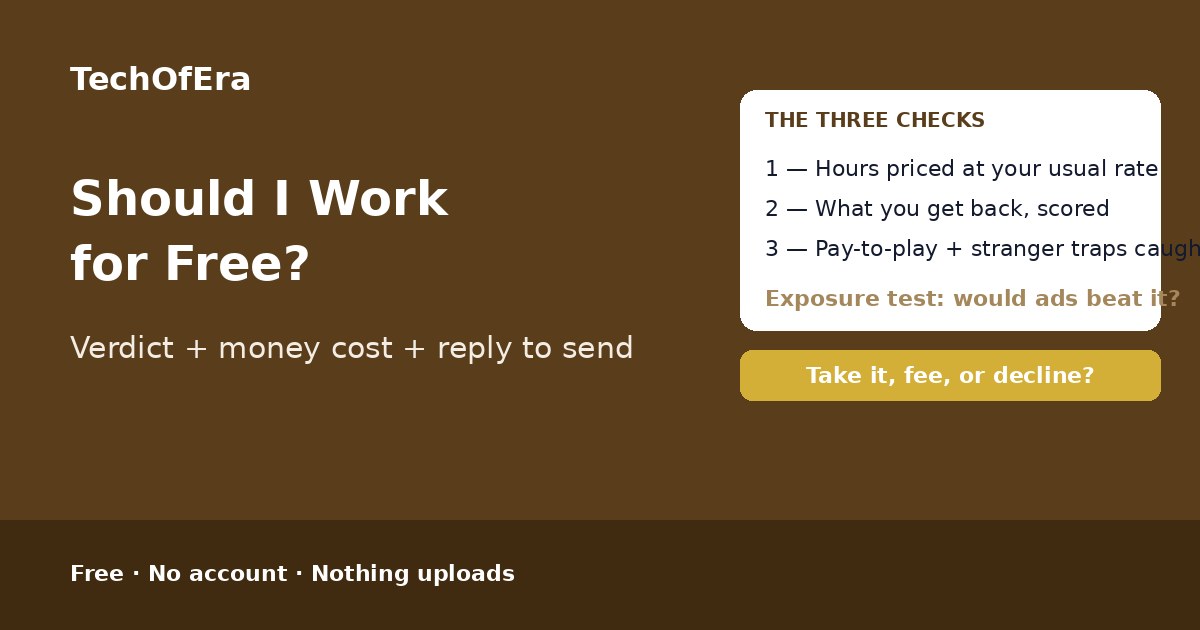
How the free-work check works
“Exposure” is not a number — but your hours are. Ten hours at $75 an hour is $750 of your time, and if you are fully booked it costs double, because every unpaid hour is an hour you could have billed. Whether it is worth working for free turns on one number first — what the unpaid hours are worth to you — and then on who is asking, what you get back, how full your paid pipeline is, whether you need the portfolio piece, whether anything is in writing, and how long you have been freelancing. This checker prices the hours, scores the offer, and names the verdict: take it, ask for a nominal fee, negotiate first, or decline politely — with the words to send the client.
To use it:
- Say who is asking. A charity, a friend and a stranger are three different offers: the same free job can be a gift for one and a bad deal for another. A big brand that can afford to pay is the weakest case for free work there is.
- Enter the hours and your usual rate. Guess high on the hours: count the revisions, the calls and the waiting, not just the work itself. Use the rate you actually charge paying clients — that is the number the offer has to beat.
- Tick everything you actually get back. A portfolio piece, a testimonial, a credit, real audience numbers, paid work promised in writing, or a service swap of equal value. Tick what the offer includes — not what you hope it includes. If it is nothing but “exposure”, tick that.
- Say how full your pipeline is, and whether you need the piece. A quiet pipeline makes a small free job easier to justify; a full one makes it cost double. A portfolio piece you genuinely need is one of the few good reasons to work free — if your portfolio is solid, that reason is gone.
- Say whether anything is in writing. A promise that is not written down is worth very little. Scope, credit, deadline and what you get back — in one short note, before you start.
- Tick the red flag if there is one. If they asked you to pay for something first — a listing fee, a licence, materials — that is the shape of a scam, not a job. The checker says decline whatever the score says.
What makes this checker different
The pages that rank for this search are guides — Legiit’s “Should You Work For Free?”, Skillcrush’s “Should I work for free to get experience in tech?”, the ten agency leaders quoted by MadCashCentral, and 90Hive’s work-from-home advice. All of them say the same things: free work is usually a bad deal, with the same short list of exceptions — a charity, a portfolio piece when you are starting out, a fair trade, or exposure that is real and measurable. None of them asks how many hours your job takes, what your rate is, who is asking, or what is in writing — and none of them prices your unpaid hours in money, or gives you a verdict for your exact offer, or the words to send the client. There is no free, standalone checker that takes your hours, your rate, your pipeline and your return and gives you a score, a verdict (take it, ask for a nominal fee, negotiate first, or decline politely), the money cost of the free job, and a copy-ready reply. This page is that answer: eight questions, an instant verdict for your exact offer, the blockers named, and the next steps. It is a self-assessment, so it says plainly what it cannot know: it cannot verify a client’s audience numbers, enforce a promise of future paid work, or know whether a charity will use your work well.
When is this the right check?
When a client’s email says “great exposure” and you want a number before you answer — because exposure that cannot be measured is not a return, and your hours have a price. When a startup promises paid work after this one free job — because a promise with nothing in writing is the oldest free-work trap there is. When a charity you care about asks for help — because a small gift with a clear scope is worth doing, and this checker tells you where the gift ends and the job begins. And when someone in your life says “just do this one for free, it will lead to more work” — because a score and a money figure settle the argument better than a feeling.
Honest limitations
A self-assessment, not a judgement
This checker cannot judge a client or verify a promise. It cannot check whether the audience numbers a client quotes are true, whether the paid work that was promised will ever arrive, or whether a charity will use your work well. It scores the offer from your answers, and says plainly where the answer depends on something it cannot check.
The money figure is an estimate, not a price
The cost of the free job is your hours times your usual rate — your own numbers, labelled as estimates. If your hours run over, or your rate is a guess, the figure moves with them. It is a planning number, not a market price and not an invoice.
Exposure is your judgement, not a measurement
The checker takes your word for what the exposure is worth. If they can show the numbers — how many people will see it, and whether they hire freelancers — tick real audience reach. If they cannot, tick nothing promised: that is what unmeasured exposure usually turns out to be.
Rules differ by place
What counts as an employee, a contractor, or unpaid work differs by country and by state. The guidance here follows the freelance guides that rank for this question as they read in November 2026 — check your local rules before you agree to anything unusual, especially if money is asked of you.
A pay-to-play request is a stop sign, not a warning
A real client never asks the freelancer to pay to work. A listing fee, a software licence, or materials you must buy upfront is the shape of a scam, not a job. Walk away, and do not send money or personal documents.
Rules from freelance guides, dated November 2026
The rules here are the freelance guides that rank for this question — Legiit’s exposure test, Skillcrush’s nominal-fee rule, Karl Sakas’s “strategically free” terms in writing, and 90Hive’s portfolio exceptions — as they read in November 2026. Guidance changes: recheck with your local freelance community if anything about the offer changes.