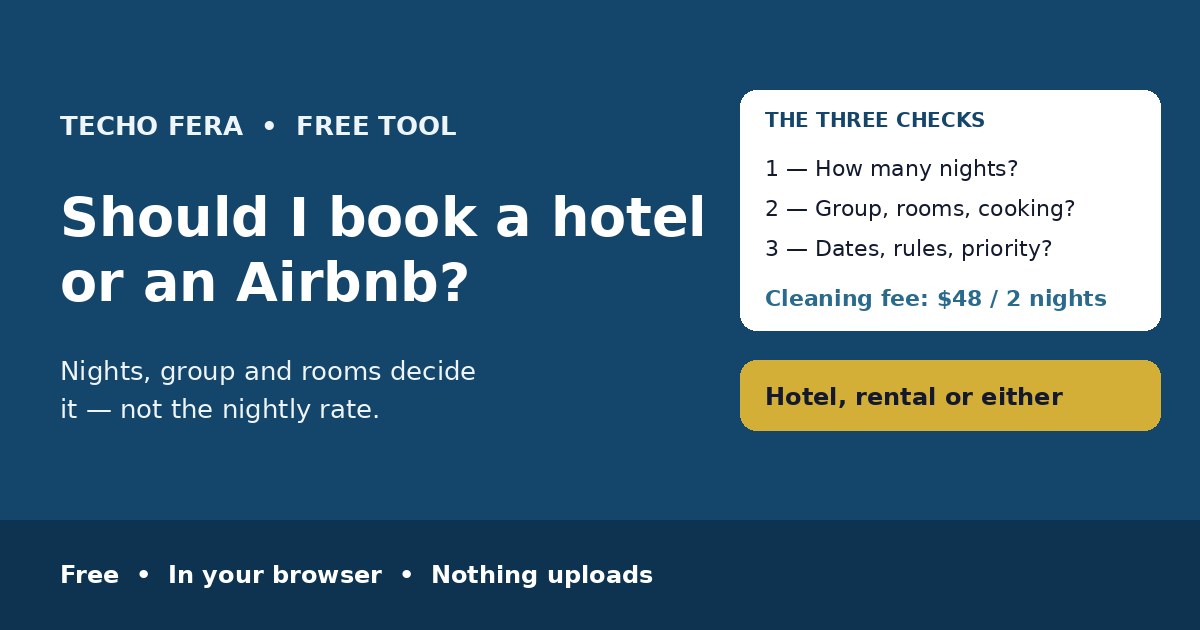
How the hotel-or-rental check works
The rule is the trip, not the brand. The deciding number is not the nightly rate — it is the one-time cleaning fee divided by how much cheaper the rental is per night than the hotel. About 89% of US rental listings charge a cleaning fee, and the average for a one-bedroom was $96 in April 2025: that adds $48 a night on a two-night stay but about $14 a night on a seven-night stay. For one or two nights the hotel usually wins; for a week or more, or when you would need two or more hotel rooms, the rental usually wins. This checker asks eight questions — how many nights, who is travelling, how many hotel rooms you would need, whether you will cook, whether your dates might change, what matters most, where you are staying, and whether the city restricts short-term rentals — and gives one verdict: book the hotel, book the rental, either works, or check the rules and the fees first.
To use it:
- Pick how many nights you are staying. 1 night, 2 nights, 3–4, 5–6, 7–13, or 14 or more. The stay length decides the answer more than anything else — a one-time cleaning fee bites on a short stay and fades over a week. If you are not sure yet, the checker says so instead of guessing.
- Say who is travelling. Just you, a couple, a family of 3 or 4, a group of 5 or more, or a business trip. The group size changes the maths — one rental replaces several hotel rooms, and the cleaning fee is charged once, not per person.
- Say how many hotel rooms you would need. One room, two rooms, or three or more. Two rooms double the hotel bill; one rental does not. Price the rental against all the rooms, not one.
- Say whether you will cook. Eat out, light cooking, or cook most meals. A kitchen only pays when you use it — cooking most meals is where a rental saves real money.
- Say whether your dates might change. Fixed, might change, or likely to change. Most rentals charge a strict cancellation fee, while hotels usually offer a flexible rate — changing dates favour the hotel.
- Say what matters most. Lowest total cost, convenience and service, space and privacy, or safety and predictability. Each one points at a different winner — service and safety point at the hotel, space points at the rental.
- Say where you are staying. A big city, a small town or the countryside, a beach or resort area, or a business district. Big cities carry the highest rental fees and the strictest rules; small towns and the countryside favour rentals.
- Say whether the city restricts short-term rentals. No, yes, or not sure. Some cities only allow 30-night stays or registered hosts — an illegal listing can be cancelled at short notice, so the checker flags it before you pay.
The stay lengths at a glance
| Your trip | Verdict | Why |
|---|---|---|
| 1 night | Book the hotel | The $96 cleaning fee adds $96 to one night — no saving survives it |
| 2 nights | Book the hotel | The cleaning fee still adds $48 a night — the hotel usually wins |
| 3–4 nights | Either works — compare the checkout totals | Close call — the fee is spread thin enough that the price decides it |
| 5–6 nights | Either works — compare the checkout totals | Close call — a group or a kitchen can tip it to the rental |
| 7–13 nights | Book the rental | The cleaning fee fades to about $14 a night, and the kitchen pays |
| 14 nights or more | Book the rental | Weekly and monthly discounts on top of the faded cleaning fee |
| Need 2+ hotel rooms | Book the rental | Two rooms double the hotel bill; one rental does not |
| City restricts rentals, or dates likely to change | Check the rules and the fees first | An illegal listing or a strict cancellation fee can cost the whole stay |
What makes this checker different
The pages that rank for this search are guides — an Ohio State tourism expert, travel blogs and cost guides that all give you the same static answer — "it depends on the trip" — and leave you to work out what it means for your nights, your group and your plans. The three cost calculators that do exist — aizenlabs.work, everydaybudd.com and novacalculator.com — answer a different question: they need you to enter both checkout totals first, and they only compare prices. None of them asks how many nights you are staying, how many hotel rooms you would need, whether you will cook, whether your dates might change, or whether the city restricts short-term rentals — and none of them tells you what to do next when the answer is risky. There is no free, standalone checker that takes a trip — nights, group, rooms, cooking, flexibility, priority, place and city rules — and gives you one verdict with the reason, the cleaning-fee maths and the next steps, without needing a single price. This page is that answer: eight questions, an instant verdict for your exact trip, the blockers named, and the next steps. It is general travel guidance, so it says plainly what it cannot know: it cannot see the two listings, their prices or their cancellation terms, and where the guidance is thinner — your listing's actual cleaning fee, the city's actual rules — it tells you to check the checkout screen instead of inventing a number.
When is this the right check?
When you are staring at two listings and the nightly rates disagree with the checkout totals — because the nightly rate is the wrong number to compare, and the cleaning fee, the resort fee and the parking fee are what decide it. When you are booking for a family or a group — because one rental usually beats two or three hotel rooms, and the checker does that maths for you. When your dates might still change — because the checker tells you when a rental's strict cancellation fee makes the hotel the safer booking. When you are staying in a city with short-term rental rules — because the checker flags the risk before you pay. And when you are booking a week or more — because the cleaning fee fades over a long stay, and the checker shows you exactly how much it fades by.
Honest limitations
General guidance, not booking advice
This checker cannot see the two listings, their prices or their cancellation terms. It cannot tell you what your listing's cleaning fee actually is, whether the host will accept your dates, or whether the hotel's flexible rate is worth the extra cost — only the checkout screens can. The verdict is a recommendation for your trip, not a booking.
The cleaning fee is an estimate, not your fee
The $96 figure is the AirDNA average for a one-bedroom in April 2025, and the per-night figures are the checker's own estimates from it. Your listing's actual cleaning fee is on its checkout screen — use that number before you book. A $200 cleaning fee changes the answer; a $40 one changes it the other way.
Not sure means the cautious answer
If you do not know how many nights you are staying, the checker refuses to guess — it tells you to count them. And if you are not sure whether the city restricts short-term rentals, it names that as still to confirm instead of assuming the rules are fine.
City rules change, and they vary by street
Short-term rental rules are set by the city, and sometimes by the building or the neighbourhood — New York, Barcelona and Paris all run different systems, and the rules change. The checker asks whether the city restricts rentals; it cannot check the rules for your exact address.
Your trip is not the average trip
Pet-friendly listings, accessible rooms, a late check-in, a pool the kids need, a kitchen for a special diet — any of them can outweigh the maths. If one side has a must-have the other cannot offer, that decides it, whatever the score says.
Rules from Ohio State, Phocuswright, AirDNA and CoStar, dated November 2026
The rules here are the Ohio State, Phocuswright, AirDNA and CoStar figures as they read in November 2026: the 89% cleaning-fee rate, the $96 average, the $161.78 average hotel rate, the 70% versus 24% split, and the 12 May 2025 total-price rule. Figures change: recheck if anything about your trip or the rules changes.