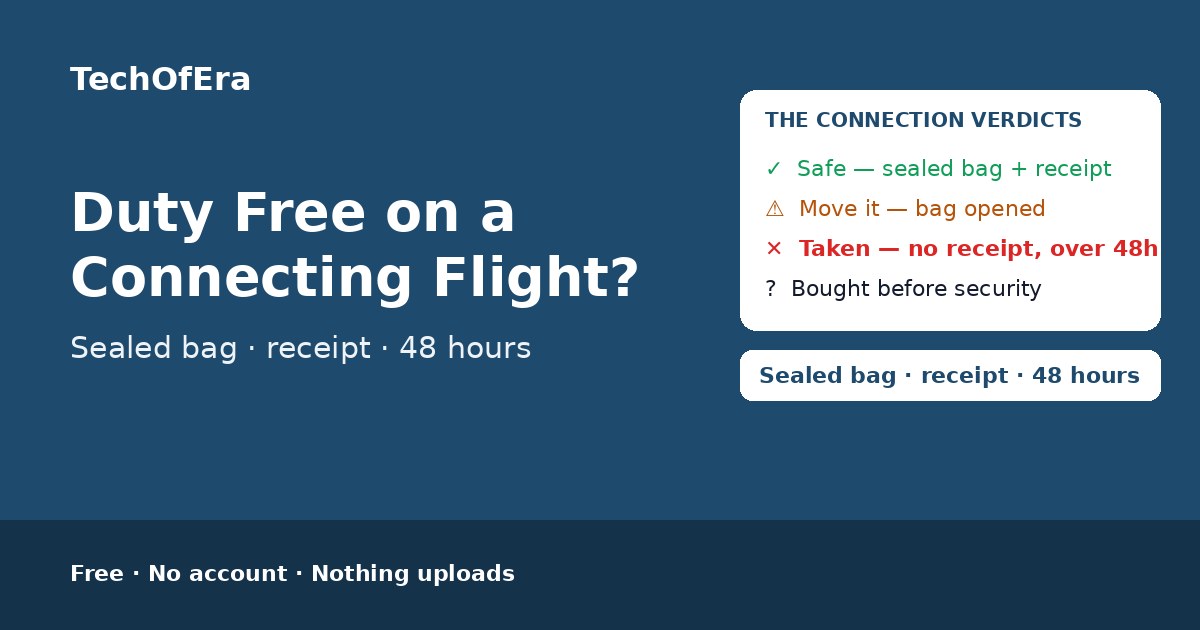
How to get duty-free through a connection
The rule that catches people is not the customs allowance — it is the security rule for liquids. At most international airports, liquids in a cabin bag must be in containers of 100 ml or less, all inside one clear resealable bag of about a litre, taken out at screening. A bottle over 100 ml cannot pass a security checkpoint in the cabin unless an exemption applies — and the exemption for duty-free is narrow: the bottle must have been bought airside, packed by the retailer in a transparent, sealed tamper-evident bag with the original receipt visible, and the bag must stay sealed until the final destination. Open it, lose the receipt, or break the seal, and the bottle is an ordinary liquid over 100 ml again.
On a direct flight that never matters, because the bottle never meets a second checkpoint. On a connection it does: you are often re-screened at the transit airport, and that is when a bottle bought on the first leg can be confiscated. The TSA rule for connecting in the USA is the strictest — the purchase must have been made within 48 hours, as well as sealed with the receipt present — and the bottle is still screened, so anything that alarms is not permitted in the cabin. The EU, UK and Canada accept a sealed bag with the receipt visible without a 48-hour window, but individual airports may apply stricter limits, and some transit airports outside those regions do not accept liquids bought elsewhere at all. This checker asks exactly what decides it.
To use it:
- Enter what you bought and where. A bottle over 100 ml is the classic case, but perfume, cosmetics and any other liquid over 100 ml follow the same rule. Where it was bought matters just as much: bought airside it has an exemption, bought before security or brought from home it has none — a bottle from home cannot pass even the first checkpoint in the cabin.
- Enter your route. Direct, or connecting — and if connecting, where. A US connection adds the 48-hour condition; a connection elsewhere is judged on the sealed bag and the receipt; a connection at an airport that does not accept liquids bought elsewhere is judged more strictly still.
- Check the bag, the receipt and the timing. Is the bag sealed, with the original receipt visible through the plastic? Was the purchase made within the last 48 hours, if you connect in the USA? If any of those is missing, the verdict changes — which is why the checker asks, instead of assuming.
- Check whether you will be re-screened, and whether you can reach your bags. No second screening means the bottle never has to prove itself. If there is re-screening and the exemption fails, the only escape is checked luggage — which only works where you collect your bags at the connection, as on arrival in the USA.
- Read the verdict, then the escape routes. Safe to carry on means the exemption holds. Move it to your checked bag means the exemption is gone but the bottle can still be saved. Likely to be confiscated means neither holds — and the next steps say what to do instead.
- Next time, buy on the last leg. A bottle bought after your final connection never meets a second checkpoint, so the exemption never has to be proved at all. It is the simplest way to avoid the whole problem.
Conditions and what to do at a glance
The table below is built from the same rules as the checker, so it can never disagree with your verdict. The sealed bag, the receipt, the route and the 48-hour rule decide, together with whether you will be re-screened and whether you can reach your bags.
| Condition | Verdict | What to know |
|---|
What makes this checker different
The pages that rank for this search are guides — the TSA’s own liquids page, airport-security explainers, and duty-free shop notices — but they leave you to apply the rules yourself: to work out whether your sealed bag, your receipt, your purchase date and your connection airport add up to a bottle that survives, or a bottle that gets taken. The duty-free allowance checkers that do exist answer a different question — how much alcohol you may bring into a country duty-free — which is a customs question, not a security one: a bottle can be within its customs allowance and still be confiscated at re-screening, and it can be over its allowance and still pass security. This page is the security answer: the bottle, the bag, the receipt, the purchase date, the connection and the checked-bag escape in, and a verdict for the exact trip you are taking — carry it on, move it to checked luggage, or expect it to be taken — with the rule that decides it named, and the escape route spelled out. It is a planning aid, so it says plainly what it cannot know: a web page cannot see your bags, your boarding pass or the rules at the airport you connect through, so anything you mark “Not sure” stays on the list until you confirm it.
When is this the right check?
Whenever you are about to buy duty-free and you change planes on the way home: the bottle of whisky at the departure airport when you connect in the USA, the perfume bought on the first leg when you change terminals, the bottle bought downtown and handed over at the gate. Also whenever the conditions are borderline and the decision turns on something specific — whether the bag is still sealed, whether the receipt is still visible, whether the purchase was within 48 hours, whether you will actually be re-screened, or whether you can reach your bags at the connection to move the bottle into the hold. And whenever you have already bought the bottle and want a straight answer before you land at the transit airport, instead of a guide to interpret at the gate.
Honest limitations
A planning aid, not a customs ruling
This checker works only from the answers you enter. It cannot see your bags, your boarding pass or the rules at the airport you connect through, and it is not a customs ruling — a screener’s decision at the checkpoint is final, whatever this page says.
The bag is the proof
The exemption rests on the sealed tamper-evident bag with the receipt visible. A bag that looks sealed but has a torn seal, a receipt folded out of sight, or a bottle swapped into a different bag is not the same thing — and this checker cannot inspect the bag for you.
Re-screening varies by airport
Whether you are re-screened depends on the transit airport, the terminal, the airline and the route — and it can change with no notice. If you are not sure, assume you will be re-screened: it is the answer that keeps the bottle safe.
Rules change, and airports differ
The rules here follow the TSA liquids rule and duty-free exemption, the EU tamper-evident bag rules and the ICAO guidance, as they read in November 2026. Individual airports may apply stricter limits, and guidance can be revised — so confirm with the transit airport or your airline before you rely on the bag.
The 48-hour rule is a US rule
The 48-hour purchase window applies to connections in the USA. The EU, UK and Canada have no 48-hour window in the rule itself — but that does not make an old purchase safe everywhere, and some transit airports apply their own limits on top.
Customs is a separate question
Security letting a bottle through is not the same as customs letting it in duty-free. How much alcohol you may bring into a country without paying duty is a customs allowance, and going over it means duty on the whole category — work it out separately before you land.