How the counteroffer check works
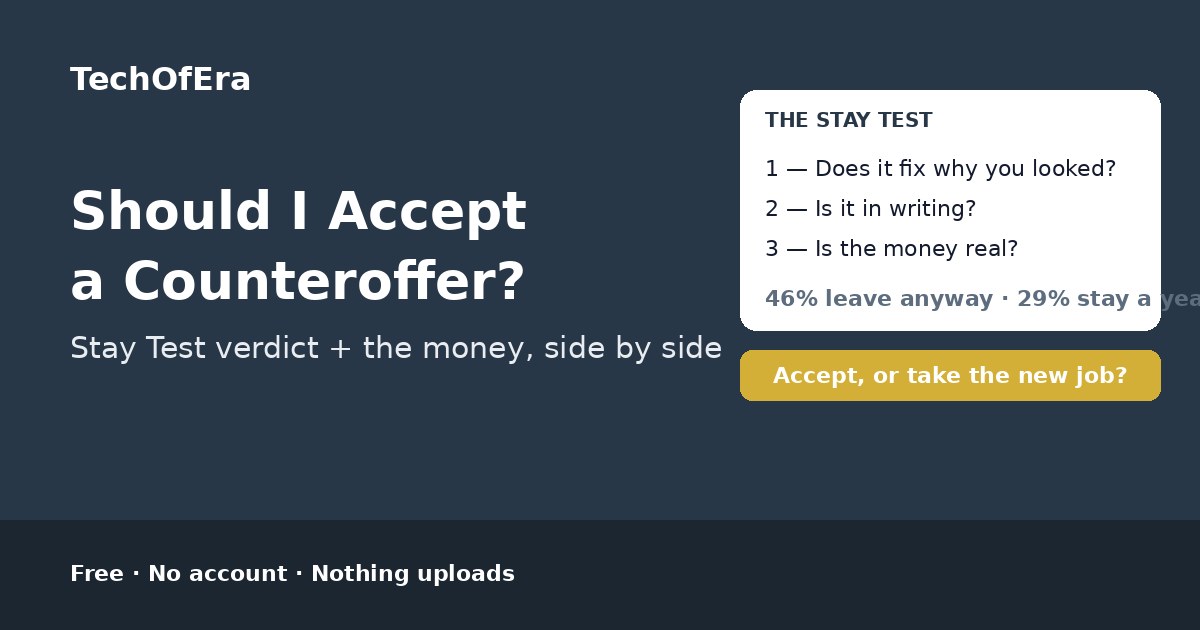
Your employer has offered you better terms to stay after you resigned, or said you would. It feels flattering, and the money is usually real. But the research says most counteroffers fail: Hays’ Salary Guide finds that of the staff who were counter-offered in the previous 12 months, on average around 46% leave anyway, 4% accept the counteroffer but stay less than three months, and 21% remain between three and twelve months — only 29% stay longer than 12 months. Hays’ own conclusion is that counteroffers work only when the employer genuinely addresses the reasons that drove the person to look elsewhere. And Pew Research Center found 63% of US workers who quit a job in 2021 named low pay, 63% named no opportunities for advancement, and 57% said they felt disrespected at work — pay is usually only part of the story. This checker runs the five-question Stay Test against your answers and scores them out of 100: does the offer fix why you started looking, would you have stayed on these terms if they had been offered without your resignation, is it in writing, do you trust your employer to deliver it, and what do you lose by giving up the new job?
To use it:
- Name why you started looking. Pay, no growth, your manager, the work itself — or several at once. The real reason, not the polite one: the whole check hangs on it.
- Say whether the counteroffer fixes that reason. Not “does it pay more” — does it change the thing that made you look? A pay rise does not fix a manager, a dead end, or work you dislike.
- Say whether it is in writing. A verbal promise is not an offer. Do not decide, and do not turn the new job down, until the role, the pay and the start date are on paper.
- Say whether you trust delivery, how strong the new job is, and whether you have already resigned. Trust is earned from a track record. The new job is what staying costs you. And once you have resigned, your employer does not have to let you take it back.
- Answer the second Stay Test question: would you have stayed happily on these terms six months ago? If the terms would not have kept you before you started looking, they will not keep you now.
- Enter the three pay figures, all in the same currency. Your current pay, the counteroffer, and the new job’s pay. The checker prices the gap between the counteroffer and the new job, and the rise the counteroffer means over your current pay.
- Tick what the counteroffer actually changes. Pay, role, manager, flexibility, training — or nothing beyond the pay. Check each one is real: a new role means a new job description, a new manager means a named person.
What makes this checker different
The pages that rank for this search are guides — a long article that tells you counteroffers usually fail, and a five-question Stay Test printed as text you have to run in your own head. None of them scores your situation: none takes your reason, whether the offer fixes it, whether it is in writing, whether you trust delivery, how strong the new job is, whether you have already resigned, and whether you would have stayed on these terms six months ago — and none prices the counteroffer against the new job in your own currency. There is no free, standalone checker that does all of that and gives you a verdict — accept, get it in writing first, negotiate the missing piece, or decline and take the new job — with the next steps for the verdict you got. This page is that answer: seven questions, three pay figures, one tick list, and an instant verdict for your exact situation. It is a self-assessment, so it says plainly what it cannot know: it cannot know your manager, your team, or what your contract says, and where a promise needs to be in writing before you act, it says so instead of giving you a maybe.
When is this the right check?
When your employer makes the offer the day you resign — the flattery is doing its work, and the Stay Test is the antidote. When the offer is only more money and the reason you were leaving was not money — because the reason will still be there in six months, when you no longer have the new job to go to. When the offer is a conversation, not a document — because a verbal promise is easy to remember differently on both sides, and once you have turned the new job down your leverage is gone. When you have already resigned and the counteroffer is not in writing — because you have given up your old job on the strength of a conversation, and you could end up with neither. And when the new job is clearly better and the counteroffer only matches the pay — because staying has to beat the new job, not just match it, and the new job also comes with the fresh start you were looking for.
Honest limitations
A self-assessment, not career or legal advice
This checker cannot know your manager, your team, or what your contract says. It scores the answers you give against the Stay Test and the published findings — it cannot tell you what your employer will actually do, and it is not career or legal advice.
The score is a guide, not a prediction
A score of 92 does not mean staying will work out, and a score of 58 does not mean leaving will. The score weighs the fix, the writing, the money, the trust and the new job together — but only you know the people involved, and only time shows whether a promise is kept.
The Hays figures are averages, not your odds
Around 46% of counter-offered staff leave anyway and only 29% stay longer than 12 months — but those are averages across many employers and many reasons. Your employer may be the exception, or the rule: the checker scores your situation, not the average.
Resignation rules differ by country
In the UK, government guidance says wait for an unconditional offer before resigning, and once you have resigned your employer does not have to let you take it back. Other countries have different rules, and your contract may say more. Check the rules where you work.
Money is the smallest part of the decision
The checker prices the gap between the counteroffer and the new job, and the rise over your current pay — but the verdict is driven by the reason, the writing and the trust. A bigger number does not fix a manager, a dead end, or work you dislike.
Rules from published findings, dated November 2026
The rules here are the Hays Salary Guide counteroffer findings and the Pew Research Center reasons-for-quitting data, as they read in November 2026. Findings change: recheck with a careers adviser or an employment lawyer if anything about your situation changes.