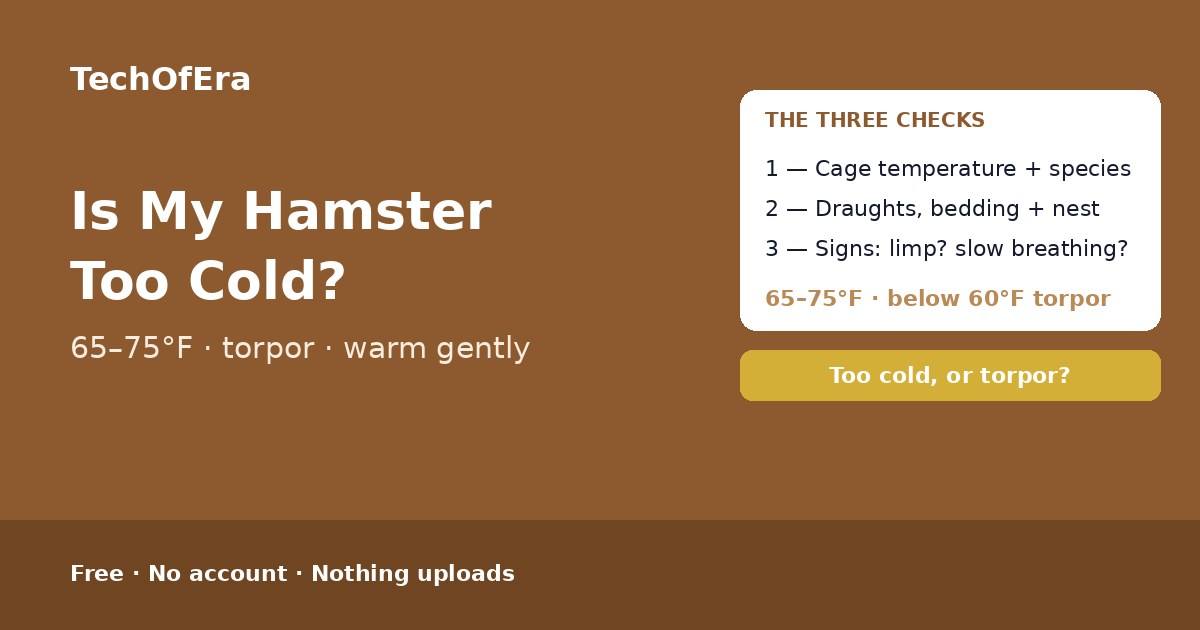
Is your hamster too cold?

Your hamster is curled up tight and barely moving — but is that a normal winter sleep, or torpor, the cold shutdown that can look exactly like death? The guides all agree on 65–75°F, but they disagree on where torpor starts, and none of them will look at your hamster in your room. Enter the cage temperature, the species, the cage spot and the signs — this checker gives you the verdict in seconds, with what to do next, free, in your browser, nothing uploads.

  • 65–75°F comfort range
  • Torpor vs illness check
  • What to do next
  • Free, no account, nothing uploads
Is my hamster too cold?

Check whether your hamster is too cold

Try a preset:
0 of 9 answered

Your result

Answer the questions Your verdict appears here as you answer.
What the room calls for

Enter the temperature by the cage above and what the room calls for will appear here.

Blockers

Things that do not fit

Things to check

Still to confirm

What to do next

    Your result summary


    Answer the questions above — the verdict updates live.

    Privacy you can verify, not just trust

    Checking whether your hamster is too cold by uploading your hamster’s details to a website would be backwards — the check should never be the leak. This one can't: your answers are checked with plain JavaScript on your device, and they never leave the device — the only third-party requests are the site's own analytics, which count page views. Don't take our word for it:

    New cross-origin requests during use: 0
    1. Press F12 to open developer tools, then the Network tab.
    2. Answer a question above. Watch: apart from the site's analytics, nothing new is requested — no uploads, and no data ever leaves your device.
    3. Extra credit: disconnect your internet after this page loads — the checker still works.

    How the hamster-cold check works

    The care guides agree on the comfortable range for a pet hamster — 65–75°F (18–24°C) — with PetMD and the Merck Veterinary Manual putting the wider safe range at about 64–80°F. Below 60°F torpor risk rises, and below 50°F torpor is almost certain for a vulnerable hamster. Above 80°F heat stress can be fatal. But those numbers are for an average hamster in a warm room — and your hamster is neither average nor necessarily in a warm room. A young dwarf in a draughty room with thin bedding reaches the line far sooner than a healthy adult Syrian in a glass tank with a deep nest. This checker does the same sums for your hamster: it works out the band from the cage temperature, moves it for your hamster’s species, age, health, cage position, bedding, cage type and food — and gives you a verdict, with what to do next.

    To use it:

    1. Enter the temperature by the cage. Put a small digital thermometer by the cage — the room thermometer on the other side of the house does not count. Enter it in °C or °F.
    2. Say what species your hamster is, how old they are, and how their health is. Syrian, Campbell’s, Winter White, Roborovski and Chinese hamsters handle cold differently — Winter Whites are the hardiest dwarfs, Roborovskis come from desert steppes and handle cold worst. Young and senior hamsters chill faster than healthy adults.
    3. Say where the cage sits. A cage by a draughty window, an outside door or the air conditioning is colder than the room — and a basement, a garage or a cold floor is the coldest place a cage can sit.
    4. Describe the bedding and nest, the cage type, and whether food and water are available. Deep bedding and a big nest are your hamster’s blanket. A glass tank holds warmth better than a barred cage. And a hungry hamster has less fuel to stay warm — torpor is linked with lack of food.
    5. Tick any signs your hamster is showing. Cold to the touch, limp or hard to wake, breathing very slowly, shivering, curled up tight, not eating, or sluggish — any one of them means act now, and limp or barely breathing means torpor until a vet says otherwise.

    What makes this checker different

    The pages that rank for this search are guides — Hamsters Info’s why-is-my-hamster-cold guide, Small Animal Advice’s temperature-range guide, Small Pet Expert’s torpor-or-emergency guide, and Spectrum Care’s cold-weather and temperature-and-humidity guides. They give you the thresholds and leave you to do the sums on a cold night, and they disagree with each other on where torpor starts. There is no free, standalone checker that takes the temperature by the cage, adjusts it for your hamster’s species, age, health, cage position, bedding, cage type and food, listens to the signs your hamster is showing — and gives you a verdict: fine, cool, cold, emergency, too hot, or check first because the hamster disagrees with the numbers — with what to do next, including the torpor warming steps and when to call a vet. This page is that answer: nine questions, an instant verdict for your exact hamster and your exact room, the blockers named, and the next steps. It is a self-assessment, so it says plainly what it cannot know: it cannot feel your hamster or read your thermometer, and where your hamster’s signs disagree with the numbers it says so instead of guessing.

    When is this the right check?

    On the first cold night of the year — because the hamster that was fine in October is a different hamster in January once the heating goes off overnight. When you find your hamster cold, limp and barely moving in the morning, and you need to know in seconds whether that is torpor or something worse. When a young hamster or a senior hamster joins the house, and the cold limits you knew for your old hamster no longer apply. When the cage has been moved — to a cooler room, near a window, or down to a basement — and you need to know whether the new spot is safe. And whenever your hamster starts curling up tight, shivering or stops eating halfway through a cold snap — because that is when a guide leaves you guessing and a checker earns its keep.

    Honest limitations

    A self-assessment, not veterinary advice

    This checker cannot feel your hamster or read your thermometer. It cannot check the temperature by the cage or whether your hamster is limp and barely breathing. If you are worried about your hamster, talk to an exotic-pet vet.

    The hamster’s signs beat the numbers

    A hamster showing cold stress in weather the numbers call fine is a hamster that needs warming up. The bands are guidance for an average hamster of that species and setup — your hamster’s own signs are the verdict that counts.

    Torpor can look exactly like death

    A hamster in torpor is cold, limp and barely breathing, and can look lifeless. Do not assume a cold, limp hamster has died: check for faint breathing for a full minute, and for a whisker twitch — and call a vet.

    The torpor trigger is our estimate, not a published rule

    The sources disagree on the exact torpor trigger — some cite 60–65°F, others about 40°F. The checker uses the cautious reading — risk starting below 65°F and high below 60°F — and says so, instead of dressing the estimate up as a rule.

    Species and age ranges are approximate

    The species differences use the usual care-guide descriptions — Winter Whites hardiest, Roborovskis least cold-tolerant — but individuals vary. Where your hamster falls between two bands, use the more vulnerable one: it is the safer reading.

    Rules from official sources, dated November 2026

    The rules here are the PetMD, Merck Veterinary Manual, Small Animal Advice, Hamsters Info, Small Pet Expert and Spectrum Care hamster guidance, as they read in November 2026. Guidance changes: recheck with your vet if anything about your hamster changes.

    Frequently asked questions

    Is my hamster too cold?

    If the temperature by the cage is below 65°F (18°C), your hamster is colder than the comfort range every major care guide agrees on — and below 60°F (15°C) torpor risk rises. A hamster that feels cold to the touch, shivers, curls up tight, stops eating or goes sluggish is too cold whatever the thermometer says, and a hamster that is limp or barely breathing may be in torpor, which is an emergency. This checker works from the cage temperature, your hamster’s species, age and health, where the cage sits, the bedding and the signs, and gives you a verdict with what to do next.

    What temperature is too cold for a hamster?

    The comfortable range for a pet hamster is 65–75°F (18–24°C), with PetMD and the Merck Veterinary Manual putting the wider safe range at about 64–80°F. Below 60°F torpor risk rises, and below 50°F torpor is almost certain for a vulnerable hamster. The sources disagree on the exact torpor trigger — some cite 60–65°F, others about 40°F — so the cautious reading is to treat anything below 65°F as too cold and anything below 60°F as a real risk. Young, senior, unwell and Roborovski hamsters, and hamsters in draughty rooms or with thin bedding, reach the line sooner.

    How do I know if my hamster is in torpor?

    A hamster in torpor feels cold and limp, like a soft, cold rag, and barely moves — breathing can slow to as little as once a minute, against a normal 50–135 breaths per minute. The difference from death is that a torpid hamster is limp and pliable, still breathes very slowly, and may give a whisker twitch or a paw movement when warmed; a hamster that has died develops stiffness (rigor mortis) within 1–3 hours. Watch the chest for a full minute and hold a small mirror by the nose to catch faint breaths. If you are unsure, warm the hamster gently and call an exotic-pet vet — do not assume a cold, limp hamster has died.

    What should I do if my hamster is cold and limp?

    Warm your hamster gently and call an exotic-pet vet now, even if they perk up — a hamster recovering from torpor can be dehydrated and low on energy. Move the cage to a warm room at 65–75°F, hold your hamster against your body or in warm hands, or put a towel-wrapped warm (not hot) water bottle beside them. Waking from torpor takes around 30 to 60 minutes and should be gradual. Never use a heating pad, a hair dryer or hot water, and never put a hamster in a fridge or an ice bath. If your hamster does not respond to gentle warming, or seems to get worse, get to a vet urgently.

    How do I keep my hamster warm in winter?

    Keep the cage in the warmest room of the house, away from draughty windows, outside doors and air conditioning, raised off the floor on a table or a stand — never in a basement or a garage, which can drop below 50°F overnight. Give your hamster deep bedding to burrow into, at least 15 cm (6 inches), plus a big nest of torn plain white toilet paper. In a barred cage, drape a blanket over three sides at night, leaving the front open for air. Keep the food bowl and water bottle full, and put a small digital thermometer by the cage so you catch overnight drops before they become dangerous.

    Can hamsters live outside in winter?

    No — pet hamsters are indoor animals and must not live outside in winter. A hamster left outside in the cold will go into torpor and can die: wild hamsters that hibernate do so in deep, insulated burrows after months of preparation, and pet hamsters do not hibernate the way wild animals do — torpor in a pet hamster is an uncontrolled emergency response, not a safe winter sleep. Keep your hamster indoors all winter, in a room that stays at 65–75°F.

    What temperature is too hot for a hamster?

    Above 80°F (27°C) heat stress can be fatal for a hamster — hamsters cope badly with heat, and a hot cage is as dangerous as a cold one. Keep the cage out of direct sun and in the coolest room in summer, and give your hamster a ceramic tile or a towel-wrapped frozen water bottle to lie against. A hamster that lies flat, breathes fast or feels hot to the touch is overheating: cool the cage down and call a vet — that is heatstroke, not just being warm.

    Does this checker give veterinary advice?

    No. This checker is a self-assessment: it runs your answers against the PetMD, Merck Veterinary Manual, Small Animal Advice, Hamsters Info, Small Pet Expert and Spectrum Care hamster guidance as they read in November 2026, entirely in your browser, and nothing you enter leaves your device. A web page cannot feel your hamster or read your thermometer — it cannot check the temperature by the cage or whether your hamster is limp and barely breathing — so it says plainly what still needs checking, and where your hamster’s signs disagree with the numbers it says so instead of guessing. The only third-party requests are the site’s own analytics, which count page views. If you are worried about your hamster, talk to an exotic-pet vet.