How the car-payment check works
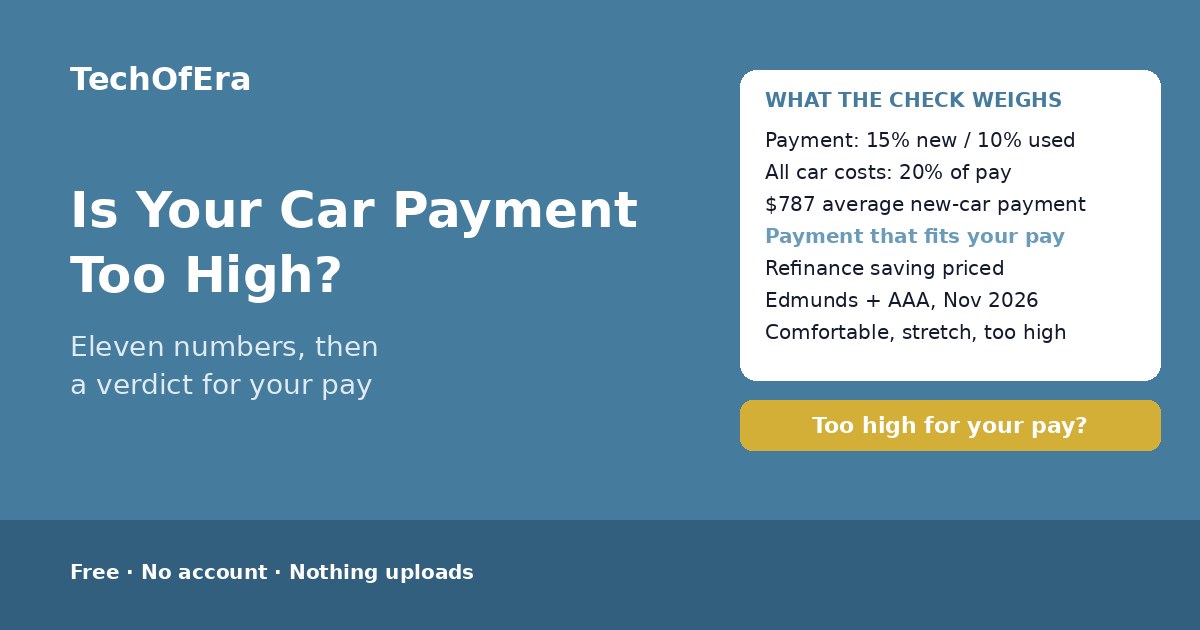
The pages that rank for this question are guides — GoBankingRates with the 10% to 15% rule and what to do when the payment exceeds it, OneCarSpot with the 15% to 20% rule, and Toyota Direct on what counts as a high payment. The interactive tools that rank answer a different question: The Calcery, MyFavi, Eastward Drive and OnlineToolSpot are affordability calculators — they tell you how much car you can afford before you buy one. None of them takes the payment you already pay and judges it against your pay, none adds insurance, fuel and maintenance into a total and judges that against the 20% rule, and none prices what refinancing the loan you already have would save. What decides it is eleven things: your currency, whether the car is new or used, your monthly take-home pay, the loan payment, insurance, fuel and maintenance, and — for the refinance check — the balance left, the months left, your current APR and the new APR on offer. The spine is two percentages: the payment against the 15% rule for a new car or 10% for a used car, and everything the car costs against the 20% rule.
To use it:
- Enter your monthly take-home pay. What reaches your bank account each month, after tax — the number your pay slip actually shows. On the US median household income after tax of about $5,353 a month, the 15% guideline puts a new-car payment at $803 or less. A payment cannot be judged against a paycheque the checker cannot see.
- Say whether the car is new or used. The payment guideline is 15% of take-home pay for a new car and 10% for a used car or a lease (Edmunds). The same payment can be comfortable on a new car and too high on a used one — the guideline changes with the car, not with the payment.
- Enter your monthly car loan payment. The payment on your loan statement — the amount you actually pay each month. The US average is $787 a month for a new car and $582 for a used car (Edmunds, Q3 2026) — but an average is not a target: the payment is too high when it takes too much of your pay, whatever the average is.
- Enter insurance, fuel and maintenance. Insurance is usually the biggest running cost after the payment itself; fuel is $150 to $250 a month for most US drivers; maintenance averages $50 to $100 a month over the year. Leave them blank and the total is the payment alone — which understates the real cost, and the checker says so.
- Read the verdict, not just the percentages. Comfortable means the payment is inside its guideline and the total inside 20%. A stretch means it can work if the rest of the budget is light, but there is little slack. Too high means both guidelines are broken and the gap is named in pounds or dollars a month. Far too high means the car takes so much of your pay that one missed payment can start a spiral — and the honest fix is usually a cheaper car.
- Fill in the refinance check if you have an offer. The balance left, the months left, your current APR and the new APR on offer. On a $20,000 balance with 48 months left, refinancing from 10% to 6% cuts the payment from about $507 to about $470 a month — about $38 a month, $1,802 over the term. That is an estimate: it assumes the same balance over the same months, no fees, and that the new rate is really on offer to you.
- Follow the next steps for the verdict you got. A comfortable verdict means keep the payment and shop the insurance at renewal. A stretch means tighten the budget and get a refinance quote. Too high means a refinance quote, cheaper insurance, and pricing a cheaper car. Far too high means talking to your lender first — before a payment is missed, not after.
What makes this checker different
The pages that rank for this search answer a different question, or the same question without your numbers. GoBankingRates, OneCarSpot and Toyota Direct explain the rules — 10% to 15% for the payment, 20% for everything the car costs — but leave you to do the maths yourself. The Calcery, MyFavi, Eastward Drive and OnlineToolSpot build a real calculator, but for the car you have not bought yet: they take an income and a price and tell you how much car you can afford. None of them takes the payment you already pay, the insurance, fuel and maintenance you already pay, and your take-home pay, and turns them into a verdict with the gap named in pounds or dollars a month, the payment and total that actually fit, and what refinancing the loan you already have would save. This page is that answer: eleven numbers, and an instant verdict for your exact situation. It is general information, so it says plainly what it cannot know: it cannot see your loan agreement, your bank statements or your pay, and it is not financial advice.
When is this the right check?
When the payment feels tight every month — because the question is not whether the payment is big in theory, but whether it is big for your pay. When you are about to miss a payment — because the verdict names the gap and the next steps before the payment is missed, not after. When a lender offers you a refinance — because the saving is only real if the new rate is lower on the same balance over the same months, and this checker prices it. When you are weighing trading the car down — because the checker names the payment your pay actually supports, so you know what cheaper means. And when the payment looks fine on its own — because insurance, fuel and maintenance can push the total over 20% even when the payment is inside its guideline, and only the total tells the whole story.
Honest limitations
General information, not financial advice
This checker cannot see your loan agreement, your bank statements or your pay. It scores the numbers you give against published guidelines as they read in November 2026 — it cannot tell you what your lender will do, and it is not financial advice.
Guidelines, not lender rules
The 15% and 10% payment rules and the 20% total rule are budgeting guidelines from Edmunds and other guides, not rules a lender must follow. A lender may approve a payment far above them — approval is not proof the payment fits your life.
Averages are US figures
The average payments — $787 new, $582 used — are US figures from Edmunds, Q3 2026, and the $1,072 all-in average is from AAA, 2026. They are shown for every currency as a reference only; your country's averages will differ.
The refinance saving is an estimate
It assumes the same balance over the same months, a fixed rate, and no fees. A prepayment penalty on the old loan, fees on the new one, or a longer term can all eat the saving — get the offer in writing first.
It does not see the rest of your money
Other debts, a mortgage, a card balance, tax — none of them are in this check. A payment inside the guideline can still be too much if the rest of your budget is already stretched. The verdict is about this car and this pay only.
Facts from the guides that rank, dated November 2026
The facts here are Edmunds' payment and total-cost guidelines and Q3 2026 average payments, AAA's 2026 all-in average, GoBankingRates' 10% to 15% rule and the US Census Bureau's median after-tax income — as they read in November 2026. Averages and thresholds change: recheck them if anything about your loan or your pay changes.