How the wedding gift calculator works
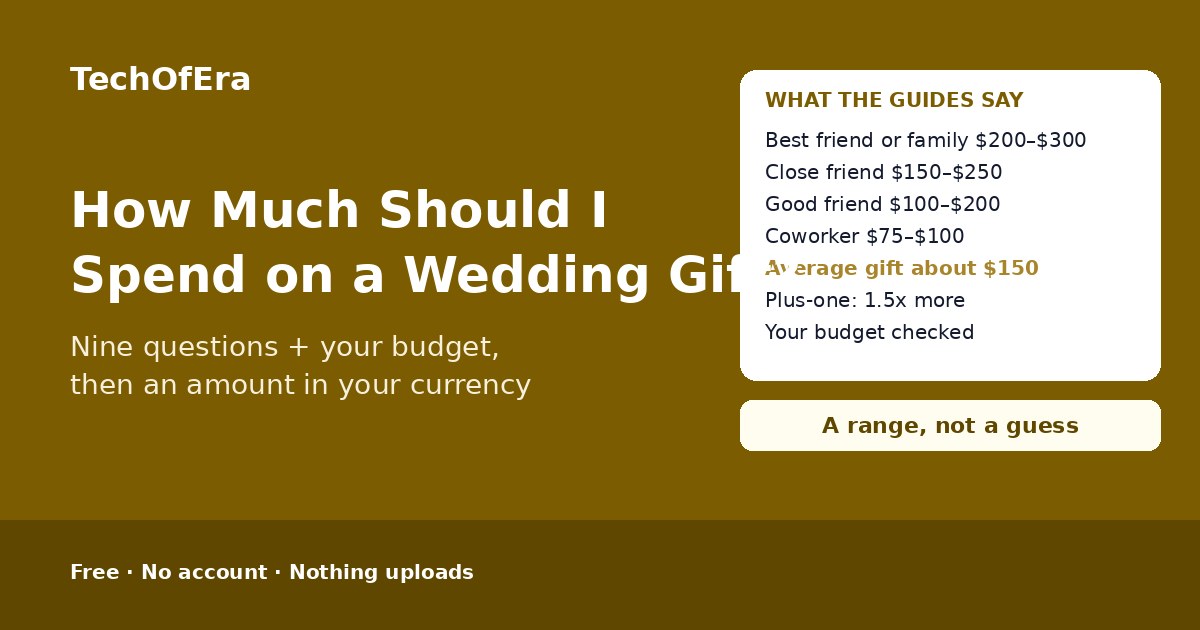
There is no single right amount for a wedding gift — only the amount that fits your relationship to the couple, the wedding, and your budget. The published etiquette guides put the average wedding gift at about $150 (The Knot Guest Study) to $130 (Zola’s 2026 First Look Report), with most guests spending $100 to $150. This calculator starts from the guides’ ranges for your relationship — $200 to $300 for a best friend or immediate family, $150 to $250 for a close friend, $100 to $200 for a good friend, $100 to $150 for extended family, $75 to $100 for a coworker, and $50 to $100 for an acquaintance — then adjusts for the wedding’s formality, a plus-one, whether you are in the wedding party, the other events you are invited to, and whether you are attending. The Emily Post Institute says matching your gift to the cost of your plate is a modern myth, not a rule — so this calculator never asks what the couple are spending on you. The figures are etiquette estimates, not prices.
To use it:
- Say who the couple are to you. The relationship sets the range. A best friend or immediate family is $200 to $300; a close friend is $150 to $250; a good friend is $100 to $200; extended family is $100 to $150; a coworker is $75 to $100; an acquaintance is $50 to $100. The Knot’s Guest Study found guests spent an average of $160 on close friends and family, and $140 on casual friends.
- Say where you are. The amount is shown in your currency — US dollars, pounds, euros, Canadian dollars or Australian dollars. Conversion uses fixed approximate rates, and the result says so: check the live rate before you buy.
- Say how big and formal the wedding is. A large formal wedding nudges the amount up a little; a small intimate wedding nudges it down a little; a destination wedding nudges it down more, because you are already paying to travel — Zola’s guidance is to spend a little less on the gift when you are travelling or spending a lot on pre-wedding events.
- Say whether you have a plus-one. Zola’s guidance is 1.5 to 2 times more when a plus-one is coming with you. This calculator uses 1.5 times — the lower end of that guidance.
- Say whether you are in the wedding party, and which other events you are invited to. Wedding party members are already spending a lot on the day, so their gift can be a little less. And the 20-20-60 rule spreads your budget across the events: 20% on the engagement gift, 20% on the shower gift, 60% on the wedding gift.
- Say whether you are attending, and enter your budget. If you cannot attend, the gift can be a little smaller — but do still send one. The calculator checks your budget against the range: if it covers the top, you can pick any figure inside it; if it covers only the lower end, aim for the bottom; if it is below the range, the result names the honest options — the lower end, a group gift, or a smaller registry item with a heartfelt card.
What makes this calculator different
The pages that rank for this search are guides — The Knot, Zola, Brides and the rest listing the same ranges in a table, with a few paragraphs of advice. The Knot does have a gift amount calculator, but it sits inside its guide article, next to a registry sign-up. None of the ranking pages gives you a standalone calculator that takes your relationship, the wedding, your currency, your plus-one, the wedding party, the other events and your budget — and none checks the range against your budget, splits it across the engagement party, shower and wedding, or lets you copy, download or print the result. This page is that answer: nine questions, one figure for your budget, and a specific amount range in your currency, with the etiquette behind every adjustment named in the result. It is a self-assessment, so it says plainly what it cannot know: it cannot know your finances, and the figures are etiquette estimates, not prices.
When is this the right calculation?
When the invitation arrives and you have no idea what number to put on the gift — the most common wedding-guest question there is. When you are going to several weddings in one season and the gifts are adding up faster than your budget. When you have a plus-one and you are not sure whether that doubles the gift. When you are in the wedding party and wondering whether the dress or the suit counts. When you are invited to the engagement party and the shower as well as the wedding, and you need to know how much of your budget each event gets. And when you cannot attend and still want to send something right — a smaller gift, sent with a card, before the wedding or within three months of it.
Honest limitations
A self-assessment, not financial advice
This calculator cannot know your finances. It gives a spending range from the published etiquette guides — it cannot tell you what you can afford, and it is not financial advice.
The figures are estimates, not prices
The ranges come from the guides — The Knot, Zola, Brides and the Emily Post Institute — as they read in November 2026. They are etiquette estimates, not prices, and the guides disagree with each other at the edges. Pick the figure inside the range that feels right for your budget.
Currency conversion is approximate
The range is worked out in US dollars and converted at a fixed approximate rate — 1 US dollar is about £0.79, €0.92, C$1.36 or A$1.52. Rates move daily, so check the live rate before you buy, and round to a figure that looks natural in your currency.
Regional norms differ
The guides are mostly American, and gift norms differ by country and by culture. In some places cash is expected; in others a physical gift is the norm; in some families the amount is set by tradition, not by a guide. The range is a starting point, not a rule for every family.
The registry beats the range
The range tells you how much to spend; the registry tells you what to spend it on. If the registry has nothing left in your range, the amount matters less than the choice: a smaller registry item with a heartfelt card beats a guess at a big item every time.
Facts from the guides, dated November 2026
The facts here are The Knot Guest Study, Zola’s 2026 First Look Report, Brides, and the Emily Post Institute, as they read in November 2026. Guides change and studies are re-run: recheck the numbers if anything about your wedding changes.