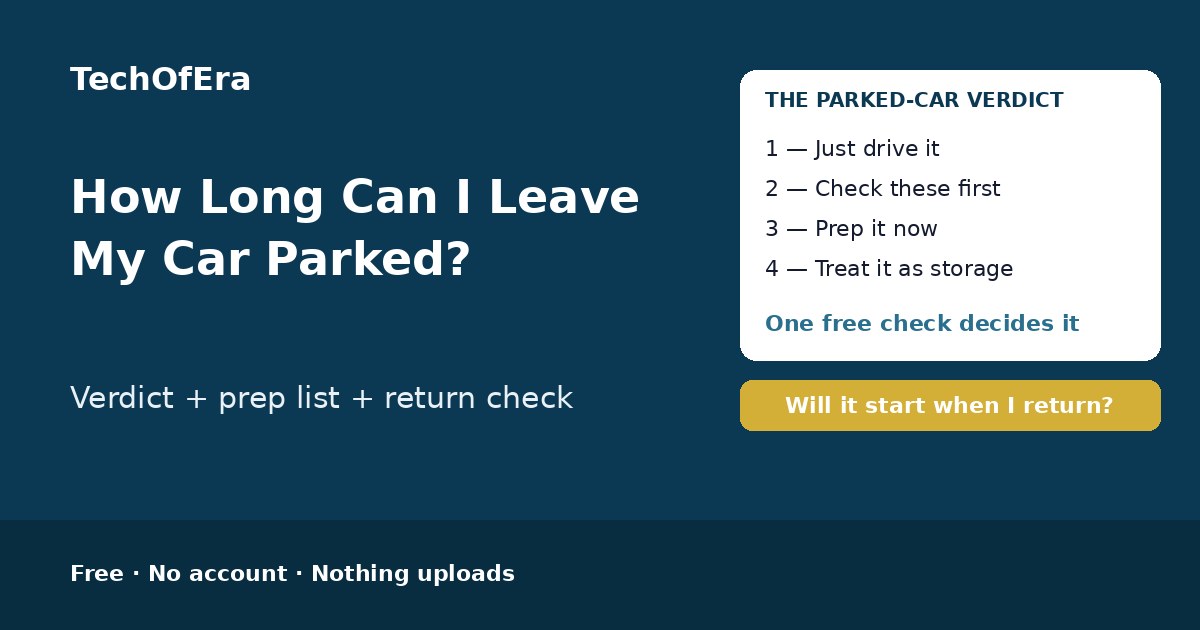
How the parked-car check works
How long a car can sit is a trade-off, not a single number. A healthy battery holds for about two weeks in mild weather, but an older battery can fail in under a week — and cold weather shortens that further. Petrol starts breaking down in about 30 days. Tyres can develop flat spots from about a month. Brakes can rust or seize from about three months. This checker weighs all of it — how long the car will sit, what fuel it takes, how old and healthy the battery is, the weather where it is parked, where it is parked, what preparation has been done, the state of the tyres, and how it was used until now — and gives you a verdict: you are fine, it will probably start but check these first, prep it now or expect trouble, or treat this as storage, plus a preparation list and a return checklist.
To use it:
- Say how long the car will sit without being driven. A few days, 1–2 weeks, 2–4 weeks, 1–3 months, 3–6 months, or 6 months or more. Two weeks is where small problems start; one month is where real ones do.
- Say what fuel it takes. Petrol, diesel, hybrid, or fully electric. Petrol goes stale in about 30 days; diesel keeps longer; an electric car still has a 12V battery that drains while it sits.
- Say how old and healthy the battery is. New — under 1 year old; 1–3 years; 3–5 years; 5+ years; or already weak — slow to start, or needed a jump. A healthy battery holds for about two weeks; an older one can fail in under a week.
- Say what the weather is like where it will be parked. Mild, cold — below freezing at night — or hot — over 30°C (86°F) most days. Cold weather shortens how long a battery holds its charge.
- Say where it will be parked. In a garage, outside under a cover or carport, or on the street or in an open car park. A garage protects the car; street parking can also be illegal after a few days.
- Say what preparation has been done. Nothing yet, fuel stabiliser added to the tank, a battery maintainer (trickle charger) connected, the battery disconnected, or full storage preparation. For a sit past two weeks, a battery maintainer and fuel stabiliser are the two moves that matter.
- Say what the tyres are like. Good — fairly new, correct pressure; older or worn, but holding air; or already low on pressure, or one tyre leaks slowly. Tyres can develop flat spots from about one month of sitting.
- Say how the car was used until now. Driven daily until now, driven about once a week, or already sitting for 2 weeks or more. A car driven daily starts its sit with a full battery.
The four verdicts, and what each one means
You’re fine — just drive it
A short sit with a healthy battery in mild weather. The battery will hold, the fuel is fresh, and the tyres will be fine. Check the tyre pressures when you return, then drive for 20 to 30 minutes to warm everything through.
It will probably start — check these first
The sit is long enough — or the battery old enough, or the weather cold enough — that a flat battery, soft tyres or rusty brakes are real possibilities. Check the battery charge, pump the tyres up, and look at the brakes before your first proper drive.
Prep it now, or expect trouble
At this length of sit, an unprepared car comes back with a flat battery, stale fuel and flat-spotted tyres. Add fuel stabiliser, connect a battery maintainer or disconnect the battery, pump the tyres a few psi over normal, and park it clean and dry.
Treat this as storage — full prep needed
Six months or more is storage, not parking. Change the oil before it sits, add stabiliser and fill the tank, connect a maintainer or disconnect the battery, over-inflate the tyres, and cover it. Before you drive it again, have a mechanic check the battery, brakes, tyres and fluids.
Your return checklist
Whatever the verdict, this is the first hour back with the car — the checklist the checker builds from your answers:
- Walk around the car before you start it. Look for flat tyres, leaks underneath, animals nesting in the wheel arches, and anything that has fallen on it. Check the oil and coolant levels under the bonnet.
- Check the tyre pressures. Tyres lose a little air every month, and a tyre that went flat while parked can have a damaged sidewall. Pump them to the pressure on the door sticker — or a few psi over if you over-inflated them for storage.
- Try the battery. If it turns over slowly or not at all, jump it and drive for at least 30 minutes — or have the battery tested, since a battery that went flat may not hold a charge again.
- Drive gently for the first few miles. Brakes can be grabby after sitting, and flat spots smooth out after 15 to 30 minutes of driving. If a thump or vibration does not fade, have the tyres checked.
- Fill up with fresh fuel. If the car sat for more than a month on old petrol, top the tank up with fresh fuel as soon as you can — it dilutes the stale fuel and helps the engine run clean.
- Listen and smell. Squealing brakes, a grinding noise, or a smell of fuel or burning after a long sit are reasons to stop and have a mechanic look at it — not to push on and hope it clears.
- If it sat for six months or more, book a mechanic first. A car that has sat that long can hide seized brakes and perished rubber. A check of the battery, brakes, tyres and fluids costs far less than the repair that follows driving on a seized caliper.
What makes this checker different
The pages that rank for this search are articles — an AutoZone storage guide, a Microgreen Filter 2026 guide, a MechanicFixa stored-car guide, and a content-farm timeline. All of them give one number — about two weeks — and then a long list of things that can go wrong. None of them asks how old your battery is, what fuel you run, whether it is freezing where you park, or whether you have done any preparation — and none of them gives you a verdict for your car. There is no free, standalone checker that takes your sit length, your battery, your fuel, your weather and your parking spot and turns them into a verdict with a prep list and a return checklist. This page is that answer: eight questions, an instant verdict, the blockers named, and the next steps. It is a self-assessment, so it says plainly what it cannot know: it cannot measure your battery's charge, test your fuel, or inspect your tyres or brakes.
When is this the right check?
When you are going away for a few weeks and you are not sure whether the car will start when you get back — because the answer depends on your battery, not on a single number, and the fix is a maintainer or a disconnect. When you are leaving a car for the winter — because cold weather kills old batteries fast, and a three-month winter sit needs stabiliser and a maintainer, not hope. When a car has already been sitting and you need to know what to check before you drive it — because the return checklist is different after two weeks than after six months. And when you are parking on the street for weeks — because the legal limit is often 72 hours, and the checker flags it before you get a ticket or a tow.
Honest limitations
A self-assessment, not a mechanic's inspection
This checker cannot measure your battery's charge, test your fuel, or inspect your tyres or brakes. It cannot tell whether your battery will hold a charge, or whether your brakes have seized. If the car has been sitting for months, have a mechanic check it before driving it.
“About two weeks” is a rule, not a guarantee
The two-week figure is what the guidance gives for a healthy battery in mild weather. An old battery can fail in under a week, a new one with a maintainer can last months, and a car with a parasitic drain can go flat overnight. The checker scores your battery and your weather rather than trusting the single number — but it still cannot measure your battery.
Fuel ages differently by blend and tank
Ethanol-blended petrol goes stale faster than pure petrol, and a full tank ages more slowly than a part-empty one because there is less room for condensation. The checker asks about fuel type, not the blend or the tank level — so the 30-day figure is a rule of thumb, and stabiliser is cheap insurance either way.
Parking law is local, not universal
The 72-hour street-parking limit is common in US cities, and the two-week abandoned-vehicle rule is a UK one — but both vary by city and by street. The checker flags street parking and tells you to check local rules rather than stating a single law, because a single law does not exist.
Electric cars are a different machine
An electric car has no petrol to go stale, but its 12V battery still drains while it sits — and if that goes flat, the car will not wake up even with a full traction battery. The checker covers the 12V drain and the slow traction-battery loss, but it does not cover battery thermal management or software updates while parked.
Rules from official sources, dated November 2026
The rules here are the car-care guidance from AutoZone, Microgreen Filter and MechanicFixa, as they read in November 2026. Guidance changes: recheck with a mechanic if anything about your car, your battery, or where you park changes.