Do you need a business bank account?

A sole trader can legally trade through a personal account — but a limited company cannot, and a bank can close a personal account used for business even where the law does not stop you. Between those two poles, the answer turns on how much money moves, how many transactions and clients there are, whether anyone else is paid, and what your bank's own terms say. Answer six questions, add three figures, and get a verdict for your exact situation — in the UK, the US, Canada or Australia. Free, in your browser, nothing uploads.

  • Six tests, scored out of 100
  • The rule for UK, US, Canada, Australia
  • Company = legally required
  • Free, no account, nothing uploads
Do you need a business bank account? Check it in seconds.

Check whether you need a business bank account

Try a preset:
0 of 9 answered

Your result

Answer the questions Your verdict appears here as you answer.
The rule where you are

Pick your country and your business structure above and the rule for you will appear here — the law draws a hard line for companies, and a softer one for sole traders.

Blockers

Things that do not fit

Things to check

Still to confirm

What to do next

    Your result summary


    Answer the questions above — the verdict updates live.

    Privacy you can verify, not just trust

    Checking whether you need a business bank account by uploading your income, your clients and your banking habits to a website would be backwards — the check should never be the leak. This one can't: your answers are checked with plain JavaScript on your device, and they never leave the device — the only third-party requests are the site's own analytics, which count page views. Don't take our word for it:

    New cross-origin requests during use: 0
    1. Press F12 to open developer tools, then the Network tab.
    2. Answer a question above. Watch: apart from the site's analytics, nothing new is requested — no uploads, and no data ever leaves your device.
    3. Extra credit: disconnect your internet after this page loads — the checker still works.

    How the business bank account check works

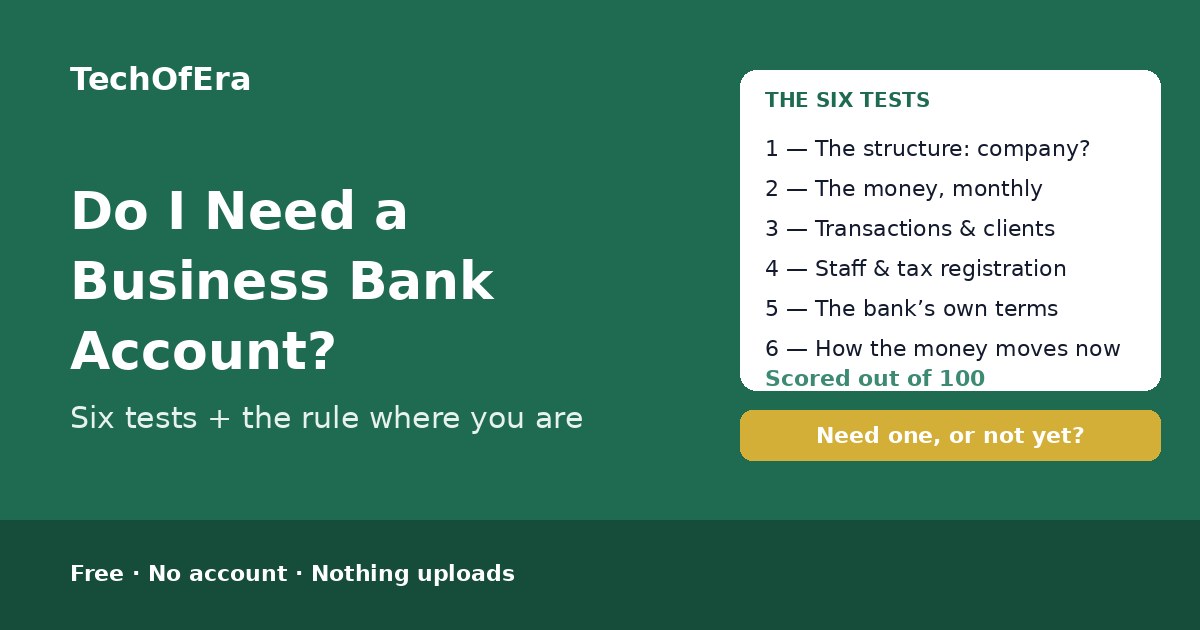
    The law draws one hard line: a limited company, LLC or corporation is a separate legal person, so its banking must be separate from yours. In the UK, GOV.UK says so plainly. In the US, mixing personal and business money is one of the grounds courts use to pierce the corporate veil — the liability shield the company exists to give you. For a sole trader or a partnership there is no legal duty to open a business account in the UK, the US, Canada or Australia — but the bank's own terms, the volume of money, the number of transactions and clients, whether anyone else is paid, and whether the business is VAT or GST registered all push the same way. This checker scores those six tests out of 100: the structure, the money, the volume, the staff, the tax registration, and the bank's own terms.

    To use it:

    1. Pick your country and your business structure. The rules differ by country — and the structure decides whether a business account is a legal requirement or a practical one. A company means yes, full stop.
    2. Say how the business money moves now. A personal account, a second personal account, or nothing yet — mixing business money with personal spending is the habit a business account fixes.
    3. Say whether you pay staff or regular contractors, and whether the business is VAT or GST registered. Paying people out of a personal account mixes their money with yours, and a registered business files tax on its turnover — both raise the bar on clean records.
    4. Check your bank's terms. Many personal accounts rule business use out even where the law does not. This is the one answer that can force the decision on its own — check it in writing, not from memory.
    5. Enter the figures: monthly business income, transactions a month, and paying clients a month. The volume is the biggest practical reason to open an account — at a few thousand a month, with dozens of transactions, untangling business from personal at tax time is a weekend of misery.

    What makes this checker different

    The pages that rank for this search are guides — a comparison site explaining the fees, a bank explaining how to open an account, an accounting guide listing the benefits. None of them scores your situation: none takes your country, your structure, how the money moves now, whether you pay staff, whether you are VAT or GST registered, what your bank's terms allow, and your monthly income, transactions and clients — and none gives you a verdict for your exact situation, with the next steps for the verdict you got. There is no free, standalone checker that does all of that. This page is that answer: six questions, three figures, and an instant verdict — you need one, open one soon, worth opening, not needed yet, or you already have one — with the rule for your country and structure beside it. It is general information, so it says plainly what it cannot know: it cannot know your bank's terms, your tax position, or what your business will do next, and where a bank or an accountant should be asked, it says so instead of giving you a maybe.

    When is this the right check?

    When you have just started trading and the first invoice is about to go out — because the first payment is easier to take into a business account than the tenth is to move. When the side hustle has grown past a few hundred a month and the personal statement is starting to look like a business statement. When you are about to register a limited company — because the company needs its own account before the next payment lands. When your bank has asked about the pattern of payments into a personal account. And when tax time is coming and the records are a mix of business and personal — because that is the moment the cost of not having a separate account becomes real, in hours.

    Honest limitations

    General information, not legal, tax or financial advice

    This checker cannot know your bank's terms, your tax position, or what your business will do next. It scores the answers you give against the published rules — it cannot tell you what your bank will actually do, and it is not legal, tax or financial advice.

    The score is a guide, not a prediction

    A score of 90 does not mean a business account will pay for itself, and a score of 20 does not mean it will not. The score weighs the structure, the money, the volume, the staff, the tax registration and the bank's terms together — but only you know your bank, and only time shows whether the volume grows.

    Your bank's terms are the missing piece

    The law is only half the answer. Many personal accounts rule business use out in their terms, and the terms are what the bank enforces. If you do not know what your terms say, the checker says so — and the next step is to read them, not to guess.

    Rules differ by country

    The rules here cover the UK, the US, Canada and Australia as they read in November 2026, in general terms. In Australia, GST registration is compulsory at A$75,000 of turnover a year. Your bank, your state or province, and your tax position may say more. Check the rules where you work.

    Fees are not scored

    The checker does not compare account fees or recommend a provider — fees change too fast, and the right account depends on the volume, the transactions, and whether you handle cash. The verdict is about whether you need an account at all; the account choice comes after.

    Rules from published findings, dated November 2026

    The rules here are the banking and tax rules for the UK, the US, Canada and Australia, the GOV.UK guidance, the HMRC Making Tax Digital thresholds, and the ATO GST threshold, as they read in November 2026. Rules change: recheck with your bank or an accountant if anything about your situation changes.

    Frequently asked questions

    Do I need a business bank account as a sole trader?

    No — not by law, in the UK, the US, Canada or Australia. A sole trader is the same legal person as the business, so the law does not force a separate account. What can force it is your bank: many personal accounts' terms do not allow business use, and a bank can close the account or refuse the payments if you trade through one. The volume matters too — at a few thousand a month, with dozens of transactions, untangling business from personal at tax time is a weekend of misery. This checker scores your country, structure, income, transactions, clients, staff, tax registration and your bank's terms, and gives you the verdict.

    Does a limited company need a business bank account?

    Yes. A limited company, LLC or corporation is a separate legal person, so its banking must be separate from yours. In the UK, GOV.UK says so plainly: “your company's banking must be separate from your personal banking. The simplest way to keep your finances separate is to open a business bank account.” In the US, mixing personal and business money is one of the grounds courts use to pierce the corporate veil — the liability shield the company exists to give you. Open the account in the company's name before the next payment lands, and never pay a personal bill from it.

    Can I use a personal bank account for my business?

    As a sole trader, usually yes — the law does not stop you — but check your bank's terms first, because many personal accounts rule business use out. If the terms allow it, it still has to be clean: the tax authority needs records that let it identify your business transactions, and in the UK that means digital records and quarterly updates under Making Tax Digital once your qualifying income passes £50,000 from 6 April 2026. A second personal account used only for the business is the minimum that works; a proper business account is the habit that scales. This checker tells you which side of that line you are on.

    What happens if my bank finds out I use a personal account for business?

    It depends on the bank and the terms you signed. At best, a warning and a request to move to a business account. At worst, the bank can freeze the account, refuse business payments, or close the account — and a closed account can make opening the next one harder. Banks notice the pattern: regular client payments, supplier payments, and a volume of transactions that looks like trading, not living. If your bank's terms do not allow business use, open a business account before the bank notices, not after.

    Do I need a business bank account for Making Tax Digital?

    No — Making Tax Digital for Income Tax does not require a business account. It requires digital records and quarterly updates through compatible software, for sole traders and landlords with qualifying income over £50,000 from 6 April 2026; the threshold drops to £30,000 from April 2027 and £20,000 from April 2028. But a separate account feeding the bookkeeping software is how the quarterly updates stay painless: every transaction in the account is business by definition, so there is nothing to untangle from your personal spending four times a year.

    How much does a business bank account cost?

    It ranges from free to a monthly fee. In the UK, free app-based business accounts exist for sole traders, and monthly-fee accounts suit businesses with staff or cash handling. In the US, Canada and Australia, many business accounts charge a monthly fee, often with a number of free transactions included. The cost to compare is not the fee alone — it is the fee against the time a separate account saves at tax time, and against the risk of a bank closing a personal account used for business. This checker names the verdict first; the account choice comes after.

    Does this checker give legal or financial advice?

    No. This checker is general information: it runs your answers against six tests — the structure, the money, the volume, the staff, the tax registration, and the bank's own terms — against the published banking and tax rules for the UK, the US, Canada and Australia as they read in November 2026, entirely in your browser, and nothing you enter leaves your device. The only third-party requests are the site's own analytics, which count page views. It cannot know your bank's terms, your tax position, or what your business will do next, and it is not legal, tax or financial advice. Check your bank's terms and the rules where you work before you decide.