How the cranberries check works
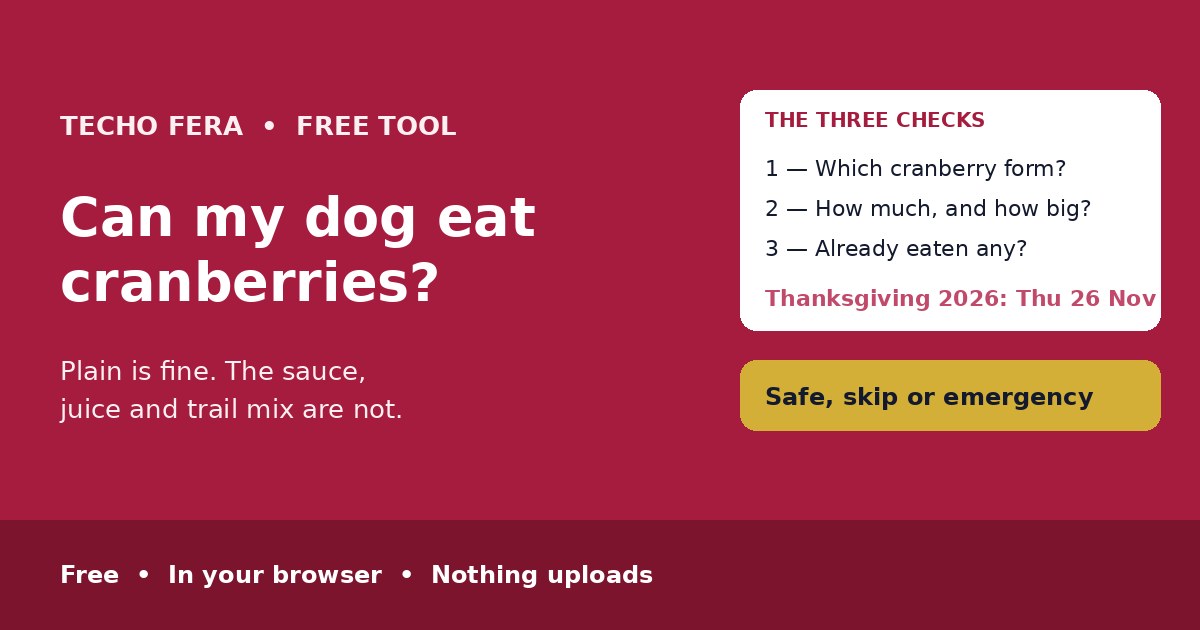
The rule is the form, not the berry. Plain fresh or dried cranberries are not toxic to dogs and are fine in small amounts — two or three berries for a small dog under 22 lb (10 kg), a small handful for a medium or large dog. Cranberry sauce, cranberry juice and sweetened dried cranberries are mostly sugar and should be skipped. Trail mix, cranberry sauce with raisins or grapes, cranberry-grape juice and anything sugar-free with xylitol are emergencies. This checker asks five questions — which form, how much, how big your dog is, any health condition, and whether the dog has already eaten any — and gives one verdict: safe in a small amount, skip it, or emergency.
To use it:
- Pick the form. Choose it from the list — raw fresh berries, unsweetened dried, thawed frozen, sweetened dried, sauce, juice, a supplement, trail mix, sauce with raisins, a grape juice blend, or a sugar-free product. The list covers 11 forms, grouped by what they are: safe when plain, skip, or emergency.
- Say how much. A few berries, a small handful, a lot, or not sure. The amount changes the answer — a lot of plain berries at once upsets the stomach, and a handful is already too many for a small dog.
- Say how big your dog is. Size decides the portion: two or three berries for a small dog under 22 lb (10 kg), a small handful — about five to eight berries — for a medium dog of 22 to 55 lb (10 to 25 kg), and a small handful — about eight to ten berries — for a large dog over 55 lb (25 kg). Treats should stay under about 10% of the dog's daily calories.
- Say whether the dog has a health condition. Diabetes, kidney or bladder stones, a sensitive stomach or medication changes the answer — with any of those, this is a vet question, not a snack question, and the checker says so instead of giving a portion.
- Say whether the dog has already eaten any. Planning to share gives you the safe-or-skip verdict. Already ate switches the answer to what to do now — watch for symptoms, call a poison line, or go to an emergency vet, with the numbers on the page.
The forms at a glance
| Form | Verdict | Why |
|---|---|---|
| Raw fresh cranberries | Safe, small amount | Not toxic; wash, remove stems, cut up for small dogs |
| Dried, unsweetened | Safe, small amount | Check the packet: cranberries only, no sugar, no raisins |
| Frozen, thawed | Safe, small amount | Same fruit — thaw first, cut up for small dogs |
| Dried, sweetened (Craisins) | Skip | Mostly sugar; upsets the stomach |
| Cranberry sauce | Skip | Mostly sugar; may hide grapes, raisins or brandy |
| Cranberry juice | Skip | Sugar and additives; never a UTI treatment |
| Cranberry supplement | Ask your vet | Dose is product-specific; check the label for xylitol |
| Trail mix with cranberries | Emergency | Raisins look identical to cranberries and are toxic |
| Sauce with raisins or grapes | Emergency | Grapes and raisins can cause kidney injury |
| Cranberry-grape juice blend | Emergency | Contains grape juice — no safe amount |
| Sugar-free (xylitol) | Emergency | Xylitol causes low blood sugar and liver damage |
What makes this checker different
The pages that rank for this search are guides — PetMD, Chewy, AKC, a vet blog and a pet-food brand. Every one of them gives you the same static answer — "yes, in moderation" — and leaves you to work out what it means for your dog, your form and your timing. None of them asks how much, how big your dog is, whether it has a health condition, or whether the dog has already eaten any — and none of them tells you what to do next when the answer is bad. There is no free, standalone checker that takes a cranberry form, an amount, your dog's size and health and the timing and gives you one verdict with the reason, the portion, and the emergency numbers when they matter. This page is that answer: five questions, an instant verdict for your exact dog, the blockers named, and the next steps. It is general information, so it says plainly what it cannot know: it cannot see your dog or your bowl, and where the guidance is thinner — how much the dog actually ate, how it is feeling — it tells you to call a vet or a poison line instead of guessing.
When is this the right check?
When your dog is eyeing the cranberries on the table and you are not sure whether the form in front of you is safe — because the plain berry and the holiday sauce have opposite answers, and guessing wrong can mean a poisoning. When you are about to share a few berries — because the portion depends on your dog's size, and a handful is already too many for a small dog. When the dog has already helped itself to the trail mix or the sauce — because the checker switches to what to do now, and for raisins, grapes or xylitol, now means an emergency vet. And when a guest offers the dog something cranberry-flavoured — because this page is the quick check you can run before you say yes.
Honest limitations
General information, not veterinary advice
This checker cannot see your dog or your bowl. It cannot tell you how much your dog actually ate, how your dog is feeling, or whether your dog has a condition that changes the answer — only your vet can. If you think your pet is in danger, go to the nearest emergency animal hospital.
The 10% rule is a guide, not a prescription
Treats should stay under about 10% of a dog's daily calories, and the portions here are sized by weight — but a dog with diabetes, kidney or bladder stones or a sensitive stomach needs stricter rules. If your dog has a health condition, ask your vet before sharing anything.
Not sure means the cautious answer
If you are not sure how many berries the dog had, the checker names the safe portion and tells you to count what is left — and if you are not sure about the dog's health, it tells you to ask your vet. That is deliberate: the safe mistake is to skip a berry that was actually fine.
Symptoms can take time
After too many cranberries, watch for vomiting, diarrhoea, lack of appetite, lethargy or a painful or distended stomach. After grapes or raisins, get the dog seen in person even if it seems fine. A dog that looks fine right after eating something toxic is not necessarily fine — the checker says so instead of reassuring you.
Poison lines may charge a fee
ASPCA Animal Poison Control charges a consultation fee, and Pet Poison Helpline charges a per-incident fee. Both take calls every day, including Thanksgiving. Save the numbers in your phone before dinner, not during an emergency.
Rules from PetMD, Chewy and AKC, dated November 2026
The rules here are the PetMD, Chewy and AKC guidance as it reads in November 2026: plain cranberries in small amounts, the 10% rule, the portion by size, the sugar and xylitol warnings, the raisin look-alike trap, and the poison-line numbers. Guidance changes: recheck with your vet if anything about your dog changes.