How the fireworks rules work
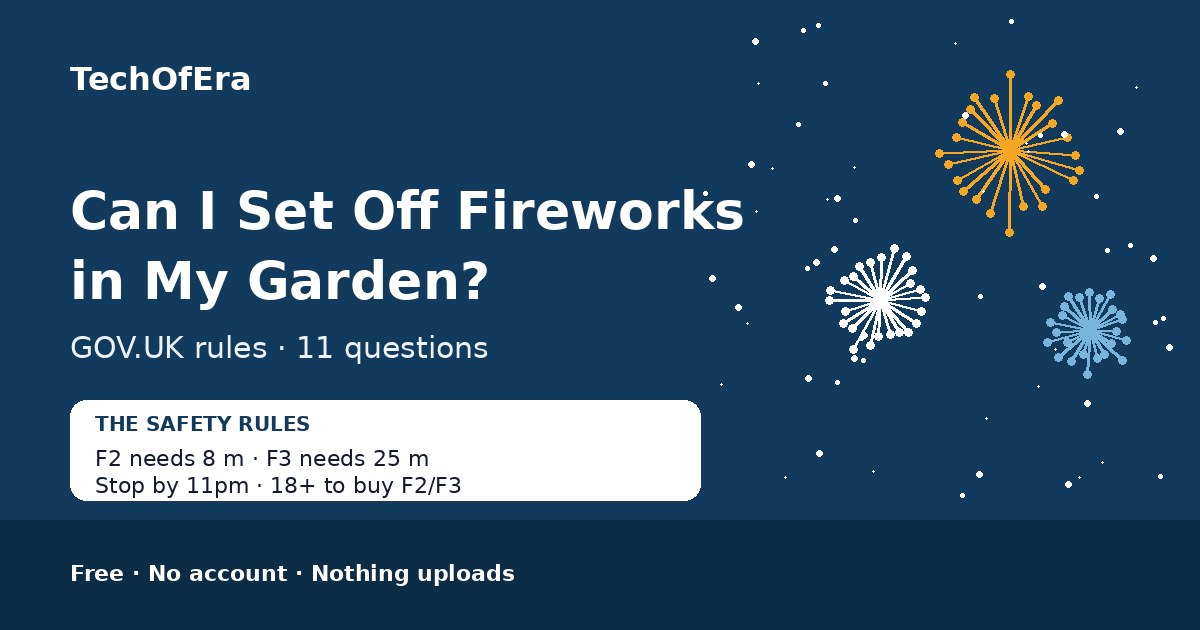
The fireworks rules fit on one card, and they come from GOV.UK’s fireworks law guide, the Fireworks Regulations 2004 and the Pyrotechnic Articles (Safety) Regulations 2015: in England and Wales you can set off fireworks on private land — your garden counts — on any night of the year, but not between 11pm and 7am, except on Bonfire Night (until midnight) and on New Year’s Eve, Diwali and Chinese New Year (until 1am). You must be 18 or over to buy or possess F2 and F3 fireworks, and it is against the law to set off fireworks, including sparklers, in a street or any other public place. The space you need depends on the category: spectators must stand at least 1 metre from F1 fireworks, 8 metres from F2 fireworks and 25 metres from F3 fireworks. F4 fireworks are for professionals only and are not sold to the public. Scotland adds a licence to buy F2 or F3 fireworks and Firework Control Zones; Northern Ireland needs a licence to buy, possess and use any fireworks. This checker runs your garden’s exact setup against those rules, and names every fix.
Safe distances by firework category
| Category | What it is | Spectator distance | Where it fits |
|---|---|---|---|
| F1 | Sparklers, party poppers, indoor fountains | At least 1 metre | Any garden, even a small one |
| F2 | Garden fireworks | At least 8 metres | A garden with 8 metres of clear space |
| F3 | Display fireworks | At least 25 metres | A large garden or open space only |
| F4 | Professional fireworks | Professional only | Not sold to the public |
Distances from the Pyrotechnic Articles (Safety) Regulations 2015 and BS EN 15947. The distance is from the firework to the nearest person watching — not to the fence.
To use it:
- Pick your country. The rules change from country to country — the UK curfew, the German New Year window, the Australian ban — so the checker starts there.
- Pick your firework category. Check the label on the box: F1, F2, F3 or F4. The category decides how far away spectators must stand.
- Say how much space you have. Measure the distance from the firing point to the nearest person watching, and to the nearest building, tree or fence.
- Say which night and what time. In the UK the curfew is 11pm on an ordinary night, midnight on Bonfire Night, and 1am on New Year’s Eve, Diwali and Chinese New Year.
- Say whether you are 18 or over, whether the neighbours know, whether pets are indoors, what the weather is like, and whether you have run a display before. Each one changes the verdict.
What makes this checker different
The pages that rank for this search are guides — retailer blogs, a solicitor’s guide and a council page — that all give the same flat answer: yes, fireworks are legal in your garden, with the curfew and the 18+ rule. That is the right answer in general, but it is not the whole question. Whether your garden display is legal and safe turns on your exact setup: your country, your firework category, how much space you have, what time it is, whether the neighbours know, whether the pets are in, and whether it is windy. There is no free, standalone checker that takes your garden’s exact setup and gives you a verdict for it: go ahead, not tonight with the fixes named, or don’t light them — plus a safe-distance plan for your category and the rules for your country. This page is that answer: eleven questions, an instant verdict for your exact garden, the blockers named, and the next steps. It is a self-assessment, so it says plainly what it cannot know: it cannot see your garden, read your firework labels, or check your local rules, and where the guidance depends on a detail it does not ask about — whether your street is in a Scottish Firework Control Zone, for example — it says so instead of guessing.
When is this the right check?
Before you buy fireworks — run the checker with the category on the box, because the category decides whether your garden is big enough. Before Bonfire Night or New Year’s Eve — because the night decides the curfew, and the neighbours and pets need warning in good time. When you move house — because the garden size, the neighbours and the local rules change with the house. When the weather turns — because a calm evening can become a windy one, and wind is the one condition that turns a garden display into a fire risk. And after a firework fails to go off — never go back to it, soak it in water after half an hour, and re-check before you light anything else.
Honest limitations
A self-assessment, not legal advice
This checker cannot see your garden, read your firework labels or check your local rules. It cannot know whether your street is in a Scottish Firework Control Zone, whether your town has its own ban, or whether your housing agreement forbids fireworks. If you are unsure, check your council or local authority — do not guess.
The safety distance is a minimum, not a target
At least 1 metre for F1, 8 metres for F2 and 25 metres for F3 is the distance every safety body gives — but more distance is always safer, and where your firework’s label asks for more, follow the label. A display that only just clears the rule is not the same as a display with room to spare.
Rules from official sources, dated November 2026
The rules here are GOV.UK’s fireworks law guide, the Fireworks Regulations 2004 and the Pyrotechnic Articles (Safety) Regulations 2015, as they read in November 2026. Guidance changes: recheck with your council if anything about your display changes.
Never go back to a firework once it has been lit
This checker does not ask whether a firework failed to go off, so its verdict does not cover it. A firework that seems to have gone out can still explode: leave it alone for at least half an hour, then soak it in water. Never try to relight it.
Wind is the one condition that overrules everything
A display that fits every other rule is still a no in strong wind. Wind carries sparks and debris onto roofs, into trees and over fences, and it can blow a rocket off course. If you have to hold your hair back, it is too windy — wait for a calm night.
Your country’s rules may be stricter than this page
This checker covers the UK rules in detail and the headline rules for the US, Canada, Australia, Germany and the EU — but it cannot know your state, city or town rules. In the United States the law is state by state and city by city, and in Canada many cities require a permit. Check locally before you buy.