Can you pass your exam?

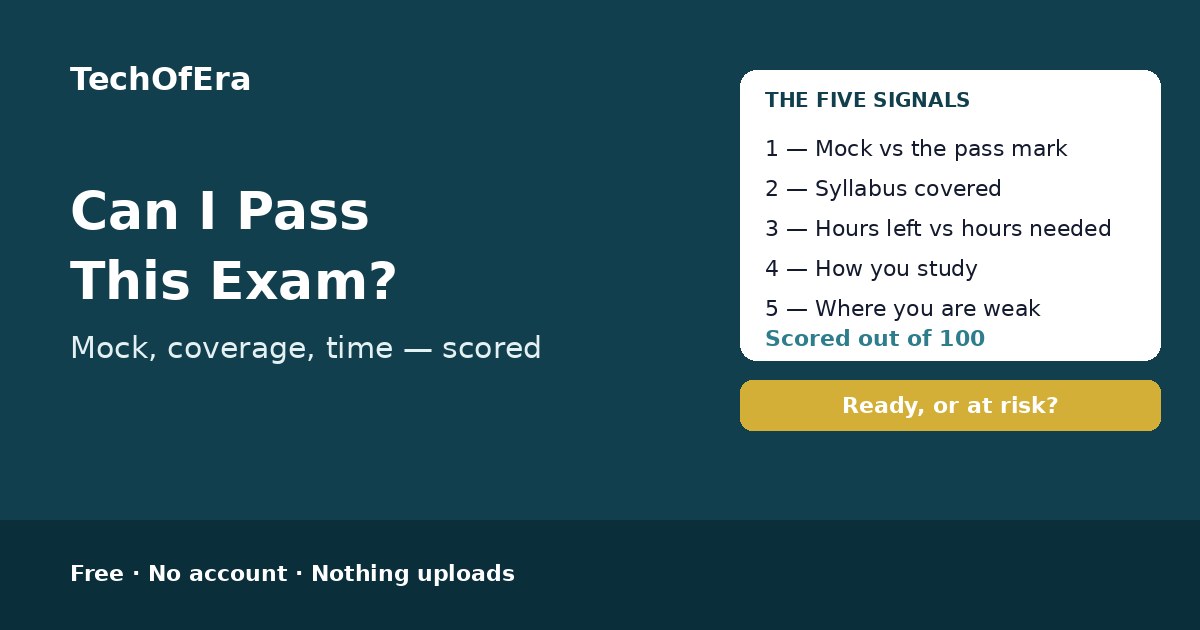
An exam is coming and you want an honest answer — not a pep talk. Enter your latest mock score, how much of the syllabus you have covered and how many days are left, and get a readiness score out of 100, a verdict — ready, on track, at risk, or unlikely — and the plan that closes the gap. Free, in your browser, nothing uploads.

  • Readiness score out of 100
  • Mock vs pass mark, measured
  • Timed-mock rule built in
  • Free, no account, nothing uploads
Can you pass your exam? Check it in seconds.

Check whether you can pass your exam

Try a preset:
0 of 10 answered

Your result

Answer the questions Your verdict appears here as you answer.
Your readiness, in numbers

Enter your syllabus coverage, your latest mock score and the days left, and the numbers will appear here — the gap to close, the hours you have, and the hours you need.

Blockers

Things that do not fit

Things to check

Still to confirm

What to do next

    Your result summary


    Answer the questions above — the verdict updates live.

    Privacy you can verify, not just trust

    Checking whether you can pass an exam by uploading your mock scores, your weak topics and your study plan to a website would be backwards — the check should never be the leak. This one can't: your answers are checked with plain JavaScript on your device, and they never leave the device — the only third-party requests are the site's own analytics, which count page views. Don't take our word for it:

    New cross-origin requests during use: 0
    1. Press F12 to open developer tools, then the Network tab.
    2. Answer a question above. Watch: apart from the site's analytics, nothing new is requested — no uploads, and no data ever leaves your device.
    3. Extra credit: disconnect your internet after this page loads — the checker still works.

    How the pass check works

    An exam is coming and you want an honest answer: can you pass it? The pages that rank for this search are mostly guides — how to revise, how to pass a specific exam — or score calculators that take a score you already have and tell you whether it passed. None of them answers the question students actually ask before the exam: given where I am now, will I pass? This checker scores your readiness out of 100 from five things: your latest mock score against the pass mark, how much of the syllabus you have covered, whether the study hours you still have cover the hours you need, how you study, and where your weak areas are. The score is a readiness score, not a probability of passing — no tool can quote a precise chance, because real exams draw different questions and are scored on different forms, and no practice platform sees enough real exam results to calibrate one honestly. That warning comes from SaveMyCert’s readiness guidance, published in November 2026.

    To use it:

    1. Pick your exam type and the pass mark. School tests often use 40–50%, many US courses use 60% as the lowest passing grade, and professional and licensing exams frequently need 70–80%. If you do not know the pass mark, the checker assumes 50% and says so.
    2. Enter your syllabus coverage. Count the topics you could explain without your notes, not the pages you have read. Be honest — the verdict is built on this number.
    3. Enter your latest mock or past-paper score, and say whether it was timed. A timed mock under exam conditions is the single best predictor of the real result; an untimed mock, or one sat with notes open, overstates readiness.
    4. Enter the days left and the hours a day you can really study. The checker turns them into a total and compares it with the hours you need — about 30 minutes per uncovered syllabus point, plus about 90 minutes per point of mock-score gap.
    5. Say how you mostly study. Past papers, flashcards and self-testing are the high-utility techniques in Dunlosky et al. 2013; rereading notes and highlighting are low utility.
    6. Say where your weak areas are. Your last mock paper shows it: the topics where you lost the most marks are the weak ones, whatever they feel like.
    7. Say how much of the grade the exam carries. If it is the whole grade, the margin matters more; if it is half or less, other components can carry some of it.

    What makes this checker different

    The tools that rank for this search answer a different question. The pass-or-fail calculators take a score you already have — 42 out of 50, say — and tell you whether it passed, and what you would need on the final to pass the class. The exam prep platforms — PrepPass, MockDen, SaveMyCert — give you a readiness score, but only inside their own question banks, for their own exams, usually behind an account or a paid plan. None of them takes your own numbers for any exam — your mock score, your coverage, your days left, your method — and turns them into a verdict with a plan. This page is that answer: ten questions, a readiness score out of 100, and the specific steps that move it — drill the weakest topic, swap rereading for past papers, cut the lowest-weight topics, sit another timed mock. It is a self-assessment, so it says plainly what it cannot know: it cannot know the real paper, how hard your exam board sets it, or how you perform under pressure.

    When is this the right check?

    When you have just got a mock result back and want to know what it means — whether the gap to the pass mark is closable in the days left, or whether the plan has to change. When you are halfway through revision and the plan feels wrong but you cannot say why — the hours-available-versus-hours-needed comparison names the problem. When you are deciding whether to book the exam, or to defer it to a later sitting — the verdict is the evidence for that conversation with your teacher or tutor. And the night before the exam, when the question is whether to keep cramming or to sleep — if the mock already clears the pass mark with margin, sleep wins; this checker tells you which side of that line you are on.

    Honest limitations

    A readiness score, not a probability

    A score of 85 does not mean an 85% chance of passing, and a score of 45 does not mean a 45% chance. No tool can quote a precise chance of passing, because real exams draw different questions and are scored on different forms. The score weighs your mock, your coverage, your time, your method and your weak areas together — but only the real paper decides the result.

    A self-assessment, not a prediction

    This checker cannot know the real paper, how hard your exam board sets it, or how you perform under pressure. It scores the answers you give against the published study research — it cannot tell you what the exam will ask, and it is not exam advice. Check your syllabus and your exam board for the pass mark and the paper format.

    The hours you need are a rule of thumb

    The time check assumes about 30 minutes per uncovered syllabus point and about 90 minutes per point of mock-score gap. That is a stated rule of thumb, not a measured fact: some topics take an evening, some take twenty minutes. Treat the hours as a planning aid, not a timetable.

    The pass mark is assumed when you do not know it

    If you do not enter a pass mark, the checker assumes 50% and says so. School tests often use 40–50%, many US courses use 60%, and professional exams often need 70–80% — but your exam board is the authority. If the real mark is higher than the assumed one, the verdict is too kind.

    An untimed mock overstates readiness

    A mock sat without a timer, or with notes open, is not the same evidence as a timed one. The checker docks the score for an untimed mock, but it cannot know by how much the real conditions would have lowered it. Sit the next one under strict timed conditions before you trust the number.

    Rules from published findings, dated November 2026

    The rules here are the study research of Dunlosky et al. 2013, the readiness guidance of SaveMyCert and PrepPass, and the pass-mark ranges for school, college and professional exams, as they read in November 2026. Exam boards change their papers and their boundaries: recheck with your syllabus and your teacher if anything about your exam changes.

    Frequently asked questions

    Can I pass this exam?

    It depends on three numbers: your latest mock score against the pass mark, how much of the syllabus you have covered, and whether the study hours you still have cover the hours you need. If your mock already clears the pass mark with margin, your coverage is above 90%, and the time fits, you can pass — sit one more timed mock on unseen questions to prove it. If your mock is below the pass mark or your coverage is low, the gap is closable only if the days left hold enough hours. This checker scores all five signals — the mock, the coverage, the time, how you study, and your weak areas — and gives you the verdict with the plan that moves it.

    What mock score do I need before the real exam?

    Aim to clear the pass mark by at least 5 points on a timed mock, on questions you have not seen before. The readiness guidance from SaveMyCert, published in November 2026, is two consecutive full-length timed mocks that both clear the pass mark with margin, with no exam domain far behind. A mock that scrapes over the line says you would pass about half the time, and a score earned on questions you have already answered measures your memory of that question bank, not your knowledge. Sit your mocks under strict timed conditions, with no notes, or the number overstates how ready you are.

    How much of the syllabus do I need to cover to pass?

    Aim for 90% or more. Below 75% the uncovered topics start costing you real marks, and below 60% a third of the paper is a guess. Coverage is not pages read — it is the share of topics you could explain without your notes. Rank the uncovered topics by how much of the exam they carry and work through them in that order: a weak topic worth 20% of the paper is worth four times a weak topic worth 5%. If time is short, drop the lowest-weight topics on purpose and spend every hour on the ones that carry marks.

    Is rereading my notes enough to pass?

    Usually not. In Dunlosky and colleagues’ 2013 review of study techniques, practice testing and distributed practice were the two high-utility techniques, while rereading and highlighting were low utility: they feel like learning and measure almost nothing. Rereading tells you that you recognise the material, not that you can reproduce it under exam conditions. Swap at least half of your rereading for past papers and self-testing — close the notes, explain the topic out loud, or answer five questions on it cold — and the mock score will move faster than the hours will.

    How many hours a day should I study before an exam?

    As many honest hours as you will actually do, not the hours you wish you would. This checker turns your days left and hours per day into a total and compares it with the hours you need — about 30 minutes per uncovered syllabus point, plus about 90 minutes per point of mock-score gap — and tells you whether the plan fits. If it does not fit, either add real hours or cut the lowest-weight topics on purpose. Short, tested sessions beat long rereading days: an hour of past papers under time teaches more than three hours of reading notes.

    Does this checker tell me my chance of passing?

    No — and no honest tool can. A readiness score is not a probability of passing, because real exams draw different questions and are scored on different forms, and no practice platform sees enough real exam results to calibrate a precise chance honestly. That warning comes from SaveMyCert’s readiness guidance, published in November 2026. What this checker gives you is a readiness score out of 100 from your mock, your coverage, your time, your method and your weak areas — plus the specific plan that moves the score — and it says plainly where the estimate ends.

    What should I do if the checker says I am unlikely to pass?

    Triage, and find out about the resit today. Cover only the highest-weight weak topics, drill them with past papers, and accept that the lowest-weight topics will go unrevised — a partial plan you finish beats a full plan you abandon. Then find out whether a resit or a later sitting exists, what it costs, and when it is: knowing the fallback takes the panic out of this attempt. And tell your teacher or tutor where you stand — they can say which topics to cut and whether the exam can be deferred, and they would rather hear it now than after the results.