How the candle safety rules work
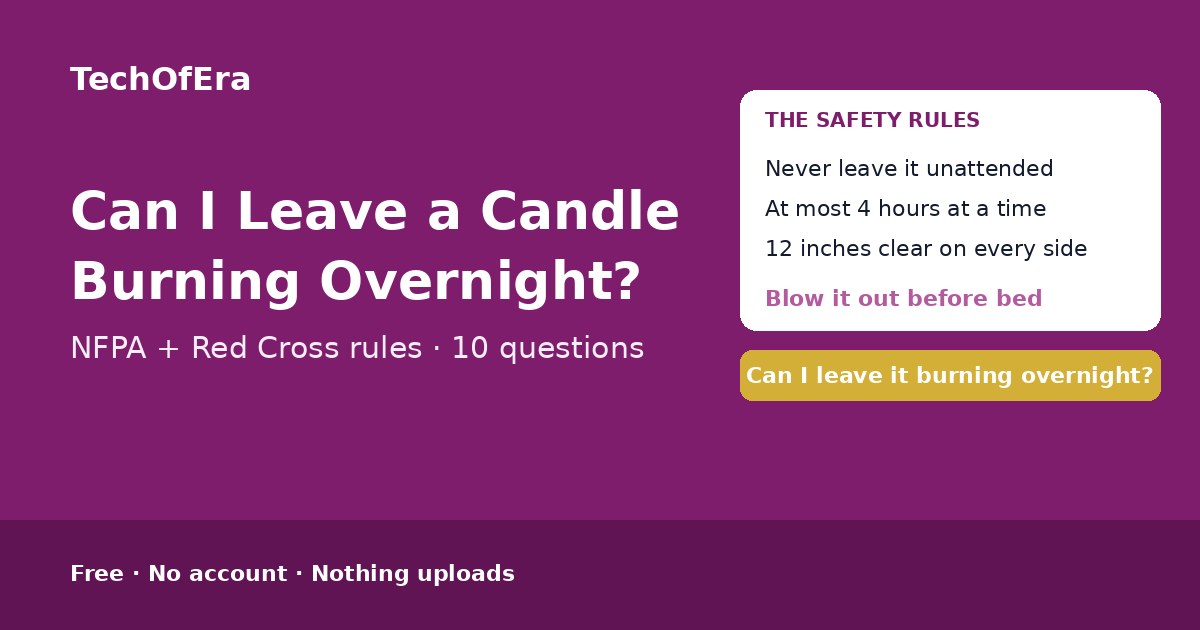
The candle safety rules fit on one card, and they come from the National Fire Protection Association, the American Red Cross and the U.S. Fire Administration: never leave a burning candle unattended; never use one in a bedroom or any room where people might fall asleep; keep it at least 12 inches (about 30 cm) from anything that can burn; burn it on a stable, heat-resistant surface in a proper holder, away from draughts; keep it out of reach of children and pets; trim the wick to a quarter of an inch before each burn; and burn it for at most 3–4 hours at a time, then let it cool for at least 2 hours. The rules exist because the numbers are stark: the NFPA counts an average of 7,610 home fires a year from candles in the United States, with about 81 deaths, 677 injuries and $278 million in damage — and nearly half of those fires start because something that can burn is too close to the flame. The bedroom is where most candle-fire deaths happen, because the person inside is asleep and cannot respond. This checker runs your candle’s exact setup against those rules, and names every fix.
To use it:
- Say when the candle will burn. Only while you are awake and in the room is the only safe answer — while you sleep, while you are out of the room, or all night with nobody there are all “blow it out”.
- Say how long it will burn at a time. Under 1 hour and 1–4 hours are inside the safe limit; more than 4 hours breaks the rule, and all night is never safe for any candle.
- Say what kind of candle it is. A jar, a pillar, a taper or a tea light — each one gets its own burn-time plan, because a taper burns about 1–2 hours per inch and a tea light only 3–5 hours in total.
- Say how far the nearest thing that can burn is, what the candle sits on, and whether it is near a draught. At least 12 inches (about 30 cm) clear on all sides, on a stable, heat-resistant surface, in still air.
- Say whether it has a proper holder, whether pets or children can reach it, whether the wick is trimmed, and whether a working smoke alarm is in the room. Each one changes the verdict — and a missing smoke alarm is a fix, not a shrug.
What makes this checker different
The pages that rank for this search are guides — sleep and candle blogs that all give the same flat answer: no, do not leave a candle burning overnight. That is the right answer for overnight use, but it is not the whole question. A candle burned while you are awake and in the room can be safe — if the type, the burn time, the clearance, the holder, the draughts, the surface and the wick are all right. The only calculator that ranks is a candle-maker’s burn-time calculator: it estimates a candle’s total life from burn-test weights, and it says plainly that its result is not a safe continuous-burn time. There is no free, standalone checker that takes your candle’s exact setup and gives you a verdict for it: blow it out, not safe yet with the fixes named, or safe as described — plus a burn-time plan for your candle type. This page is that answer: ten questions, an instant verdict for your exact candle, the blockers named, and the next steps. It is a self-assessment, so it says plainly what it cannot know: it cannot see your candle, your holder or your room, and where the guidance depends on a detail it does not ask about — how much wax is left, for example — it says so instead of guessing.
When is this the right check?
Before you light a candle in the evening — run the checker while you set the candle out, because the clearance, the holder, the surface and the smoke alarm are all decided before the first match. When you buy a new candle — because the type decides the burn-time plan, and a taper is never an overnight candle. When you move a candle to a new room — because the clearance, the draughts, the surface and the smoke alarm change with the room. When you are tempted to leave it burning overnight — because the checker will tell you plainly that no candle is made for that, and what to use instead. And after you notice the flame flare, the wick mushroom or the jar crack — blow it out, trim the wick or replace the holder, and re-check before relighting.
Honest limitations
A self-assessment, not fire-safety advice
This checker cannot see your candle, your holder or your room. It cannot check whether the wick is trimmed, whether the holder is cracked, or whether the smoke alarm works. If you are unsure, check the maker’s instructions or ask your local fire service — do not guess.
The 12-inch rule is a minimum, not a target
At least 12 inches (about 30 cm) is the distance every safety body gives — but more distance is always safer, and where your candle’s maker asks for more, follow the maker. A candle that only just clears the rule is not the same as a candle with room to spare.
The 4-hour limit is an estimate, not a guarantee
Most candles burn safely for up to 3–4 hours at a time, but the exact safe time depends on the candle: its wax, its wick, its size and its holder. A candle that flares, smokes or mushrooms its wick is telling you to blow it out early — do not wait for the 4-hour mark.
A smoke alarm does not make an unsafe candle safe
A working smoke alarm is your warning if something goes wrong — it is not a substitute for the rules. A candle burning overnight, close to curtains, in a cracked jar, or in a draught is dangerous with or without an alarm. The rules come first.
Stop when half an inch of wax is left
This checker does not ask how much wax is left, so its verdict does not cover it. Stop burning any candle when about half an inch (about 1 cm) of wax is left — a candle burned low can overheat its jar or holder and crack it.
Rules from official sources, dated November 2026
The rules here are the NFPA’s candle fire data, the American Red Cross candle safety guidance and the U.S. Fire Administration’s advice, as they read in November 2026. Guidance changes: recheck with your candle’s maker if anything about your candle changes.