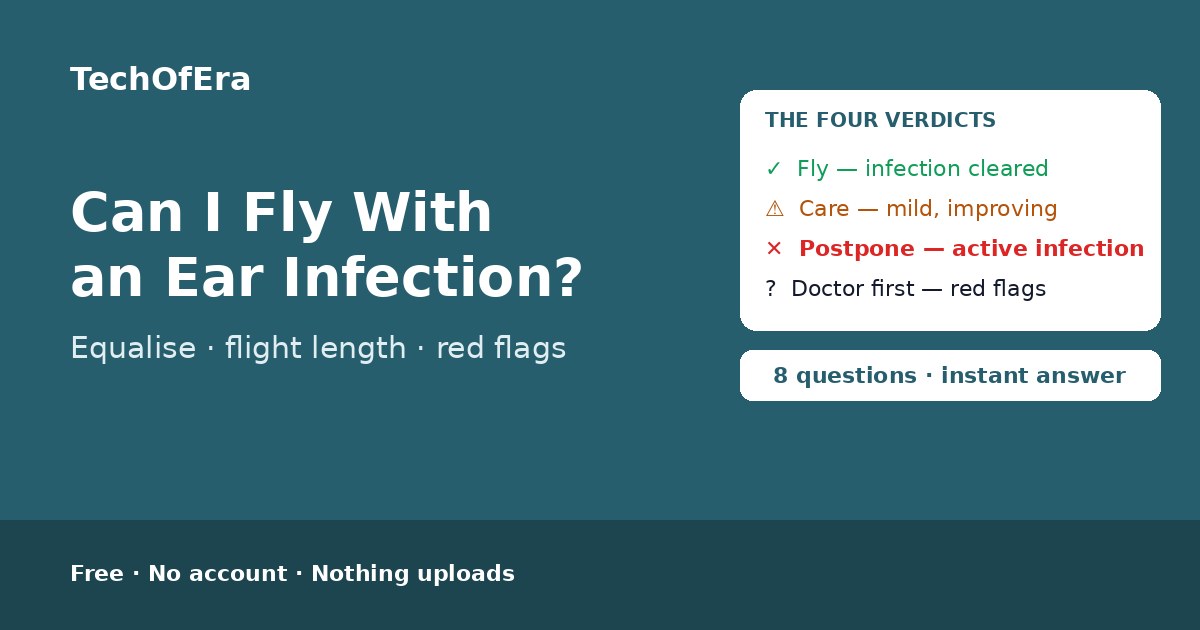
How to decide whether to fly with an ear infection
Aircraft cabins are pressurised to the equivalent of roughly 6,000 to 8,000 feet above sea level. On every ascent and descent, your Eustachian tubes — the narrow tubes between your middle ear and the back of your nose — must equalise the pressure in your middle ear. An infection swells or blocks those tubes, so equalisation fails and pressure builds behind the eardrum. The result ranges from significant pain to, in rare cases, a ruptured eardrum. Descent is the highest-risk phase: pressure rises fastest then, and a blocked tube cannot let air back in. This checker asks exactly what decides it.
To use it:
- Find out which part of your ear is infected. A middle ear infection (otitis media, behind the eardrum) is much riskier to fly with than an outer ear infection (swimmer’s ear, in the ear canal). Only a doctor with an otoscope can tell for sure — if you do not know, get it checked before you fly.
- Try to clear your ears. Swallow, yawn, or pinch your nose and blow gently. If your ears pop easily, the tube is open. If you cannot clear them on the ground, you will not be able to in the air — and Qantas does not accept passengers who cannot clear their ears.
- Watch for the red flags. A perforated eardrum, fluid or pus draining from the ear, severe pain, dizziness or balance problems, or a child with an ear infection are not postponement questions — they mean see a doctor before you fly.
- Check the fever and the stage. A fever means the infection is active. Most ear infections clear up within 3 days to a week (NHS), and doctors generally advise waiting at least 5 to 7 days after starting antibiotics before flying.
- Weigh the flight length. A short flight under 2 hours with a mild infection may be tolerable. A long flight over 5 hours with a moderate infection carries real risk of injury — postpone it if you can.
- Use the pressure techniques if you fly. Swallow often, chew gum, yawn, and pinch your nose and blow gently (Valsalva) during take-off and descent. Take a decongestant an hour before take-off and descent if your doctor agrees it is suitable for you.
Ear infection situations and what to do at a glance
The table below is built from the same rules as the checker, so it can never disagree with your verdict. Which part of the ear is infected, whether you can equalise, and how bad the symptoms are decide together with flight length.
| Ear infection situation | Verdict | What to know |
|---|
What makes this checker different
The pages that rank for this search are guides — thorough explanations of barotrauma, the 6,000–8,000-foot cabin equivalent, and the advice to postpone — but they leave you to work out what that means for the infection you have right now: whether your infection is outer or middle, whether being able to clear your ears changes the answer, whether a two-hour flight is different from a ten-hour one, whether being three days into antibiotics is different from being one day in, and whether a child is different from an adult. They also rarely name the red flags — a perforated eardrum, drainage, dizziness — that mean see a doctor rather than just postponing. This page is that answer: eight questions, an instant verdict, the reason named, and the red flags stated plainly instead of buried in the text — with nothing to install, no account, and nothing uploaded. It is a self-assessment, so it says plainly what it cannot know: a web page cannot look inside your ear, so anything you mark “Not sure” stays on the list until you confirm it.
When is this the right check?
Whenever you have an ear infection and a flight booked: the earache the morning of a business trip, the swimmer’s ear the day before a holiday flight, the child who woke up tugging at their ear the night before you fly. Also whenever you are deciding whether to move a flight: the checker tells you whether a few days’ delay is likely to solve it — most ear infections clear within 3 days to a week — or whether you need a doctor first. And whenever you are not sure what counts: outer versus middle, mild discomfort versus severe pain, being able to clear your ears with effort versus not at all. If the answer is “postpone”, the checker names the return rule too — symptoms clearly improving, able to equalise by swallowing, no fever or drainage.
Honest limitations
A self-assessment, not a diagnosis
This checker works only from the answers you enter. It cannot diagnose you — no web page can look inside your ear, measure the pressure in it, or know your medical history. If an answer is wrong, the verdict is wrong. When in doubt, postpone — or ask a doctor.
There is no medical ban
No health authority forbids flying with an ear infection outright. Mayo Clinic advises not flying if you can avoid it, and the CDC says travellers might choose to postpone — but the final decision on carrying a passenger belongs to the airline (UK Civil Aviation Authority). This checker gives the safe call, not a rule.
Red flags override everything
A perforated eardrum, fluid or pus draining from the ear, severe pain, dizziness or balance problems, or a child with an ear infection are not postponement questions — they mean see a doctor before you fly. A doctor can only see the eardrum in person, with an otoscope.
The equalisation test is the practical one
If you cannot clear your ears by swallowing or yawning on the ground, you will not be able to in the air. But passing it on the ground does not guarantee the tube will stay open for a whole long flight — especially on descent, the highest-risk phase.
Decongestants help, they do not clear you
A decongestant an hour before take-off and descent can help a partly blocked tube — but it does not make a blocked tube open, and it does not make an active infection safe to fly with. If you cannot equalise, postpone instead of relying on a spray.
Rules from named health sources
The rules here follow Mayo Clinic guidance, the CDC Yellow Book, NHS guidance, Qantas fit-to-fly rules and UK Civil Aviation Authority guidance, as they read in November 2026. Guidance can be revised, so re-check if a new edition appears.