How much salt goes in pasta water
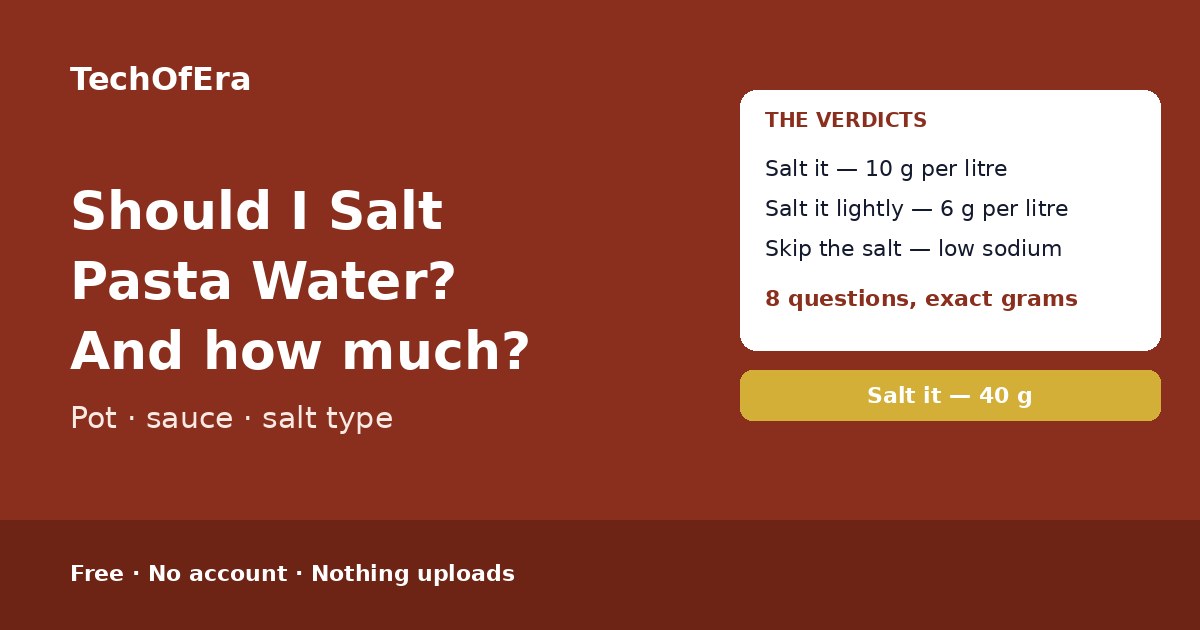
The rule the guides agree on is the Italian 1, 10, 100 rule: 1 litre of water, 10 g of salt, 100 g of pasta. That is about 1% salinity — enough to season the pasta from the inside out, without making it taste salty on its own. Anywhere from about 0.8% to 1.5% works; 1% is the safe middle. The guides that rank for this search all give you that one number, and then leave you to adjust it yourself: less for a salty sauce, less for fresh pasta, less for children, and a different spoon measure for every salt in the cupboard. This checker does that work for you: pick your pasta, your sauce and your salt, and it gives you the exact grams for the pot in front of you.
To use it:
- Pick your pasta. Dried, fresh, filled or gluten-free. Fresh pasta absorbs salt faster and cooks in minutes, so it needs a little less; filled pasta has delicate seams and a filling that is already seasoned.
- Say how much water is in the pot. The salt is measured per litre of water, not per portion, so the pot size decides the total grams. Four litres is the usual pot for a pound of pasta.
- Say how salty the sauce is. This decides the amount more than anything else. A plain butter sauce wants the full 10 g per litre; a pecorino- loaded cacio e pepe wants about 6 g.
- Say who is eating. Young children and anyone watching their sodium get a lower amount — and a doctor-advised low-sodium diet means skipping the salt entirely.
- Pick your salt. A teaspoon of one salt weighs twice as much as another: table salt about 6 g, Morton kosher about 5 g, Diamond Crystal kosher about 3 g. The checker converts the grams into spoon measures for the salt you actually have.
- Add it at the boil, not before. Bring the water to a full rolling boil, add the salt, stir, wait for the boil to come back, then add the pasta. Taste the water first: it should taste like a pleasantly seasoned broth, not like the sea.
Salt by water volume and sauce
The table below is built from the same rules as the checker, so it can never disagree with your verdict. Mild and normal sauces share the standard 10 g per litre; a very salty sauce drops to 6 g per litre. Spoon measures are for table salt.
| Water | Mild or plain sauce | Normal sauce | Very salty sauce |
|---|
What makes this checker different
The pages that rank for this search are guides — thorough explanations of how much salt goes in pasta water, written by cooks and food writers — but they give you one static number and leave you to adjust it yourself: less for a salty sauce, less for fresh pasta, a different spoon measure for every salt in the cupboard. There is no free interactive checker that takes your actual pot — your pasta type, your water volume, your sauce, who is eating, and which salt you have — and turns it into an exact number of grams. This page is that answer: your pot in, the exact grams out, with the spoon measure for your salt and the reason for every adjustment — plus an honest verdict when the right answer is to skip the salt. It is a self-assessment, so it says plainly what it cannot know: a web page cannot taste your pasta water, so anything you mark “not sure” stays on the list until you decide it.
When is this the right check?
Whenever the salt is about to go in and you are not sure how much: the weeknight spaghetti with a sauce you have not made before, the cacio e pepe where the pecorino is already salty, the ravioli you do not want to burst, the pot you are cooking for a toddler, the low-sodium dinner a doctor asked for, the big pot for a crowd where a guess would be a big mistake, or the first time you have switched salts and the spoon measure you always used is suddenly wrong. This is not a pasta timer — it answers whether and how much salt, not how long to cook. For the timing, use the packet time and taste a strand a minute before it is due.
Honest limitations
A self-assessment, not a tasting
This checker works only from the pasta and answers you enter. It cannot taste your pasta water — no web page can know how salty your pot actually is. If your answer is wrong, the verdict is wrong. When in doubt, taste the water before the pasta goes in.
Salt weights vary by brand
A teaspoon of one salt weighs twice as much as another, and the weights here are the published averages — table salt about 6 g, Morton kosher about 5 g, Diamond Crystal about 3 g. If you have kitchen scales, weigh the salt: a scale beats a spoon for this job, every time.
Not medical advice
This checker gives general cooking guidance. A doctor-advised low-sodium diet means skipping the salt in the water — and that advice comes from the doctor, not from this page. If you are unsure about your sodium limit, ask your doctor, not a web page.
The sea is not the target
“As salty as the sea” is the most repeated line about pasta water, and it is wrong: seawater is about 3.5% salt, more than three times the standard 1%. Pasta water should taste like a pleasantly seasoned broth. If it tastes like the ocean, pour it out and start again.
Oil does not help
Oil in the water floats on top, does little to stop sticking, and coats the pasta so the sauce slides off instead of clinging. Stirring the pasta in the first minute stops sticking far better than oil ever did — and it costs nothing.
Rules from kitchen guidance
The rules here follow the published kitchen guidance on salting pasta water, as it reads in November 2026 — the 1, 10, 100 rule, the 6 g per litre adjustment for very salty sauces, and the spoon weights by salt type. Guidance can be revised, so re-check if a new edition appears.