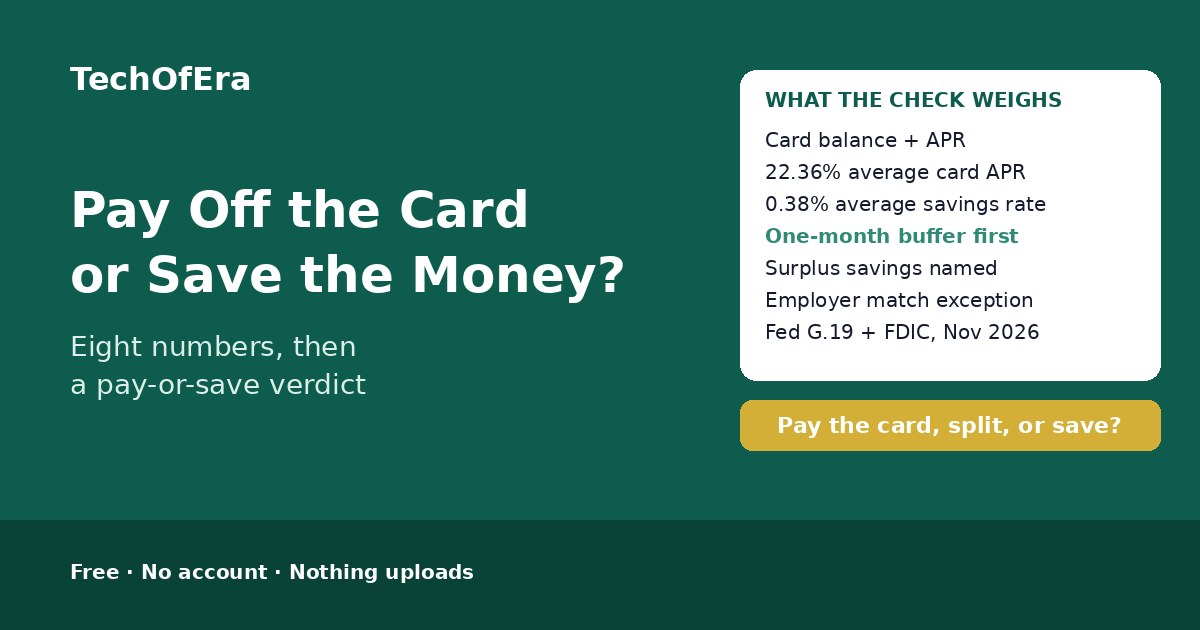
Pay off the card — or save the money?

Guides tell you the order in theory. None of them runs your numbers. Enter the balance, the APR, your savings and your essentials, and get a verdict for your exact situation — pay the card first, split it, or save first — with the interest the card charges set against what your savings earn. Free, in your browser, nothing uploads.

  • 22.36% average card APR (Fed G.19)
  • 0.38% average savings rate (FDIC)
  • Buffer-first verdict
  • Free, no account, nothing uploads
Should you pay off your credit card or save the money? Check it in seconds.

Check whether to pay the card or save

Try a preset:
0 of 7 answered

Your result

Answer the questions Your verdict appears here as you answer.
What holding both costs you

Enter the card balance and the cost of holding both will appear here — the interest the card charges against what your savings earn.

The money, broken down

Blockers

Things that do not fit

Things to check

Still to confirm

What to do next

    Your result summary


    Enter the card balance — the verdict updates live.

    Privacy you can verify, not just trust

    Checking whether to pay off a card or save by uploading your balance, your savings and your pay to a website would be backwards — the check should never be the leak. This one can't: your numbers are checked with plain JavaScript on your device, and they never leave the device — the only third-party requests are the site's own analytics, which count page views. Don't take our word for it:

    New cross-origin requests during use: 0
    1. Press F12 to open developer tools, then the Network tab.
    2. Enter a number above. Watch: apart from the site's analytics, nothing new is requested — no uploads, and no data ever leaves your device.
    3. Extra credit: disconnect your internet after this page loads — the checker still works.

    How the pay-off-or-save check works

    The pages that rank for this question are guides — SoFi, Experian and MoneyAesthetic with the order in theory, and ZEN Calculators with the dollar comparison. The two interactive tools that rank answer a different question: Money With May and MoneyRecon compare paying the card off against investing, not against saving, and FinRung is a payoff calculator that never asks what you hold in savings. None of them gives you a verdict on your exact situation: none weighs your card's interest against your savings' interest, none sizes a starter buffer from your essential spending, and none says pay the card first, split it, or save first. What decides it is eight things: the balance you carry, your card's APR, the savings you already hold, what your savings pay, your essential monthly spending, the spare cash each month, the minimum payment, and whether an employer retirement match is still on the table. The spine is the interest gap: at the averages, the card charges 22.36% while savings pay 0.38% — every $1,000 held in savings while carrying a card balance costs about $220 a year.

    To use it:

    1. Enter the card balance you carry. The amount on your statement that you do not pay off. A balance you clear in full each month costs no interest, and there is nothing to weigh — the checker says so. A $5,000 balance at the average 22.36% APR costs about $1,118 a year in interest.
    2. Say whether you know your APR — or use the average. Your own APR is on your statement. If you do not know it, the checker uses 22.36% in the US (Federal Reserve G.19, Aug 2026) or 21.71% in the UK (Bank of England, Sep 2026) and says so. If your real APR is higher, the card-first case is even stronger.
    3. Enter the savings you already hold. What you actually hold, not a goal. Savings you already have change the answer: a buffer you hold is a buffer you do not need to build. $6,000 saved against $3,000 of monthly essentials is two months of cover — and $3,000 of it sits above the one-month buffer, costing you interest while it waits.
    4. Enter what your savings pay. Your account's actual rate if you know it. Leave it blank and the checker uses the US national average of 0.38% (FDIC, Aug 2026) — but high-yield savings accounts pay far more, and the real rate changes the interest-earned figure directly.
    5. Enter your essential monthly spending. Rent or mortgage, food, utilities, transport — what you must spend. One month of this is the starter buffer that comes before extra card payments. Without it, the checker uses a $1,000 placeholder and says so.
    6. Enter your spare cash and your minimum payment. The spare cash is what is left each month after the minimum and the essentials — the money the verdict is really about. The minimum is what you must pay to stay current, and the checker assumes you always pay at least that. Together they set the payoff time: at $625 a month, a $5,000 balance at 22.36% clears in about 9 months.
    7. Say whether an employer match is on the table. A 50% match is an instant 50% return and a dollar-for-dollar match is 100%, before any investment growth — the one common thing that beats even a 22% card. Contribute just enough to take the full match, then put everything else on the card.

    What makes this checker different

    The pages that rank for this search answer a different question, or the same question without your numbers. SoFi, Experian and MoneyAesthetic explain the order — buffer, then debt, then savings — but leave you to do the maths yourself. Money With May and MoneyRecon build a real comparison, but against investing, not saving: they never ask what you hold in a savings account, never size an emergency buffer, and never tell you to split the money. FinRung tells you when a balance clears at a payment level, but never asks whether the money should be saved instead. None of them turns your balance, your APR, your savings and your essentials into a verdict with the interest gap shown, the surplus savings named, and the next steps for the verdict you got. This page is that answer: eight numbers, and an instant verdict for your exact situation. It is general information, so it says plainly what it cannot know: it cannot see your card agreement, your bank statements or your pay, and it is not financial advice.

    When is this the right check?

    When you carry a card balance and hold savings at the same time — because the question is not whether the card is expensive in theory, but whether your money is in the wrong place. When you have spare cash each month and cannot decide where it goes — because the answer changes with your buffer: no buffer means save first, a full buffer means the card. When your card is on a 0% offer — because the maths flips while it lasts, and flips back the day it ends. When an employer match is on the table — because the match is the one exception to paying the card first, and it only exists while you are employed there. And when you are paying only the minimum — because a $5,000 balance at 22% on minimum payments can take over 15 years and cost more in interest than the original balance.

    Honest limitations

    General information, not financial advice

    This checker cannot see your card agreement, your bank statements or your pay. It scores the numbers you give against published averages as they read in November 2026 — it cannot tell you what your issuer will do, and it is not financial advice.

    Payoff times are estimates

    The payoff time assumes a fixed APR, a fixed monthly payment, and no new charges on the card. New spending pushes the payoff out, a rate rise pushes it out further, and a missed payment can add fees and a penalty rate.

    Averages are not your rates

    The averages — 22.36% US card APR, 21.71% UK, 0.38% savings — are what the checker uses when you do not enter your own. Your card's APR and your account's rate are on your statements, and the verdict is only as exact as the numbers you enter.

    The buffer is a judgement, not a rule

    One month of essentials before the card, three to six months after, is the standard guidance — but only you know how steady your income is. Irregular income needs a bigger buffer; a steady salary with a second income needs less.

    It does not see the rest of your money

    Other debts, a mortgage, a car loan, a pension, tax — none of them are in this check. A cheap loan at 4% can wait while you invest; a card at 22% cannot. The verdict is about this card and this savings account only.

    Facts from the guides that rank, dated November 2026

    The facts here are the Federal Reserve's G.19 release, the Bank of England's Money and Credit release, the FDIC national average savings rate, and the emergency-fund guidance from SoFi, Experian and ZEN Calculators — as they read in November 2026. Rates and thresholds change: recheck them if anything about your card or your savings changes.

    Frequently asked questions

    Should I pay off my credit card or save money first?

    Build a small buffer first, then pay the card. Save one month of essential spending — rent or mortgage, food, utilities, transport — while still paying at least the minimum on the card, then send every spare pound or dollar to the card until it is clear, and only then build the full three-to-six-month emergency fund. The reason is the interest gap: the average APR on US card accounts actually charged interest is 22.36% (Federal Reserve G.19, Aug 2026), while the US national average savings rate is 0.38% (FDIC, Aug 2026), so every $1,000 held in savings while carrying a card balance costs about $220 a year. Enter your numbers in this checker and it works the order out for your exact balance, APR and savings.

    How much emergency savings do I need before paying off my card?

    One month of essential spending is the starter buffer that comes before extra card payments — without it, the next surprise expense goes straight back onto the card you are trying to clear. The full emergency fund is three to six months of essential expenses, and that comes after the card is gone, not before. If you do not know your essential spending, $1,000 to $2,000 is the usual placeholder. This checker sizes the starter buffer from the essential spending you enter, and says plainly when it is using the $1,000 placeholder instead.

    How much interest does a $5,000 card balance cost at the average APR?

    About $1,118 a year. At the Federal Reserve's average APR on accounts assessed interest — 22.36% in August 2026 — a $5,000 balance costs $5,000 × 22.36% = $1,118 a year in interest. The same $5,000 in a savings account at the FDIC national average rate of 0.38% earns about $19 a year. Holding both at once costs about $1,099 a year for nothing. In the UK the average rate on balances charged interest is 21.71% (Bank of England, Sep 2026), so a £5,000 balance costs about £1,086 a year. Enter your own balance and APR above and the checker works out your exact figures.

    Should I use my savings to pay off my credit card?

    Only the part above your one-month buffer. If you hold $6,000 in savings and your essential spending is $3,000 a month, move $3,000 onto the card and keep $3,000 — the surplus saves you about $671 a year in interest at a 22.36% APR, guaranteed, and you still hold a full month of spending. Never drain the buffer itself: with no savings, the next emergency goes straight back onto the card and the payoff starts again. This checker works out exactly how much of your savings sits above the buffer and what moving it saves each year.

    Does paying off my credit card beat investing?

    Almost always, yes. Paying off a card is a guaranteed return equal to its APR — 22% on an average card — while an investment return is not guaranteed and a typical long-run stock return is around 7%. On $5,000, paying the card saves about $1,100 a year in interest, guaranteed; investing it earns about $350 a year, maybe. The one common exception is an employer retirement match you have not taken yet: a 50% match is an instant 50% return and a dollar-for-dollar match is 100%, before any investment growth, and that beats even a 22% card. This checker flags the match as the first step when you say one is available.

    What if my card is on a 0% APR offer?

    Then save first while the offer lasts. At 0% the card charges no interest at all, so your savings earn more than the card costs and the maths flips — saving wins. But find out when the 0% period ends and what rate follows, because the answer flips back the day the real rate starts: a balance left over at 22% costs about $1,100 a year per $5,000. This checker gives a save-first verdict at 0% APR and tells you to set a reminder a month before the offer ends.

    Is my credit card APR high?

    Compare it with the averages: in the US the average APR on accounts actually charged interest is 22.36% (Federal Reserve G.19, Aug 2026), and across all accounts it is 21.19%. In the UK the average rate on balances charged interest is 21.71% (Bank of England, Sep 2026), while the average quoted representative rate is 24.71%. Below the average for your country is a good APR; above it, ask your issuer for a lower rate or look at a 0% balance-transfer offer — and check the transfer fee and how long the 0% period lasts. This checker flags an APR above the average for your currency and says so.

    Does this checker give financial advice?

    No. This checker is general information: it runs the numbers you enter against published averages — the Federal Reserve's G.19 card APRs, the Bank of England's card rates, the FDIC national average savings rate and the three-to-six-month emergency-fund guidance — entirely in your browser, and nothing you enter leaves your device. The only third-party requests are the site's own analytics, which count page views. It cannot see your card agreement, your bank statements or your pay, and it is not financial advice. Check a qualified adviser before you rely on it for a big decision.