Is organic worth it? Check your own basket.

Not a blanket yes or no — your foods, at your prices. Enter what you buy and this checker gives each item a verdict — buy organic, skip it, or your call — and prices the smart list for a year. Free, in your browser, nothing uploads.

  • Per-item verdicts, not a blanket rule
  • Your prices, your basket
  • Smart list vs everything organic
  • Free, no account, nothing uploads
Is organic worth it? Check your own basket and see which foods are worth buying organic.

Work out whether organic is worth it for your shop

Try an example basket:

Your budget never leaves your device — like everything else on this page.

Your list — edit any price and the verdicts update

FoodCategoryConventionalOrganicTimes a monthRemove

Example prices are the tool's own examples — change them to your shelf prices. The verdict follows the price, not the label.

Add a food to your list

Your result

Working it out… Your verdicts appear here as you answer.
Your smart list

Your smart list — only the items worth buying organic — will appear here.

What the year costs

Everything organic

—

A year, if every item on your list were organic.

Smart list

—

A year, buying organic only where it is worth it.

Smart list saves

—

A year, against buying everything organic.

Share of your budget

—

What the smart list costs against your monthly grocery budget.

Your verdicts, item by item

ItemExtra a monthVerdict

Ways to spend less

    Your result summary


    Change a price or add a food — the verdicts update live.

    Privacy you can verify, not just trust

    Working out your grocery bill by uploading your shopping list to a website would be backwards — the calculation should never be the leak. This one can't: your list is worked out with plain JavaScript on your device, and it never leaves the device — the only third-party requests are the site's own analytics, which count page views. Don't take our word for it:

    New cross-origin requests during use: 0
    1. Press F12 to open developer tools, then the Network tab.
    2. Change a price above. Watch: apart from the site's analytics, nothing new is requested — no uploads, and no data ever leaves your device.
    3. Extra credit: disconnect your internet after this page loads — the checker still works.

    How the checker works out whether organic is worth it

    There is no single answer to whether organic is worth it, because the answer is two numbers multiplied together: how much extra the organic version costs, and how much the organic label actually buys you for that food. This checker does that multiplication in the open: it scores each food on the published evidence, compares the organic premium you enter against the threshold for that score, and prices the whole basket three ways — everything organic, only the items worth buying organic, and the saving between the two. Every assumption is labelled as the tool's own rating or example, and the evidence is named with its sources, so you can see exactly where each number comes from — and correct the one that matters most, your shelf price.

    To use it:

    1. Say where you shop. Your country sets the currency. The example prices are in that currency — they are the tool's own examples, so replace them with the prices on your shelf.
    2. Say what your monthly grocery budget is, if you like. The checker shows the organic premium as a share of your budget. Leave it blank and everything else still works.
    3. Check the example basket, or load a different one. The family weekly shop loads first: 12 everyday items with example prices. Essentials is the six items most households buy every week; produce only is eight fruit and vegetables. Or clear the list and build your own.
    4. Put in your own prices. For each food, the conventional price, the organic price and how many you buy a month. The verdict follows the price, not the label — the same food can be worth it at a 20% premium and a luxury at 100%.
    5. Pick the right category for each food. The category sets the benefit rating: leafy greens and berries, thin-skinned fruit, and meat, eggs and dairy score high; root vegetables and processed pantry goods score medium; thick-skinned produce and pantry staples score low. The category list explains why each one scores as it does.
    6. Add foods of your own. Anything you buy regularly — blueberries, yoghurt, bread, baby food — with its own prices and how often you buy it. Remove anything you do not buy.
    7. Read the result. The smart list names the items worth buying organic and what they cost a year; the totals show what everything organic would cost and what the smart list saves; the item-by-item table gives each food its verdict and its reason; and the tips show the next savings worth making.

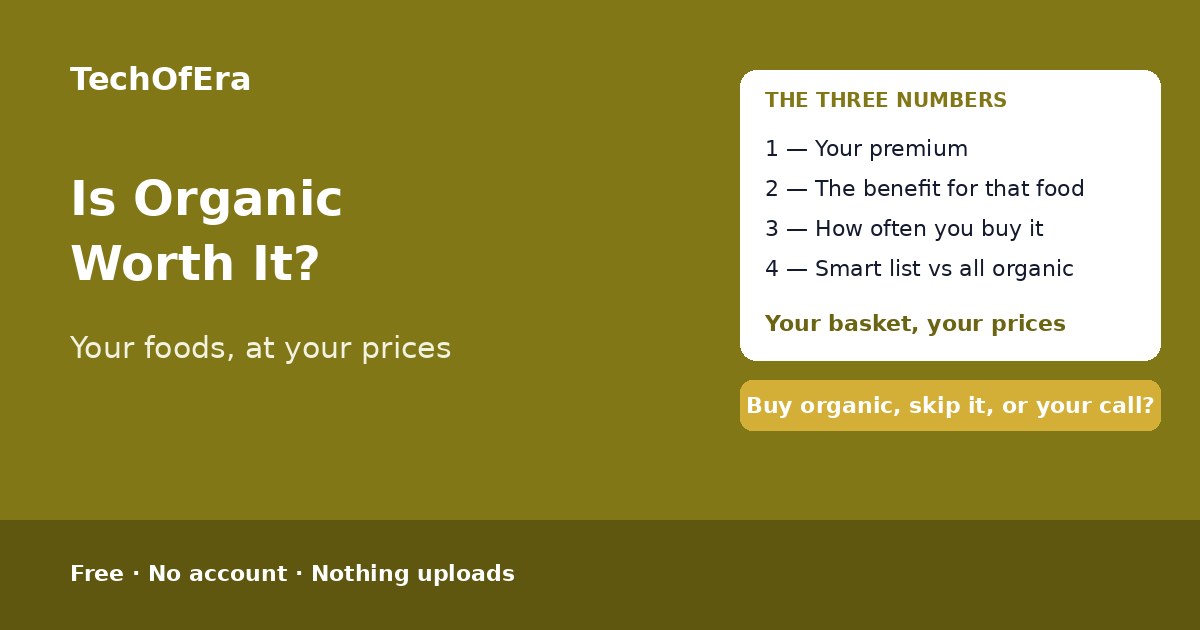
    The three numbers that matter most

    Your premium

    The percentage gap between the organic and conventional prices is the single biggest lever. A 20% premium on spinach is a different decision from a 100% premium on eggs, even though both are organic — and the gap changes by store, by season and by promotion. Check the shelf, not the label.

    The benefit for that food

    Organic buys the most where residue sits on the part you eat — leafy greens, berries, thin-skinned fruit — and where the rules ban antibiotics and growth hormones, which is meat, eggs and dairy. It buys the least where the peel comes off or the food is dried and standardised. The evidence finds no meaningful nutrition difference either way.

    How often you buy it

    A small premium on something you buy every week adds up; a big premium on something you buy twice a year barely matters. The checker prices the premium per month and per year, so the foods you buy most often carry the weight they deserve in the answer.

    What makes this checker different

    The pages that rank for this search are guides: they explain the evidence and give you a rule of thumb, and then leave you to do the maths for your own basket. The one calculator that exists is for farmers working out the premium a crop needs to break even, not for shoppers. None of them takes your prices for the foods you actually buy and returns a verdict per item, with a yearly cost for the smart list against buying everything organic. This page does that, entirely in your browser, with the model stated in the open: the benefit ratings, the premium thresholds and the evidence are all on the page, so you can check every number instead of trusting a black box.

    When is this the right checker?

    When you are standing in the supermarket wondering whether the organic strawberries are worth double the price — because the answer is a number in your currency, not a slogan. When you are setting a grocery budget and want to know what buying organic sensibly costs, rather than what buying everything organic costs. When someone in the house has a reason to care about pesticide residue or antibiotics — because the checker scores the foods where those reasons actually apply, and skips the ones where they do not. And when the organic aisle feels like a moral test — because it is not one, and a per-item verdict is kinder than a blanket rule.

    Honest limitations

    An estimate, not a quote

    This checker works out the verdict from the numbers you enter, entirely in your browser. It cannot know your shelf prices, your taste, or whether your household will actually eat what you buy. If a food nobody eats costs 100% of its price, organic or not.

    The benefit ratings are the tool's own

    The high, medium and low ratings are this tool's summary of the published evidence, not a medical judgement. The evidence itself is mixed and mostly about residue and farming practice, not about health outcomes — no study has shown that eating organic makes people healthier, and this checker does not claim otherwise.

    Conventional is not unsafe

    The USDA's testing found more than 99% of conventional samples below the EPA's safety limits. A skip verdict means the organic premium buys little for that food — it does not mean the conventional version is dangerous. Wash all fresh produce before eating it, organic and conventional alike.

    Prices change by store and season

    Out-of-season organic berries can cost double the conventional price; in season the gap often halves, and the verdict flips to buy. A promotion can make the organic version cheaper than the conventional one. Re-run the checker when the prices change — the verdict follows the price, not the label.

    The example prices are examples

    The baskets load with the tool's own example prices, in the currency of the country you pick. They are there so the checker shows a result straight away — they are not your prices, and they are not a survey of any store. Replace them with the prices on your shelf before trusting a verdict.

    Evidence sources, dated November 2026

    The evidence named on this page is: the Stanford review of 237 studies (Smith-Spangler and others, Annals of Internal Medicine, 2012); the Newcastle review of 343 studies (Baranski and others, 2014); a 2024 review of 147 studies; the USDA Pesticide Data Program's 2024 data; the Environmental Working Group's Dirty Dozen and Clean Fifteen lists; and the USDA's organic rules, as they read on 21 November 2026.

    Frequently asked questions

    Is organic food worth the extra money?

    It depends on the food. Organic is worth it where the benefit is real and the premium is small: leafy greens and berries eaten raw, thin-skinned fruit, and meat, eggs and dairy, where organic rules ban antibiotics and growth hormones. It is rarely worth it for thick-skinned produce like bananas and avocados, or for pantry staples like oats and rice, where the evidence finds no meaningful nutrition difference and the peel or the drying does most of the work. The honest rule is per item, not per shop: this checker prices your own basket, because the same food can be worth it at a 20% premium and a luxury at 100%.

    Is organic food more nutritious than conventional food?

    Mostly no. A Stanford review of 237 studies, published in the Annals of Internal Medicine in 2012, found no strong evidence that organic foods are significantly more nutritious than conventional foods. A Newcastle review of 343 studies in 2014 did find organic crops higher in some antioxidants and lower in cadmium, and a 2024 review of 147 studies found no across-the-board nutritional advantage. The differences that do exist are small and unlikely to matter to your health. If nutrition is your only reason for paying more, the evidence says keep the money and buy more vegetables instead.

    Does organic mean pesticide-free?

    No. Organic means no synthetic pesticides or fertilisers and no GMOs, but organic farms may use approved natural pest controls, and residue can still drift in from neighbouring fields. The Stanford review found organic produce about 30 percentage points less likely to carry detectable pesticide residue than conventional produce — less, not none. Wash all fresh produce before eating it, organic and conventional alike. And conventional produce is not automatically unsafe: the USDA Pesticide Data Program's 2024 data found more than 99% of conventional samples below the EPA's safety limits.

    Which foods are worth buying organic?

    The foods where organic earns its premium are the ones you eat raw with the skin — leafy greens, berries, apples, peaches and grapes — because residue sits on the part you swallow, and organic cuts detectable residue by about 30 percentage points. Meat, eggs and dairy are worth it for a different reason: organic rules ban antibiotics and growth hormones. The foods to skip are thick-skinned produce — bananas, avocados, oranges, onions, sweetcorn — where the peel comes off, and pantry staples — oats, rice, beans, flour — where the evidence finds no meaningful nutrition difference. This checker scores each of your foods against that evidence and your own prices.

    Is organic meat, milk and eggs worth it?

    This is the strongest case for organic, and it has little to do with pesticide residue. Organic animal products must come from animals given no antibiotics or growth hormones, and organic feed must itself be organic. That is a clear, checkable difference from conventional meat, milk and eggs, where antibiotics are routinely used to prevent infection in crowded conditions. The catch is the price: organic milk routinely costs 60% to 100% more than conventional, and organic chicken and beef can cost 50% to 150% more. At those premiums the verdict depends on your budget, which is why this checker prices them against your own numbers instead of giving a blanket yes.

    What is the Dirty Dozen and the Clean Fifteen?

    They are the Environmental Working Group's annual lists, built from USDA residue testing data. The Dirty Dozen is the produce with the most pesticide residue — thin-skinned fruit and leafy greens show up most often — and the Clean Fifteen is the produce with the least, mostly thick-skinned fruit and vegetables where the peel is removed. The pattern is the same one this checker uses: buy organic first where the skin is eaten, skip it where the peel comes off. The lists change a little each year as the testing data changes, so treat them as a guide to the pattern, not a fixed shopping list.

    How much more does organic food cost?

    Typically 20% to 50% more than the conventional version, but the premium is not flat — it ranges from near zero to well over double. Pantry staples like oats, rice, dried beans and flour are usually only 10% to 25% more, and sometimes the organic version is cheaper on promotion. Fresh produce, dairy, eggs and meat sit at the high end: organic milk routinely costs 60% to 100% more, organic berries in winter can cost double, and organic chicken and beef can cost 50% to 150% more. That spread is the whole point of this checker: a 20% premium on spinach is a different decision from a 100% premium on eggs, even though both are organic.

    Does this checker replace checking my own prices?

    No. This checker is an estimate: it works out the verdict from the numbers you enter, entirely in your browser, and nothing you enter leaves your device. It cannot know your shelf prices, your taste, or whether your household will actually eat what you buy — and a food nobody eats costs 100% of its price, organic or not. The example prices are the tool's own examples: replace them with the prices on your shelf, because the verdict follows the price, not the label. The only third-party requests are the site's own analytics, which count page views.