How the compost-ready check works
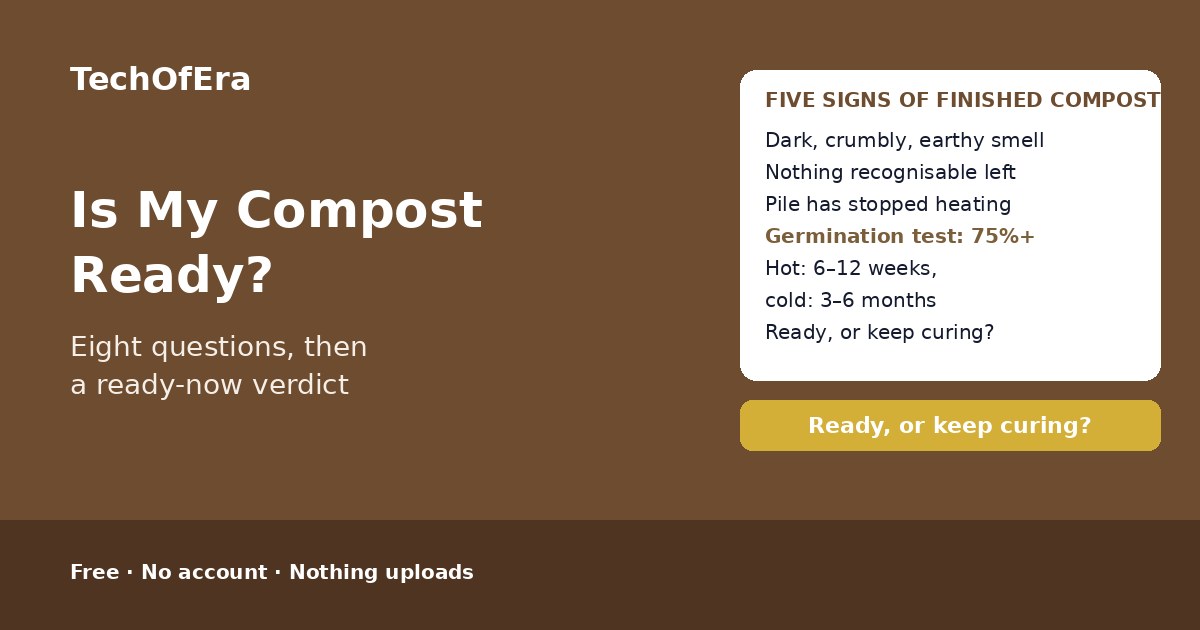
Compost does not go from “not ready” to suddenly “ready”: it passes through stages, and each stage has its uses. The guides that rank for this question all list the same five signs — dark and crumbly, earthy smelling, nothing recognisable left, the pile stopped heating, and a bag test that still smells earthy — but none of them scores your pile. What decides it is eight things: how you compost, how long it has been since fresh material went in, what the compost looks like, what it smells like, whether the pile still heats up, what is still recognisable in it, whether you have run a germination test, and what you want to use it for. The calendar is only a rough guide: a hot pile can be ready in 6–12 weeks, a cold pile takes 3–6 months or longer, and curing adds 4–8 more weeks after the heating stops. And the intended use matters as much as the signs — only fully mature compost goes into seed starting or potting mix, while semi-mature compost is fine as a mulch or topdressing on established beds.
To use it:
- Say how you compost. A hot compost pile — turned regularly, and heating up in the middle — can be ready in 6–12 weeks. A cold or static pile, a tumbler and an enclosed bin each have their own pace: a tumbler works like a hot pile, while a cold pile or an enclosed bin takes 3–6 months or longer. The method sets how long to expect.
- Say how long it has been since fresh material went in. The clock restarts every time fresh material goes in, so count from the last addition, not from when the pile was started. Less than 4 weeks is too soon for any method, and 1–2 months is too soon for a cold pile or an enclosed bin, whatever the signs say.
- Say what it looks like. Finished compost looks like dark, rich soil: dark brown or black, crumbly, and uniform. If it still looks like what went in, it has not broken down yet. Mostly dark with a few recognisable bits is semi-mature — the fine material underneath is usable, and the bits go back on the next pile.
- Say what it smells like. Finished compost smells earthy, like a forest floor after rain. Sour, ammonia or rotten smells mean microbes are still actively breaking it down — turn the pile, add dry browns if it is soggy, and wait. No smell at all is fine on its own: dry finished compost can be nearly odourless, but check it is not simply dried out.
- Say whether the pile still heats up. Turn it, then push your hand into the centre a few days later: if it no longer warms up, the active phase is over and the pile is curing. If it still heats up strongly, decomposition is still going and the compost is not ready. A pile that never heated up at all is usually too small, too dry, or short on greens — it still composts, just slowly.
- Say what is still recognisable in it. Finished compost has nothing recognisable left in it. A few stubborn bits — twigs and eggshells take far longer than everything else — do not mean the compost is unfinished: sift them out and throw them back on the next pile. Lots of food scraps, leaves and paper still visible means it has a long way to go.
- Say whether you have run the germination test. Sow cress or radish seeds in a pot of the compost and keep them warm: if 75% or more sprout and grow normally within about a week, the compost is mature. If they germinate poorly, or the seedlings come up yellow and stunted, it still carries phytotoxins. For seed starting, this is the test that decides it — the signs alone are not enough.
What makes this checker different
The pages that rank for this search are guides — a farm site laying out three home tests, a composter brand listing the five signs of finished compost, a gardening site explaining the radish test. None of them scores your pile: none takes your method, your age, your look, your smell, your heat, your recognisable bits, your germination test and your intended use — and none gives you a verdict — ready, nearly ready, or keep curing — with the safe uses for the verdict you got. There is no free, standalone checker that takes a pile’s five signs and returns a ready-now verdict with the curing plan. The nearest things are physical test kits you buy — a Solvita maturity kit, an N-P-K kit, a pH checker, a compost thermometer — not a free web page. This page is that answer: eight questions, and an instant verdict for your exact pile. It is a self-assessment, so it says plainly what it cannot know: it cannot smell your compost, feel whether the pile is warm, or watch seeds germinate, and where the compost smells sour or the germination test failed it tells you to wait instead of giving you a maybe.
When is this the right check?
When spring is coming and you are wondering whether the pile you started last autumn is ready for the beds — because using it too early takes nitrogen out of the soil just as the seedlings need it most. When you are about to sow seeds and need to know whether your own compost is safe for potting mix — because seed starting is the strictest use there is, and only the germination test proves it. When the pile looks dark on top but you are not sure what is underneath — because the signs are in the middle of the pile, not on the surface. When the compost smells a little off and you are not sure whether that means wait or use it anyway — because sour and ammonia smells mean keep curing, and earthy means ready. And when you have a pile that has been sitting for months and you are not sure whether time alone has finished it — because compost is ready when the signs say so, not when a number of weeks has passed.
Honest limitations
A self-assessment, not gardening advice
This checker cannot smell your compost, feel whether the pile is warm, or watch seeds germinate. It scores the answers you give against what the composting guides say — it cannot tell you what your compost actually needs, and it is not gardening advice.
The times are ranges, not dates
6–12 weeks for a hot pile and 3–6 months for a cold one are the guides’ usual ranges, not a promise: the size of the pile, what went into it, how often it was turned and the weather all move them. The signs decide it, not the calendar.
The germination test takes a week
The cress or radish test needs about a week before it gives an answer — and it should be run a month before you plan to use the compost, so there is time to let it mature further if the result is inconclusive. The checker can only score a test you have already run.
Some bits are always slow
Twigs, eggshells, avocado pits and wood chips can take more than a year to break down, long after the rest of the compost is finished. A few of them in an otherwise dark, crumbly pile do not mean the compost is unfinished — sift them out and throw them back.
Curing is invisible from the outside
A pile that has stopped heating is not finished yet — it is curing, and curing takes 4–8 more weeks. The only way to know curing is done is the signs plus the germination test: nothing on the surface of the pile shows it.
Facts from the composting guides, dated November 2026
The facts here are the composting guides that rank for this question — Moutta Farm, Reencle, Epic Gardening, Gardening Know How, Garden Botany and Pumpkins and Petals — as they read in November 2026. Guides change and piles differ: recheck the signs if anything about your compost changes.