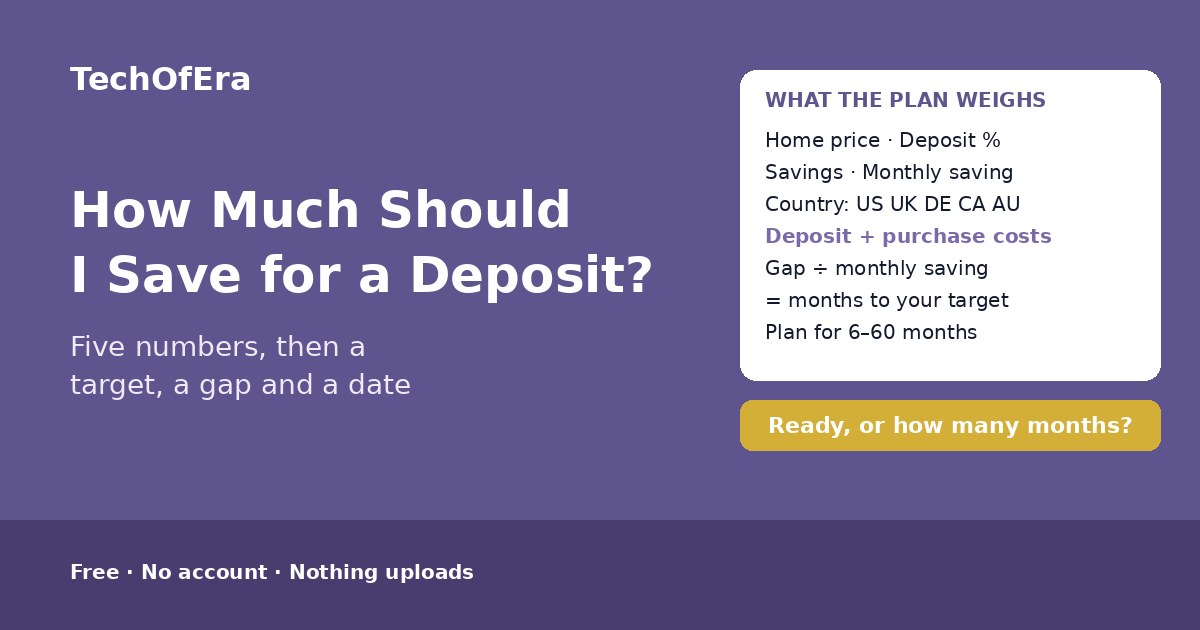
How much should you save for a house deposit?

A deposit percentage is not a savings target — the cash you need is the deposit PLUS the purchase costs on top, and the gap from what you have saved decides how many months it takes. Enter the home price, the deposit percentage, your savings and what you can put aside each month, and get the deposit, the costs, the gap, the date you would be ready, and a monthly saving plan. Free, in your browser, nothing uploads.

  • Deposit + purchase costs, not just the deposit
  • US, UK, Germany, Canada and Australia norms
  • Months to target + a 6–60 month saving plan
  • Free, no account, nothing uploads
How much should you save for a house deposit? Work it out in seconds.

Work out your deposit target and saving plan

Try a preset:
0 of 3 answered

Your result

Answer the questions Your verdict appears here as you answer.
Your saving plan

Enter the home price, your savings and what you can save each month and your saving plan will appear here — the monthly amount for a two-year target and the date you would be ready at your current rate.

Your deposit breakdown

Blockers

Things that do not fit

Things to check

Still to confirm

What to do next

    Your result summary


    Enter the home price, your savings and what you can save each month — the plan updates live.

    Privacy you can verify, not just trust

    Working out a house deposit by uploading your savings and your monthly income to a website would be backwards — the plan should never be the leak. This one can't: your numbers are worked out with plain JavaScript on your device, and they never leave the device — the only third-party requests are the site's own analytics, which count page views. Don't take our word for it:

    New cross-origin requests during use: 0
    1. Press F12 to open developer tools, then the Network tab.
    2. Enter a number above. Watch: apart from the site's analytics, nothing new is requested — no uploads, and no data ever leaves your device.
    3. Extra credit: disconnect your internet after this page loads — the calculator still works.

    How the deposit saving plan works

    The pages that rank for this question are guides and one generic savings-goal calculator — Premier Lending and Gerald with step-by-step saving guides, FinanceBand with a table of deposits by price, and 101 Planners with a general savings-goal calculator that happens to include a house deposit table. None of them is built for this question: none takes your home price, your deposit percentage, your savings and your monthly saving amount and turns them into a deposit target, a gap and a date — none adds the purchase costs for your country, none shows the monthly amount for a 6, 12, 24, 36 and 60-month target, and none says whether the deposit percentage you picked is even enough where you are buying. What decides it is five things: the price of the home, the deposit percentage, the cash you have saved, what you can put aside each month, and the country. The cash you need is the deposit PLUS the purchase costs on top — closing costs of 2–5% in the US, stamp duty in the UK and Australia, land transfer tax in Canada, and about 7% purchase costs in Germany — and the gap is that total minus your savings. Divide the gap by your monthly saving amount and you have the months; pick a target date and work backwards and you have the monthly amount.

    How much deposit do you need, by country?

    The deposit norms, the purchase costs and the insurance that applies under 20% down are different in every country this calculator covers. The table below is the guide the calculator uses — the published norms as they read in November 2026.

    • United States — 3–20% down. 3% is the conventional minimum for first-time buyers, 3.5% for FHA loans, and 20% avoids private mortgage insurance (PMI). Closing costs typically run 2–5% of the price, according to the Consumer Financial Protection Bureau.
    • United Kingdom — 5–10% down. 5% is the usual minimum, 10% is common and opens up far more mortgage deals, and 20% or more gets the best rates. Stamp duty at the standard rates is 0% to £125,000, 2% from £125,001 to £250,000 and 5% from £250,001 to £925,000 — first-time buyers pay 0% up to £300,000.
    • Germany — about 20% down. Lenders usually expect about 20% of the price as equity plus the purchase costs. Grunderwerbsteuer (land transfer tax) is 3.5–6.5% depending on the state, and notary and land registry fees add about 1.5–2% — about 7% in all.
    • Canada — 5–20% down. 5% under $500,000, 10% on the part from $500,000 to $999,999, and 20% at $1 million and above. Mortgage insurance is required under 20% down. Land transfer tax varies by province and is roughly 1–2.5% of the price.
    • Australia — 5–20% down. 5% is the usual minimum with lenders mortgage insurance (LMI), and 20% avoids LMI. Stamp duty varies by state and is roughly 4% of the price at typical prices.

    To use it:

    1. Enter the price of the home. The asking price of the home you want — or the price you hope to pay. The median US home price is $416,700, and at 10% down that home needs a $41,670 deposit plus about $12,501 in closing costs — $54,171 in cash before you have even started.
    2. Pick the deposit percentage. 10% is the default and a common first-home choice. 3% is the US conventional minimum and 3.5% the FHA minimum; 5% is the UK minimum; 20% avoids PMI in the US, mortgage insurance in Canada and LMI in Australia. A smaller deposit means a smaller cash target but a bigger loan, a higher monthly payment, and an insurance charge on top.
    3. Enter the cash you have saved. The cash you have saved for the deposit and the purchase costs. The calculator subtracts it from the total cash needed — the deposit plus the purchase costs — and the difference is the gap. If you have more saved than the total, the verdict is ready, and the surplus is your moving and furnishing buffer.
    4. Enter what you can save each month. What you can put aside each month, every month, for the deposit. The gap divided by this number is the months to your target — and the plan table shows what each monthly amount buys you for a 6, 12, 24, 36 and 60-month target. Pick the date first and work backwards, or take your monthly amount and read off the date.
    5. Pick the country. The deposit norms and the purchase costs change by country, and so does the insurance: PMI in the US, LMI in Australia, mortgage insurance in Canada, and no equivalent charge in the UK or Germany — where a small deposit instead means fewer deals, higher rates, or a lender that simply says no.

    What makes this calculator different

    The pages that rank for this search give you a guide or a generic savings table and stop. None of them adds the purchase costs to the deposit — the 2–5% of closing costs, the stamp duty, the transfer tax — which is the mistake that leaves first-time buyers thousands short at closing. None of them takes your savings and your monthly saving amount and turns them into a gap and a date. None of them shows the monthly amount for a 6, 12, 24, 36 and 60-month target, so you can pick the date and work backwards. And none of them checks your deposit percentage against the norms where you are buying — whether 5% is enough, whether 20% removes the insurance charge, or whether German lenders would expect more. This page is that answer: five numbers, and a deposit target, a gap, a date and a plan. It is a self-assessment, so it says plainly what it cannot know: it cannot see your bank statements, your credit file or a lender's rules, and it is not financial advice.

    When is this the right check?

    When you have a home price in mind and no idea how far your savings get you — because the deposit percentage is not a target until you add the purchase costs. When you know the gap but not the date — because dividing it by your monthly saving amount is the only honest way to get one. When you are choosing between a 5% and a 10% deposit — because the calculator shows what each one costs in cash and what it costs in insurance and rates. When you are buying in a country whose rules you do not know — because the deposit minimum, the purchase costs and the insurance are all different. And when a lender or an estate agent has quoted you a deposit figure — because this calculator checks whether that figure includes the purchase costs at all.

    Honest limitations

    A self-assessment, not financial advice

    This calculator cannot see your bank statements, your credit file or a lender's rules. It scores the numbers you give against the published deposit norms and purchase-cost ranges — it cannot tell you what a lender will approve, and it is not financial or lending advice.

    Purchase costs are estimates

    The calculator estimates closing costs at 3% of the price in the US, stamp duty at the standard England and Northern Ireland rates in the UK, purchase costs at 7% in Germany, land transfer tax at 2% in Canada and stamp duty at 4% in Australia. Real figures vary by state, province and lender, and they change the cash target directly.

    No interest counted on your savings

    The months and the monthly amounts are simple division of the gap — no interest on your savings is counted. Money in a high-interest savings account earns interest while you save, so the real wait is a little shorter. The plan is the cautious version.

    The deposit is only half the question

    Having the deposit does not mean you can afford the home. The monthly mortgage payment has to fit your income too — run the Can I Afford to Buy a House? Checker with the same home price and your income before you make an offer.

    Home prices move while you save

    A plan that takes three years assumes the home costs the same in three years. If prices rise, the deposit and the purchase costs rise with them, and the target moves. Re-check the plan every few months if the wait is long.

    Facts from the deposit guides, dated November 2026

    The facts here are the deposit guides and the official ranges that rank for this question — Premier Lending, Gerald, FinanceBand, 101 Planners, the Consumer Financial Protection Bureau and the published deposit norms for the US, UK, Germany, Canada and Australia — as they read in November 2026. Guides change and rates move: recheck the numbers if anything about your income or the home changes.

    Frequently asked questions

    How much should I save for a house deposit?

    The deposit is a percentage of the home's price — 3–20% in the US, 5–10% typically in the UK, about 20% in Germany, 5–20% in Canada and Australia — and the cash you need is the deposit PLUS the purchase costs on top: closing costs of 2–5% in the US, stamp duty in the UK and Australia, land transfer tax in Canada, and about 7% purchase costs in Germany. On a $350,000 home at 10% down in the US, the deposit is $35,000 and closing costs add about $10,500, so the cash target is about $45,500 — not $35,000. Enter your home price, deposit percentage, savings and monthly saving amount in this calculator and it works out your exact target, the gap, and how many months it takes.

    What is a good deposit percentage for a first home?

    It depends on the country. In the US, 3% down is the conventional minimum for first-time buyers and 3.5% for FHA loans, while 20% down avoids private mortgage insurance. In the UK, 5% is the usual minimum, 10% is common and opens up far more mortgage deals, and 20% or more gets the best rates. In Germany, lenders usually expect about 20% of the price as equity plus the purchase costs. In Canada, 5% down is the minimum under $500,000, 10% on the part from $500,000 to $999,999, and 20% at $1 million and above. In Australia, 5% is the usual minimum with lenders mortgage insurance, and 20% avoids it. A bigger deposit always means a smaller loan and a lower monthly payment — the question is what you can reach without waiting so long the price moves away from you.

    How long will it take to save my deposit?

    Divide the gap by what you can save each month. If you need $45,500 in cash, have $20,000 saved and can put aside $1,000 a month, the gap is $25,500 and it takes about 26 months. This calculator does exactly that, and then shows the monthly amount for a 6, 12, 24, 36 and 60-month target, so you can pick the date and work backwards. The plan counts no interest on your savings, so money in a high-interest savings account gets you there a little faster than the plan says. The two levers that move the date are saving more each month and aiming for a cheaper home — every 10% off the price cuts the cash target by about 10% too.

    Do I need to save for stamp duty or closing costs too?

    Yes — and forgetting them is the most common deposit mistake. The deposit is only part of the cash you need at closing. In the US, closing costs typically run 2–5% of the price, according to the Consumer Financial Protection Bureau. In the UK, stamp duty at the standard rates is 0% to £125,000, 2% from £125,001 to £250,000 and 5% from £250,001 to £925,000 — though first-time buyers pay 0% up to £300,000. In Germany, purchase costs run about 7% of the price (transfer tax of 3.5–6.5% by state, plus notary and registry fees of about 1.5–2%). In Canada, land transfer tax is roughly 1–2.5% depending on the province, and in Australia stamp duty is roughly 4% depending on the state. This calculator adds the estimate for your country to the deposit and labels it as an estimate — your conveyancer or lender gives the exact figure.

    Is a 5% deposit enough to buy a house?

    In the UK, yes — 5% is the usual minimum and 95% mortgages exist, though fewer lenders offer them and the rates are higher than at 10% down. In the US, 5% down is above the 3% conventional minimum and the 3.5% FHA minimum, so it is enough to buy — but under 20% down you pay private mortgage insurance on top of the mortgage until you build 20% equity. In Canada, 5% is the minimum under $500,000, but mortgage insurance is required under 20% down. In Australia, 5% is the usual minimum with lenders mortgage insurance, which is usually added to the loan. In Germany, 5% is not enough — lenders usually expect about 20% equity plus the purchase costs. So 5% buys a house in most countries, but it costs more every month than a bigger deposit, and it buys nothing in Germany.

    What is PMI or LMI, and when do I pay it?

    PMI (private mortgage insurance) in the US and LMI (lenders mortgage insurance) in Australia are insurance that protects the lender, not you — and you pay for it. In the US, PMI applies on conventional loans below 20% down and lasts until you build 20% equity; in Australia, LMI applies below 20% down and is usually added to the loan as a one-off charge; in Canada, mortgage insurance is required below 20% down and is usually added to the loan too. The UK has no equivalent charge — instead, smaller deposits mean fewer mortgage deals and higher rates. A 20% deposit removes the charge entirely in the US, Canada and Australia, which is why this calculator flags it whenever your deposit is under 20%.

    How is this different from the Can I Afford to Buy a House? Checker?

    They answer two halves of the same question. This calculator plans the deposit: how much cash you need, how far your savings get you, and how many months of saving it takes to close the gap. The Can I Afford to Buy a House? Checker tests the other half — whether the monthly mortgage payment fits your income under the 28/36 rule, whether the deposit plus closing costs empties your savings, and whether three months of payments would be left over — and gives a yes, a stretch, or not yet verdict on a specific home. Use this calculator first to set the savings target, then the affordability checker to test whether the home itself fits.

    Does this calculator give financial advice?

    No. This calculator is a self-assessment: it runs the numbers you enter against the published deposit norms and purchase-cost ranges — the US 3–20% deposit range and the CFPB's 2–5% closing-cost range, the UK 5–10% norm and standard stamp duty rates, Germany's 20% equity expectation and 3.5–6.5% transfer tax, Canada's 5–20% tiers and Australia's 5–20% range with LMI — as they read in November 2026, entirely in your browser, and nothing you enter leaves your device. The only third-party requests are the site's own analytics, which count page views. It cannot see your bank statements, your credit file or a lender's rules, and it is not financial or lending advice. Only a lender can say what you will actually be approved for. The decision is yours alone.