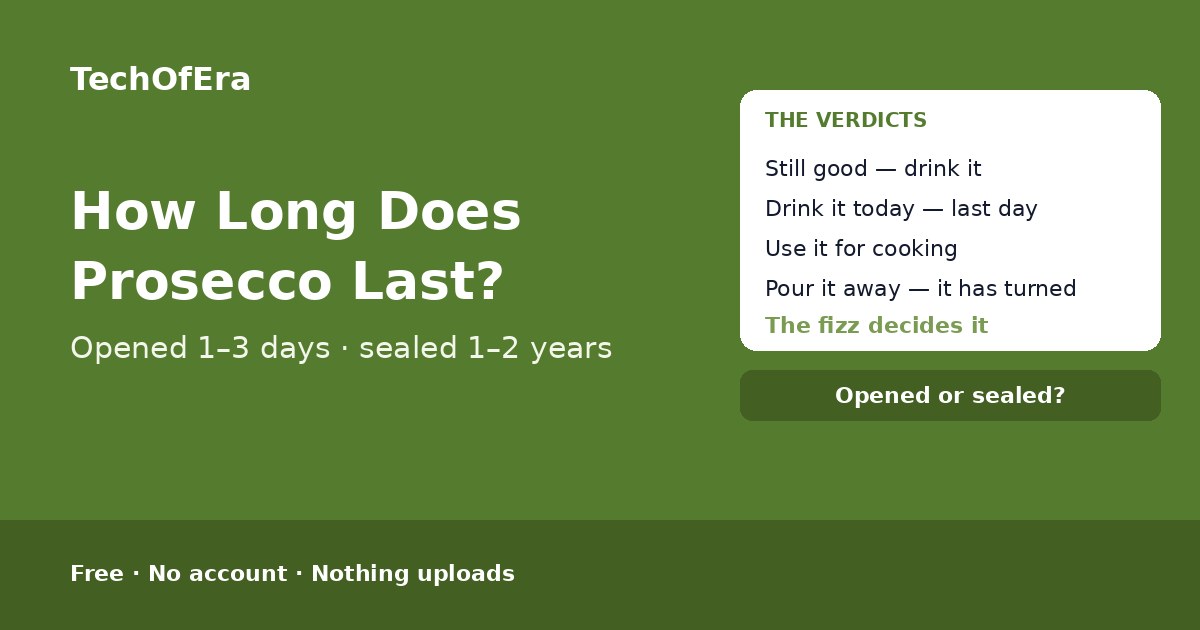
How long does Prosecco last once opened?
It depends on whether the bottle is opened or still sealed — the two rules are completely different. Once opened, Prosecco lasts 1 to 3 days with a proper sparkling-wine stopper in the fridge: WSET says a suitable stopper can preserve bubbles for up to about five days, and explains that tank-method wines such as Prosecco generally keep less well than traditional-method wines. Frizzante, which is only lightly sparkling, lasts about 1 day. With an ordinary cork or plastic wrap, about 1 day; with no stopper, or a spoon in the neck, a few hours. Still sealed, Prosecco DOC and Rosé are best within 1 year of harvest, and Prosecco DOCG within 2 years — the Prosecco DOC consortium advises enjoying the wine in the year after harvest. Those are quality windows, not safety limits: Prosecco does not go off like milk, it fades and loses its fizz. This checker uses the cautious end of each range — 2 days opened for DOC, DOCG and Rosé, 1 day for Frizzante, and 1 and 2 years sealed — so it errs towards drinking it sooner, not later.
To use it:
- Start with opened or sealed. That one answer decides which rule applies — days for an opened bottle, about a year for a sealed one. Then say which Prosecco it is: DOC (the usual spumante bottle), DOCG (Valdobbiadene or Conegliano, including Superiore di Cartizze), Rosé, or Frizzante.
- Say when it was opened — or bought. For an opened bottle, the number of days since opening is the day count against its window. For a sealed bottle, the years since purchase are counted against its best-before window.
- Say how it was resealed. Only a hinged sparkling-wine stopper holds the pressure. The original cork cannot be pushed back in — it mushrooms on opening. An ordinary cork or plastic wrap slows the fizz escaping but cannot hold it, and a spoon in the neck does nothing at all: in tests, bottles with a spoon lost about half their pressure in 48 hours, the same as bottles left open.
- Say how it has been stored. In the fridge is best — cold is what holds the fizz, because carbon dioxide dissolves better in cold liquid. A bottle kept warm, in sunlight, or left out on the counter goes flat far faster, and the checker shortens its window for that.
- Check the bubbles. The bubbles are the first thing to go — a Prosecco that is completely flat is past drinking as Prosecco, even if it smells fine. Mostly flat means drink it today, or use it for cooking.
- Give it a sniff and a sip. A sour or vinegar-like smell means it has turned. A small sip of Prosecco that has gone off will not harm you — it is just unpleasant. Sour, flat or vinegary means it is past drinking.
Prosecco windows and what they mean, at a glance
The table below is built from the same rules as the checker, so it can never disagree with your verdict. Whether the bottle is opened, which Prosecco it is, how it was resealed and how it has been stored decide together.
| Bottle | Window | What to know |
|---|
What makes this checker different
The pages that rank for this search are guides — thorough explanations of how long Prosecco lasts opened and unopened, from Prosecco.com, Personal Wine, Chowhound and others — but they leave you to work out what that means for the bottle in your fridge: whether a DOC opened two days ago with plastic wrap is still worth pouring, whether a flat bottle is cooking wine or drain wine, and whether a three-year-old sealed DOC is past its best. There is no interactive result on the first page at all. And Prosecco is not Champagne with a different label: it is made by the Charmat tank method, so its fizz fades faster once opened; it has no vintage that improves with age, so a sealed bottle is best within a year or two rather than a decade; and Frizzante is a different drink again, with far less pressure. This page is the missing answer, built on Prosecco's own rules: ten questions, an instant verdict that combines the day or year count, the stopper, the storage and the signs — drink it, drink it today, use it for cooking, or pour it away — with days left and a use-by date, and nothing to install, no account, and nothing uploaded.
When is this the right check?
Whenever a bottle has been open for a few days and you are not sure whether to finish it: the Prosecco from New Year's Eve still in the fridge, the bottle you opened for a spritz and never finished, the one that has gone flat. Whenever a sealed bottle has been sitting in a cupboard for years and you are not sure whether it is still worth saving for the next celebration — a three-year-old DOC is past its best, a one-year-old DOCG is not. And whenever a bottle smells odd or has lost all its bubbles — the signs beat the day count, and the checker weighs them together.
Honest limitations
General information, not medical advice
This checker gives general information about Prosecco from published guides. It is not medical advice, and it cannot know your health, your medicines, or whether you should drink at all. If you are pregnant, taking medication, or unsure about alcohol, ask a doctor — or do not drink.
The guides disagree — so the checker is cautious
Sources do not all give the same figures. WSET says up to about five days opened with a good stopper; most guides say one to three days. This checker uses two days for DOC, DOCG and Rosé with a proper stopper and says so, because a cautious verdict costs you a glass, not your health.
The signs beat the day count
A Prosecco inside its window that smells sour or tastes vinegary has turned, whatever the calendar says — and a Prosecco just past its window that still smells and tastes right is usually fine for a risotto. The checker weighs the signs with the days, not instead of them.
Sealed windows are estimates, not expiry dates
Prosecco carries no use-by date. The sealed windows — 1 year for DOC and Rosé, 2 years for DOCG — are the producers' best-before guidance, and a bottle kept badly can fade sooner while one kept perfectly can outlast them. The checker's use-by date is an estimate from those windows.
Old and fragile bottles are different
An old, fragile Prosecco may be best finished the same evening it is opened — it has far less life once opened than a young bottle, and Prosecco never improves with age. If the bottle was already old when you opened it, tick the warning sign and treat the window as a maximum, not a promise.
Windows from WSET and the Prosecco DOC consortium
The windows follow WSET's guidance on preserving opened wine and the Prosecco DOC consortium's tasting guide, with the published Prosecco guides, as they read in November 2026. Guidance can be revised, so re-check if a new edition appears.