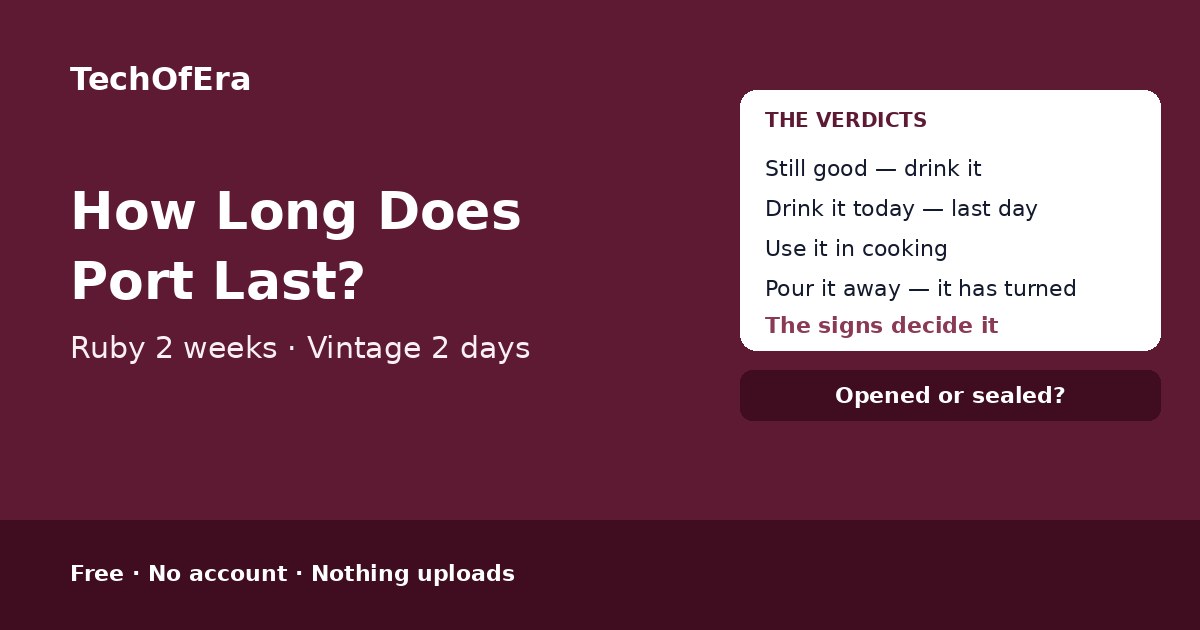
How long does port last once opened?
It depends on the style — and the range is wide. A Vintage lasts just 1 to 2 days once opened, an LBV or Crusted 4 to 5 days, a Ruby 8 to 10 days, a Tawny 3 to 4 weeks, and an aged Tawny or Colheita 1 to 4 months, according to the IVDP (Instituto dos Vinhos do Douro e do Porto), the body that regulates port. White keeps 8 to 10 days in its fresh style or 15 to 20 days wood-matured; Rosé gets no IVDP figure, and Food Republic gives about 2 weeks. Producers and guides give longer figures than the IVDP — Taylor's gives 2 months for its Select Ruby, Food Republic about a month for Ruby and 2 months for Tawny, Wine.com 4 to 6 weeks for Ruby and up to 2 months for Tawny in the fridge. This checker uses the conservative end of each range — 14 days for Ruby, 4 weeks for Tawny, 2 days for Vintage — so it errs towards drinking it sooner, not later. Port is a fortified wine, about 19 to 20% ABV, so an opened bottle outlasts a bottle of table wine by weeks — except Vintage, which fades in days, like a great red wine.
To use it:
- Start with opened or sealed. That one answer decides which rule applies — days for an opened bottle, years for a sealed one. Then say which port it is: Ruby, Tawny, aged Tawny, Vintage, LBV, White or Rosé.
- Say when it was opened — or bought. For an opened bottle, the number of days since opening is the day count against its window. For a sealed bottle, the years since purchase are counted against its window — decades for a Vintage, about 5 years for a Ruby or Tawny. A half-empty bottle ages faster, because it holds more air.
- Say how it has been stored, and how it is closed. In the fridge is best for every style — cold slows what air does to the port. A cool, dark place is fine too, just a little faster. Heat is the real enemy: a bottle kept warm can be gone well before its window is up. A vacuum stopper buys a few extra days; a bottle left in a decanter is open to the air and fades about twice as fast.
- Check what it looks like. Browning or a faded colour means the port is oxidising; cloudiness is a warning too. But sediment at the bottom of a Vintage or Crusted port is normal — it is not cloudiness, and it is not a bad sign. Mould on the cork or in the neck means it has turned.
- Give it a sniff and a sip. A vinegary or sharp smell means the port has turned to vinegar. A small sip of port that has gone off will not harm you — it is just unpleasant. Sour or vinegary means it is past drinking, and cooking with it will not save it. A flat or dull taste means the fruit has faded — past drinking neat, but still fine in a sauce.
Port windows and what they mean, at a glance
The table below is built from the same rules as the checker, so it can never disagree with your verdict. Whether the bottle is opened, which port it is, how it has been stored and what it looks like decide together.
| Bottle | Window | What to know |
|---|
What makes this checker different
The pages that rank for this search are guides — thorough explanations of how long each port style lasts, from Food Republic, Wine.com, SavorEveryEat, prtwine, Dram+Vine and Decantis — but they leave you to work out what that means for the bottle in your fridge: whether a Ruby opened nine days ago and kept in a cupboard is still worth pouring neat, whether a Tawny opened five weeks ago is cooking port or drain port, and whether a Vintage opened yesterday is already past it. There is no interactive result on the first page at all. This page is the missing answer: ten questions, an instant verdict that combines the day count, the storage, the closure and the signs — drink it, drink it today, use it in cooking, or pour it away — with days left and a use-by date, and nothing to install, no account, and nothing uploaded.
When is this the right check?
Whenever a bottle has been open for days or weeks and you are not sure whether to finish it: the Ruby from Christmas still in the fridge, the Tawny you opened for a cheese board and never finished, the Vintage you decanted last night. Whenever a sealed bottle has been sitting for years and you are not sure whether it is still worth saving — a fifteen-year-old Vintage is still young, a six-year-old Ruby is past its best. And whenever a bottle smells vinegary or tastes sour — the signs beat the day count, and the checker weighs them together.
Honest limitations
General information, not medical advice
This checker gives general information about port from published guides. It is not medical advice, and it cannot know your health, your medicines, or whether you should drink at all. If you are pregnant, taking medication, or unsure about alcohol, ask a doctor — or do not drink.
The guides disagree — so the checker is cautious
Sources do not all give the same figures. The IVDP gives a Ruby 8 to 10 days; Taylor's gives 2 months for its Select Ruby. This checker uses 14 days for Ruby, 4 weeks for Tawny and 2 days for Vintage, and says so, because a cautious verdict costs you a glass, not your health.
The signs beat the day count
A port inside its window that smells vinegary or tastes sour has turned, whatever the calendar says — and a port just past its window that still looks, smells and tastes right is usually fine in cooking. The checker weighs the signs with the days, not instead of them.
Sealed windows are estimates, not expiry dates
Port carries no use-by date. The sealed windows — 50 years for a Vintage, about 5 years for a Ruby, Tawny or LBV, 3 years for a White, 2 years for a Rosé — are guidance from the published guides, and a bottle kept badly can fade sooner while one kept perfectly can outlast them. The checker's use-by date is an estimate from those windows.
Sediment is not a bad sign
A Vintage or Crusted port throws sediment as it ages — that is normal, and it is why Vintage is decanted. Do not mistake the sediment at the bottom of the bottle for cloudiness, and do not pour a Vintage away for it.
Windows from the IVDP and the port guides
The windows follow the IVDP and the published port guides, as they read in November 2026. Guidance can be revised, so re-check if a new edition appears.