How the fruitcake check works
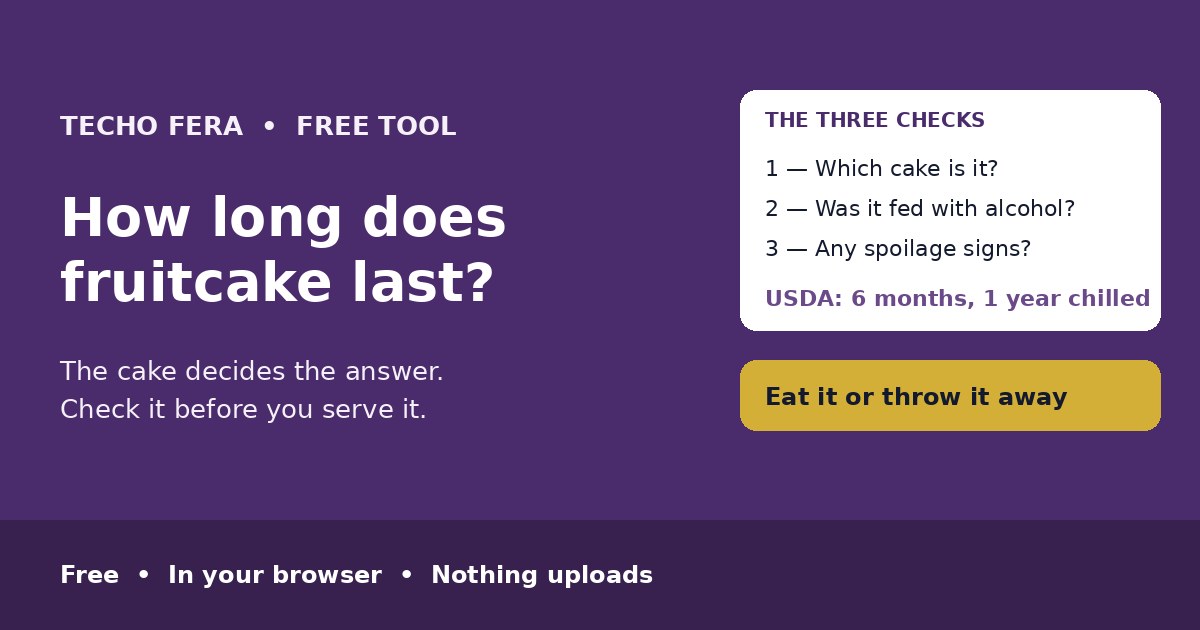
The rule depends on the cake: a traditional alcohol-soaked fruitcake keeps 6 months at room temperature, 12 months in the fridge and 12 months in the freezer, according to the USDA FoodKeeper database. An alcohol-free cake keeps 1 month at room temperature and 6 months in the fridge, and an iced cake keeps 1 to 2 weeks at room temperature and 3 months in the fridge. A cake fed regularly with brandy or rum keeps longest. And a dry, hard or crumbly cake with no mould and no off smell is stale, not unsafe — it goes into a trifle, not the bin. This checker asks seven questions — which cake, where it is stored, how long it has been there, how it was fed with alcohol, any spoilage signs, who will eat it, and optionally the date it was made or bought — and gives one verdict: eat it, eat it today, use it for trifle or cooking, or throw it away. If you enter the date, it works out the exact days and your use-by date as well.
To use it:
- Pick the cake. Choose it from the list — traditional alcohol-soaked, alcohol-free, marzipan- or royal-iced, or shop-bought. The list covers 4 cakes, grouped by type: homemade, iced, and shop-bought.
- Say how long it has been stored. Less than 1 day, 1 to 2 days, 3 to 4 days, 5 to 7 days, 1 to 2 weeks, 2 to 4 weeks, 1 to 3 months, 3 to 6 months, 6 to 12 months, or more than 1 year — or not sure. Count from the day the cake was made, or the day you bought it.
- Say where it is stored. At room temperature in a cool, dark cupboard, in the fridge, or in the freezer. The cupboard is the traditional home for a fruitcake; the fridge buys extra months, and the freezer buys a year.
- Say how it was fed with alcohol. Fed regularly with brandy or rum, fed once or twice after baking, never fed, or not applicable for a shop-bought or iced cake. Feeding matters for a traditional cake: one fed regularly keeps longest.
- Say whether it shows any spoilage signs. Visible mould, a sour or rancid smell, dry and hard or crumbly, or more than one of these. Mould and smell mean throw it away, whatever the calendar says — dry and crumbly on its own means stale, not unsafe.
- Say who will eat it. A healthy adult, someone pregnant, someone over 65 or under 5, or someone with a weakened immune system. People at higher risk get the stricter answer when the cake is near the end of its life.
- Optionally, enter the date it was made or bought. The checker works out the exact days stored and your use-by date. Leave it blank to use the time band above.
The cakes at a glance
| Cake | Room temp | Fridge | Freezer | Why |
|---|---|---|---|---|
| Traditional, alcohol-soaked | 6 months | 12 months | 12 months | USDA FoodKeeper — fed regularly, 12 months at room temperature (the checker's own estimate) |
| Homemade, no alcohol | 1 month | 6 months | 12 months | Clemson Extension — no alcohol means less keeping power |
| Marzipan- or royal-iced | 1–2 weeks | 3 months | 12 months | Icing traps moisture — the room-temperature window is the checker's own estimate |
| Shop-bought | 6 months | 12 months | 12 months | USDA FoodKeeper — the date on the label is the honest clock |
What makes this checker different
The pages that rank for this search are articles and storage guides — Scientific American, NC State, Clemson, Collin Street Bakery, Veena Azmanov, and a KeepOrToss data page — and every one of them gives you the same static answer: "6 months in the pantry" or "1 month in the cupboard". None of them asks which cake it is, where it is stored, how long it has actually been there, how it was fed with alcohol, whether it shows any spoilage signs, or who will eat it — and none of them gives you a use-by date. The numbers on those pages do not even agree with each other: the USDA gives 6 months in the pantry, Clemson gives 1 month, and a commercial baker gives 2 weeks at room temperature. There is no free, standalone checker that takes a cake type, a storage place, a time band, the feeding, spoilage signs and an eater and gives you one verdict with the days left, the use-by date, and the next steps. This page is that answer: seven questions, an instant verdict for your exact cake, the blockers named, and the next steps. It is general information, so it says plainly what it cannot know: it cannot see your cupboard, your thermometer or your cake, and where the guidance is thinner — how long the cake has really been stored, how it was fed — it tells you to throw it away instead of guessing. The live Christmas cake checker answers the UK "Christmas cake" question; this one answers the "fruitcake" question, with the USDA FoodKeeper windows and the alcohol-feeding question.
When is this the right check?
When you pull the Christmas fruitcake out of the cupboard in January and it has been there since November, and you are not sure whether it is still good — because a traditional cake keeps 6 months at room temperature, and guessing wrong can mean serving cake that has turned. When the cake you baked in October has gone dry and hard, and you are deciding whether it goes in the bin or into a trifle — because a stale cake with no mould and no off smell is fine for cooking, and the checker tells you so. When you are deciding whether to feed the cake again or freeze it — because a cake fed regularly keeps longest, and the checker shows you the longer window. And when you find a shop-bought fruitcake at the back of the pantry with no idea when you bought it — because the label date is the honest clock, and the checker tells you what to do when you cannot confirm the time.
Honest limitations
General information, not food-safety advice
This checker cannot see your cupboard, your thermometer or your cake. It cannot tell you how long the cake has really been stored, how warm your cupboard is, or whether the cake shows any spoilage signs — only you can. If you cannot confirm the time, the honest answer is to throw it away.
The days left are an estimate
The checker works from the time band you pick — 1 to 2 weeks, 2 to 4 weeks, and so on — and takes the middle of the band to work out the days left. Enter the date the cake was made or bought for the exact count and your use-by date. The exact clock is the one on your wall: if you know the cake went into the cupboard on 20 November, trust that, not the band.
Not sure means the cautious answer
If you are not sure how long the cake has been stored, the checker does not guess — it tells you to eat it today or throw it away. That is deliberate: the safe mistake is to throw away cake that was actually fine.
The fed-cake extension and the iced-cake window are the checker's own estimates
The published rules give one window per cake, whatever the feeding. This checker gives 12 months at room temperature as a planning window for a traditional cake fed regularly with brandy or rum — alcohol-fed cakes are reported to keep for several years — and 1 to 2 weeks at room temperature for an iced cake, whose icing traps moisture. Those adjustments are the checker's own estimates, and it says so. A traditional cake fed once or twice gets the full published USDA window.
The smell test cannot be trusted
A sour or rancid smell means throw the cake away — but a fine smell does not mean the cake is safe. Mould can grow without any smell at all, which is why the calendar limit still applies to a cake that looks and smells fine. If it is past its limit, throw it away even if it seems fine.
Rules from the USDA FoodKeeper database, Clemson University Cooperative Extension, Collin Street Bakery and Veena Azmanov, dated November 2026
The rules here are the fruitcake storage rules as they read in November 2026: a traditional alcohol-soaked cake 6 months at room temperature, 12 months in the fridge and 12 months in the freezer; an alcohol-free cake 1 month at room temperature and 6 months in the fridge; an iced cake 1 to 2 weeks at room temperature and 3 months in the fridge. Guidance changes: recheck with your local food-safety authority if anything changes.