How the FSA year-end check works
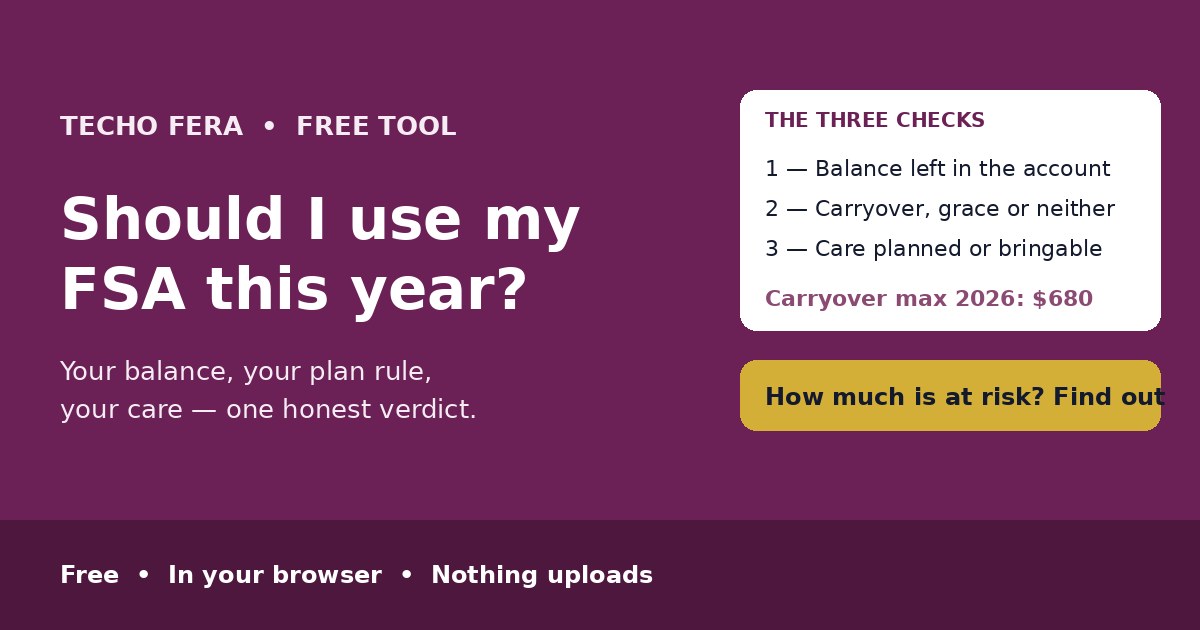
A health flexible spending account lets you set aside pre-tax money from your paycheck for medical, dental and vision costs. The 2026 health FSA contribution limit is $3,400. The catch is the use-it-or-lose-it rule: you generally must use the money within the plan year. Your employer may soften that rule with one of two options — but not both, and it does not have to offer either. A carryover lets up to $680 of your unused 2026 balance roll into 2027 (the IRS maximum for plan years beginning in 2026; your employer may allow less). A grace period gives you up to two and a half extra months to incur eligible expenses — through March 15, 2027 for a calendar-year plan. If your plan offers neither, whatever is left at the end of the plan year is forfeited. This checker does the arithmetic for you: your balance, minus the spending you already have planned, minus the spending you could bring forward, minus any carryover protection — and whatever is left is the money at risk.
To use it:
- Pick your account. Health FSA, dependent care FSA, or HSA. An HSA never expires — if that is what you have, there is nothing to use up, and the checker says so straight away. A dependent care FSA has no carryover, ever, so the checker will not let you claim one.
- Enter your remaining balance. Find it in your FSA administrator’s portal or app — it is usually on the home screen. The balance is the whole problem: a $50 balance and a $1,500 balance are completely different situations.
- Say what your plan offers. Carryover, grace period, or neither. Ask HR or check your benefits portal if you are not sure — the answer decides how much money is at risk, and the checker says so plainly if you leave it unknown. If your plan offers a carryover, enter the amount it allows (the IRS maximum for 2026 is $680).
- Enter the eligible spending you already have planned before the deadline — appointments already booked, prescriptions to refill, glasses on order. Then the spending you could bring forward — the dental cleaning, the eye exam, the refill you have been putting off. Only care that actually happens before the deadline counts.
- Optionally, pick your federal tax bracket. Every FSA dollar is pre-tax, so losing it also wastes the tax saving — at a 22% marginal rate, $500 lost is about $110 of tax saving gone. The checker shows that figure so the loss is concrete, not abstract.
What makes this checker different
The pages that rank for this search are guides — a year-end checklist that explains the rules, and dental-office articles that tell you to book a cleaning before December 31. None of them asks what your balance is, which rule your plan offers, or what care you already have planned — and none of them tells you how much money is actually at risk, or what to do about it. There is no free, standalone checker that takes your balance, your plan’s carryover or grace period rule, your planned spending and the spending you could bring forward — and gives you a dollar figure at risk, a score, and a recommended action built on your own numbers. This page is that answer: seven questions, an instant verdict for your exact account, the blockers named, and the next steps. It is a self-assessment, so it says plainly what it cannot know: it cannot see your plan documents, and where your plan’s rule is unknown it assumes the worst instead of guessing.
When is this the right check?
When you have money left in your FSA and the year is nearly over — because the deadline is real, and the amount at risk depends on your plan’s rule, not on the calendar alone. When you are not sure whether your plan offers a carryover or a grace period — because that one fact decides whether $680 is protected or nothing is. When you have appointments you have been putting off — because a dental visit, an eye exam and a prescription refill are exactly the eligible spending that turns at-risk money into care you needed anyway. And when someone tells you to spend your FSA “before it’s gone” — because if your account is an HSA, there is nothing to spend, and if your balance is already covered by planned spending and a carryover, there is nothing to rush.
Honest limitations
A self-assessment, not financial advice
This checker cannot see your plan documents, your balance, or your administrator’s rules. It cannot tell you what your plan actually offers, when your plan year ends, or whether a specific expense is eligible — only HR or your FSA administrator can. If you are unsure, ask them before you spend.
The incurred-date rule catches people out
Paying a bill before December 31 does not, by itself, make next year’s treatment eligible. The service has to happen during the plan year — or during the grace period, if your plan has one. Check with your administrator before prepaying for future treatment.
Not every plan year ends on December 31
Some employer plans run on a different 12-month plan year, such as July through June. If yours does, your deadline is not December 31 — and neither is the grace-period end date. Confirm your plan year dates with HR.
Do not buy things you do not need
Bringing spending forward only works for care you genuinely need: glasses you will wear, a refill you will take, a visit you were going to book anyway. Buying things you do not need to “use up” the money wastes more than it saves.
The tax figure is an estimate
The tax saving shown is your marginal federal rate applied to the money at risk. Your real saving also depends on state tax, payroll tax and your exact bracket — the checker says so instead of pretending the number is exact.
Rules from official sources, dated November 2026
The rules here are the IRS rules for flexible spending accounts as they read in November 2026: the 2026 health FSA limit of $3,400, the $680 maximum carryover for plan years beginning in 2026, the two-and-a-half-month grace period, and IRS Publication 502 on eligible expenses. Guidance changes: recheck with your administrator if anything about your plan changes.