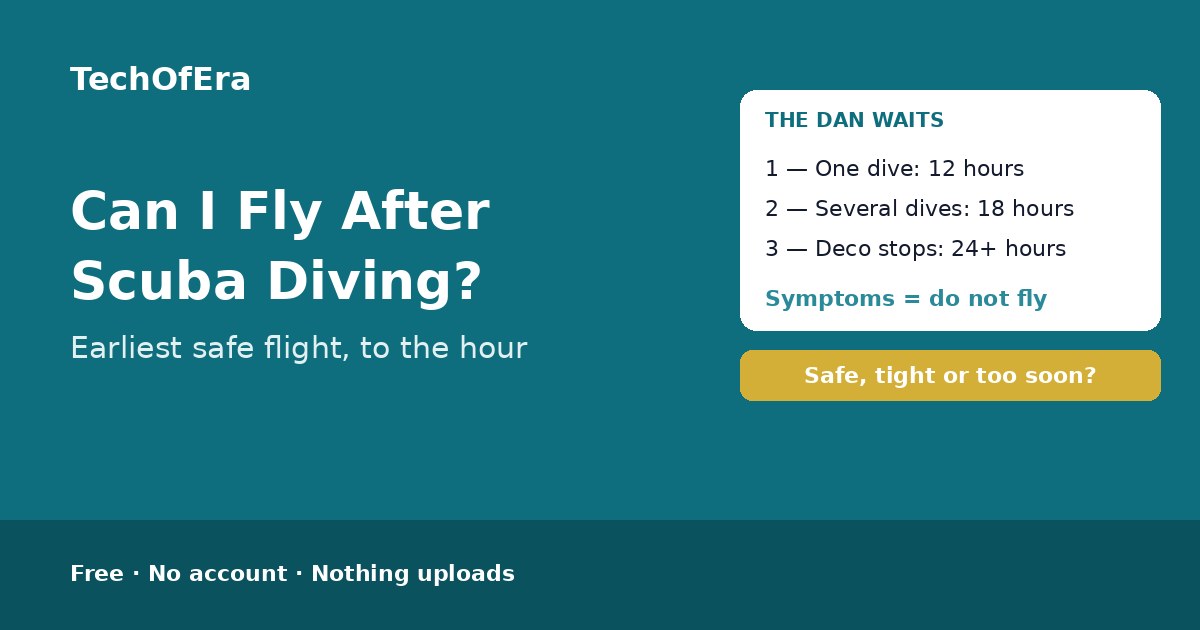
Can you fly after scuba diving?

You surfaced at 3 in the afternoon, your flight leaves at 8 tomorrow morning, and nobody at the resort can tell you whether that is 17 hours or 18. The DAN guidance says 12 hours after one dive, 18 after several, 24 after a decompression dive — but none of that tells you whether your flight is safe. Enter your last dive and your flight, and this checker works out your earliest safe flight time, to the hour — free, in your browser, nothing uploads.

  • DAN 12 / 18 / 24-hour rules
  • Earliest flight to the hour
  • Symptoms = do not fly
  • Free, no account, nothing uploads
Can you fly after scuba diving? Check your earliest safe flight time in seconds.

Check when you can fly after your last dive

Try a preset:
0 of 5 answered

Your result

Answer the questions Your verdict appears here as you answer.
Your earliest safe flight

Enter your dive pattern, last-dive time and flight time above and the earliest time you can fly will appear here.

Blockers

Things that do not fit

Things to check

Still to confirm

What to do next

    Your result summary


    Answer the questions above — the verdict updates live.

    Privacy you can verify, not just trust

    Checking when you can fly after a dive by uploading your dive times to a website would be backwards — the check should never be the leak. This one can't: your answers are checked on your device, and they never leave the device — the only third-party requests are the site's own analytics, which count page views. Don't take our word for it:

    New cross-origin requests during use: 0
    1. Press F12 to open developer tools, then the Network tab.
    2. Answer a question above. Watch: apart from the site's analytics, nothing new is requested — no uploads, and no data ever leaves your device.
    3. Extra credit: disconnect your internet after this page loads — the checker still works.

    How the flying-after-diving check works

    The Divers Alert Network (DAN) Flying After Diving Workshop (2002) sets minimum waits before flying in a commercial aircraft: 12 hours after a single no-decompression dive, 18 hours after several dives in a day or diving over several days, and substantially longer than 18 hours — in practice, 24 hours or more — after a dive that needed decompression stops. PADI gives the same 12- and 18-hour figures. The reason is nitrogen: breathing compressed air at depth loads your tissues with extra gas, and a plane cabin sits at the equivalent of 1,800–2,400 m (6,000–8,000 ft), so the pressure around you drops to about three quarters of sea level and the nitrogen can form bubbles — decompression sickness, the bends. The trials behind the numbers ran 802 chamber flights at Duke University: after single no-stop dives there were no cases with intervals of 11 hours or more, and after repetitive dives cases occurred with intervals shorter than 17 hours. But a number of hours is not a verdict: the figures are minimums, not targets, and longer intervals kept reducing risk — which is why most dive resorts work on a simple 24-hour rule of thumb. This checker does the subtraction for your own dive and your own flight, and tells you how much margin you have.

    To use it:

    1. Pick what kind of diving you did. One no-decompression dive calls for 12 hours, several dives or several days calls for 18, and a dive that needed decompression stops calls for 24 or more. If you are not sure, pick the longer wait.
    2. Enter when you surfaced from your last dive. The clock starts at surfacing, not at the end of the dive day — your dive computer or logbook has the time.
    3. Enter when your flight leaves. The departure time from your ticket, in local time at the airport you fly from. The checker subtracts one from the other and compares it with the wait your diving calls for.
    4. Say what kind of flight it is, and whether you climb before it. The DAN numbers assume a pressurised cabin at 2,000–8,000 ft — a small or unpressurised aircraft can climb higher, and the minimums no longer cover you. And the same wait applies to any climb above about 600 m (2,000 ft), including driving over a mountain pass.
    5. Tick any symptoms since the dive. Joint pain, dizziness, numbness, a rash, breathlessness, unusual tiredness or confusion after a dive is a diving accident until proven otherwise — it overrides the clock completely, and this checker says so instead of giving you a flight time.

    What makes this checker different

    The pages that rank for this search are guides — a resort blog, a dive-magazine explainer, a travel doctor's page — that tell you the 12/18/24-hour numbers and leave you to do the maths against your own ticket. None of them takes your last dive and your flight and gives you an earliest safe flight time, to the hour, with the margin named. There is no free, standalone checker that takes your dive pattern, your surfacing time, your departure time, your flight type, your mountain-pass drive and your symptoms — and gives you a verdict (safe, only just, too soon, or do not fly), the earliest time you can fly, and what to do about it. This page is that answer: six questions, an instant verdict for your exact dive and flight, the blockers named, and the next steps. It is a self-assessment, so it says plainly what it cannot know: it cannot measure the nitrogen in your body, and where a symptom is present it says so instead of giving you a flight time.

    When is this the right check?

    On the last day of a dive holiday, when the flight home is tomorrow morning and the last dive is this afternoon — because that is the exact subtraction this checker does, and the resort's 24-hour rule of thumb may be costing you a dive you could safely take, or hiding a flight that leaves an hour too early. When you have dived every day for a week and the 18-hour wait is counted from your last dive, not your first — because skipping the last dive buys you a whole day. When your drive home crosses a mountain pass — because the same wait applies to the climb, and the pass is the flight you forgot about. And whenever you feel even slightly unwell after a dive — because a symptom overrides the clock, and this checker says so before you get to the airport.

    Honest limitations

    A self-assessment, not medical advice

    This checker cannot measure the nitrogen in your body. It cannot check how much gas your tissues absorbed, how fast you are off-gassing, or whether a bubble is forming. If you feel unwell after a dive, do not fly — get medical help at once.

    Minimums, not guarantees

    The DAN figures are minimums, not targets. Decompression sickness has happened to divers who respected the intervals, though it is rare, and the trials found longer intervals kept reducing risk. A flight that is only just past the minimum is legal by the numbers and still worth moving if you can.

    The decompression-dive evidence is thinner

    For dives that needed decompression stops, the DAN workshop found little experimental or published evidence and said substantially longer than 18 hours appears prudent. This checker uses 24 hours as the minimum — and says plainly that some dive physicians advise 48 hours after heavy decompression diving.

    Unpressurised flights are not covered

    The DAN numbers assume a pressurised cabin at 2,000–8,000 ft. A small or unpressurised aircraft can climb higher, where the pressure drop is bigger and the minimums no longer apply. This checker caps the verdict and tells you to get advice from a diving doctor.

    Mountain passes count too

    The wait applies to any climb above about 600 m (2,000 ft), not just flying. If your drive home crosses a pass before your earliest safe time, take the low road or wait — the pass is the flight you forgot about.

    Rules from official sources, dated November 2026

    The rules here are the Divers Alert Network Flying After Diving Workshop (2002) minimums, echoed by PADI, as they read in November 2026. Guidance changes: recheck with DAN or a diving doctor if anything about your diving changes.

    Frequently asked questions

    How long after scuba diving can I fly?

    At least 12 hours after a single no-decompression dive, at least 18 hours after several dives in a day or diving over several days, and 24 hours or more after a dive that needed decompression stops. Those are the minimums from the Divers Alert Network (DAN) Flying After Diving Workshop (2002), echoed by PADI, and they apply to commercial flights at cabin altitudes of 2,000–8,000 ft. They are minimums, not targets — the trials behind them found longer intervals kept reducing risk — so if your flight is only just past the minimum, a few more hours on the ground are cheap insurance. This checker works out your earliest safe flight time from your own last dive.

    Why can't I fly straight after diving?

    Because breathing compressed air at depth loads your body's tissues with extra nitrogen, and a plane cabin is not pressurised to sea level. A commercial airliner cabin sits at the equivalent of 1,800–2,400 m (6,000–8,000 ft), so the pressure around you drops to about three quarters of sea level — and that drop can make the dissolved nitrogen come out of solution as bubbles in your tissues and blood, which is decompression sickness, the bends. The wait is the time your body needs to breathe the extra nitrogen out through your lungs before the pressure drops. The same wait applies to any climb above about 600 m (2,000 ft), including driving over a mountain pass.

    What should I do if I feel unwell after a dive?

    Do not fly, and get medical help at once. Joint or muscle pain, dizziness, numbness or tingling, a skin rash or itch, shortness of breath, unusual tiredness or confusion after a dive is a diving accident until proven otherwise — decompression sickness is treatable, but only if it is caught early. Give oxygen if it is available, keep the diver lying flat, do not give alcohol, and call the emergency services — and DAN, if you are a member. Do not wait to see if it passes, and do not take a painkiller and board the plane. This checker treats any symptom as a hard block: the clock does not matter until a doctor has seen you.

    Is the 24-hour rule the real rule?

    It depends whose rule you mean. The DAN minimums are 12 hours after a single no-decompression dive and 18 hours after repetitive or multi-day diving — and 24 hours or more after a dive that needed decompression stops. But most dive resorts work on a simple 24-hour rule of thumb for guests who have been diving repetitively, and a Swiss travel-medicine source advises 24 hours after any dive and up to 48 hours after dives with mandatory decompression stops. The 24-hour rule is the cautious, simple version — it is never wrong, and it is what most dive holidays are planned around. This checker uses the DAN minimums and tells you how much margin you have, so you can decide whether the extra hours are worth it.

    Can I drive over a mountain after diving?

    Only after the same wait as flying. The DAN guidance covers any ascent above about 600 m (2,000 ft), not just flights — driving over a mountain pass counts, and so does going up to altitude in any other way. If your drive crosses a pass before your earliest safe flight time, take the low road or wait until after that time. This checker asks about it and applies the same earliest safe time to the climb as to the flight.

    What if my last dive is the day before my flight?

    Then the wait is counted from that dive — every dive resets the clock. If you dived several times, or over several days, the 18-hour minimum runs from when you surfaced from your last dive, not your first. Skipping the last dive of the trip buys you a whole day: your earliest flight is counted from the dive before it instead. That is the single easiest way to fix a flight that leaves too soon — one dive less, and the whole day opens up. This checker shows you the earliest safe flight time either way, so you can see exactly what skipping it buys you.

    Does this checker give medical advice?

    No. This checker is a self-assessment: it runs your answers against the Divers Alert Network (DAN) Flying After Diving Workshop guidance as it reads in November 2026, entirely in your browser, and nothing you enter leaves your device. A web page cannot measure the nitrogen in your body — it cannot check how much gas your tissues absorbed, how fast you are off-gassing, or whether a bubble is forming — so it says plainly what still needs checking, and where a symptom is present it says so instead of giving you a flight time. The only third-party requests are the site's own analytics, which count page views. If you feel unwell after a dive, do not fly — get medical help at once.