How the coffee while pregnant checker works
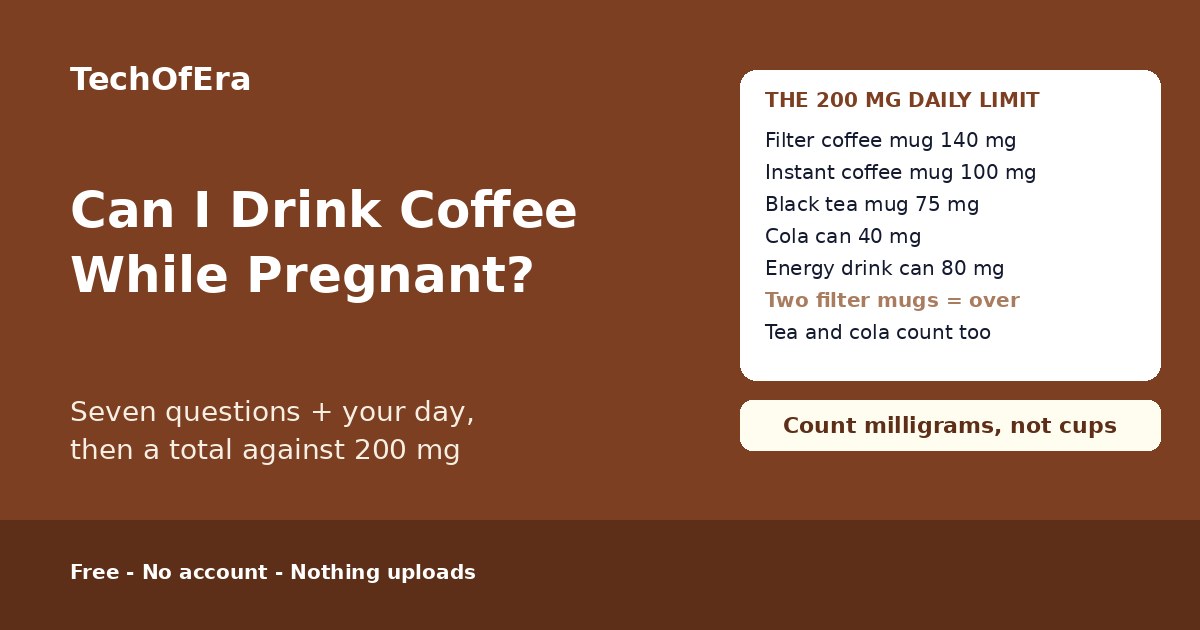
Yes, you can drink coffee while pregnant — under 200 mg of caffeine a day. That is the limit the NHS and the American College of Obstetricians and Gynecologists (ACOG) both give, and it applies in every trimester, including the first. The catch is that the limit covers caffeine from every source, not just coffee: a mug of filter coffee is about 140 mg, a mug of instant coffee about 100 mg, a mug of black tea about 75 mg, a can of cola about 40 mg, a can of energy drink about 80 mg and a 50 g bar of plain chocolate up to 25 mg. One mug of filter coffee plus a cola is already close to the limit, and two mugs of filter coffee is 280 mg — over it. This checker starts from your drink, its size and how many cups you had, adds anything else caffeinated you ticked, and tells you where the whole day sits against 200 mg — under it, right at it, or over it — with the decaf swap that fixes an over-limit day. The figures are general information, not medical advice: the checker cannot know your pregnancy, and your doctor or midwife has the last word. This is a caffeine-limit calculator. It is a different question from the live Can I Take Painkillers While Pregnant? Checker, which covers medicines — paracetamol, ibuprofen, aspirin — not caffeine: this page never advises on any medicine, and only counts a caffeine-containing painkiller as one optional extra source.
To use it:
- Say how far along you are. The 200 mg limit is the same in every trimester, and while trying to conceive too. If you are in the first trimester, the note is worth reading: some people choose to cut back further then, and that is a personal choice to discuss with your doctor or midwife.
- Pick your main drink. Filter coffee, espresso, instant, latte, tea, cola, energy drink, decaf or chocolate. The caffeine per cup is very different between them: a double espresso is 126 mg, a mug of instant coffee 100 mg, a mug of black tea 75 mg.
- Pick the size. Cup size matters as much as the drink: a large filter coffee is 180 mg, a small one 95 mg, an extra-large 235 mg. For espresso, the sizes are 1, 2, 3 or 4 shots. If you are not sure, the checker counts a medium and says so.
- Enter how many cups or servings today. How many of your main drink you have had so far today — enter 0 if none yet. The total only counts what you enter, so come back and add a cup if you have one later.
- Tick any other caffeine today. Black tea, green tea, cola, an energy drink, chocolate or a caffeine-containing painkiller — each adds its milligrams to the same 200 mg. Three mugs of tea alone is already over the limit, even with no coffee at all.
- Say where you are, and whether you have asked your doctor or midwife. The limit is 200 mg a day in the United States, the United Kingdom, Germany, Canada and Australia — the authority behind the number is what changes. And the checker is general information, not medical advice: ask your doctor or midwife about caffeine, and follow their personal limit over this calculator.
What makes this checker different
The pages that rank for this search are articles — KidsHealth, The Bump, Cleveland Clinic, Healthline, GoodRx, March of Dimes — telling you the 200 mg limit in a paragraph, with a table of caffeine per drink. None of them adds up your day: none takes your drink, its size, how many cups and your other sources and returns a total against the limit, none tells you how much headroom is left, none names the decaf swap that fixes an over-limit day, and none flags energy drinks or counts a caffeine-containing painkiller. This page is that answer: seven questions, one total in milligrams, the verdict, and what to do next. It is a self-assessment, so it says plainly what it cannot know: it cannot know your pregnancy, your health, or what your doctor or midwife has told you — and the figures are general information, not medical advice.
When is this the right calculation?
When you have had your morning coffee and wonder whether a second cup is still fine. When you had tea at breakfast, a cola at lunch and a coffee in the afternoon and want to know where the day stands. When you are choosing between a large and a small, or between filter and instant. When you are wondering whether three mugs of tea counts — it does. When you went over the limit yesterday and want to know whether to worry — you do not need to panic, just take in less today. And when you want to see what swapping to decaf actually saves: about 135 mg on a medium filter coffee.
Honest limitations
General information, not medical advice
This checker cannot know your pregnancy, your health or what your doctor or midwife has told you. It adds up the caffeine in the drinks you enter against the published 200 mg limit — it cannot tell you what is safe for you, and it is not medical advice.
The figures are estimates, not measurements
The caffeine figures come from the NHS, ACOG, Cleveland Clinic, The Bump and Nebraska Medicine, as they read in November 2026. Real coffee varies by bean, roast and brew: a strong café filter coffee can be higher than the 140 mg a mug used here. Treat the total as a guide, not a lab result.
Cup sizes are approximate
A small is about 240 ml, a medium about 350 ml, a large about 450 ml and an extra-large about 600 ml. Café sizes vary — a large takeaway cup can hold more than 450 ml — so pick the closest size, and round up if you are unsure.
The limit is a daily total, not a per-drink rule
The 200 mg limit is for the whole day, from every source. One drink being under the limit does not mean the day is: a coffee plus a tea plus a cola can add up to more than 200 mg even when each one alone is fine.
Energy drinks are a separate warning
The Academy of Nutrition and Dietetics recommends avoiding energy drinks entirely during pregnancy — not just counting their caffeine. This checker counts their 80 mg a can and flags them, but the guidance is to avoid them altogether.
Facts from the guides, dated November 2026
The facts here are the NHS, ACOG, Cleveland Clinic, The Bump, Nebraska Medicine and Healthline, as they read in November 2026. Guidance changes and studies are re-run: recheck the numbers if anything about your pregnancy changes.